Imagine you have followed the rules. You cited your sources. You kept your tone neutral. Yet, another editor keeps reverting your work, calling you names in the edit summary, and ignoring every attempt to talk it out. You’ve tried talking pages. You’ve asked for mediation. Nothing worked. Now, you are looking at the Arbitration Committee, or ArbCom. It feels like the final stop on the train. But what happens after they issue a ruling? How does that piece of text actually change behavior on the site?
This is where the rubber meets the road. The decision itself is just words until someone enforces it. If you are an editor who has been sanctioned, or if you are a bystander watching a high-profile case unfold, understanding the enforcement mechanisms of Wikipedia's arbitration system is crucial. It isn’t just about bans; it’s about how the community polices its own boundaries when diplomacy fails.
The Anatomy of an Arbitration Decision
Before we get into the nitty-gritty of enforcement, you need to understand what you are enforcing. An arbitration decision is not a suggestion. It is a binding order from the highest judicial body on English Wikipedia. When ArbCom issues a ruling, it usually contains three distinct parts: findings of fact, conclusions, and remedies.
The "remedies" section is the only part that matters for enforcement. This is where specific actions are mandated. For example, the committee might say, "Editor X is banned from editing articles related to politics." Or, "Editor Y must use civil language in all discussions." These orders are precise. Vague instructions lead to loopholes. Good decisions are surgical.
If you are new to this process, remember that arbitration is a last resort. The Wikipedia dispute resolution process starts with talk pages, moves to mediation, then to formal inquiries, and finally to arbitration. By the time a case reaches ArbCom, the parties involved are usually deeply entrenched in conflict. The enforcement phase is designed to cut through that noise.
Who Enforces the Rules?
This is the most common misconception. Many editors think the Arbitration Committee sits in a virtual room, monitoring edits 24/7. They don’t. ArbCom members are volunteers who write decisions. They do not have the bandwidth to police every single edit made by sanctioned users.
The burden of enforcement falls on two groups:
- Administrators (Admins): These are trusted editors with technical tools. They block users, protect pages, and revert vandalism. If an arbcom decision says "User A is blocked," an admin executes that block.
- The Community: Every editor plays a role. If you see a user violating a ban, you report it. You leave a message on the user’s talk page. You flag their edits. The community acts as the eyes and ears.
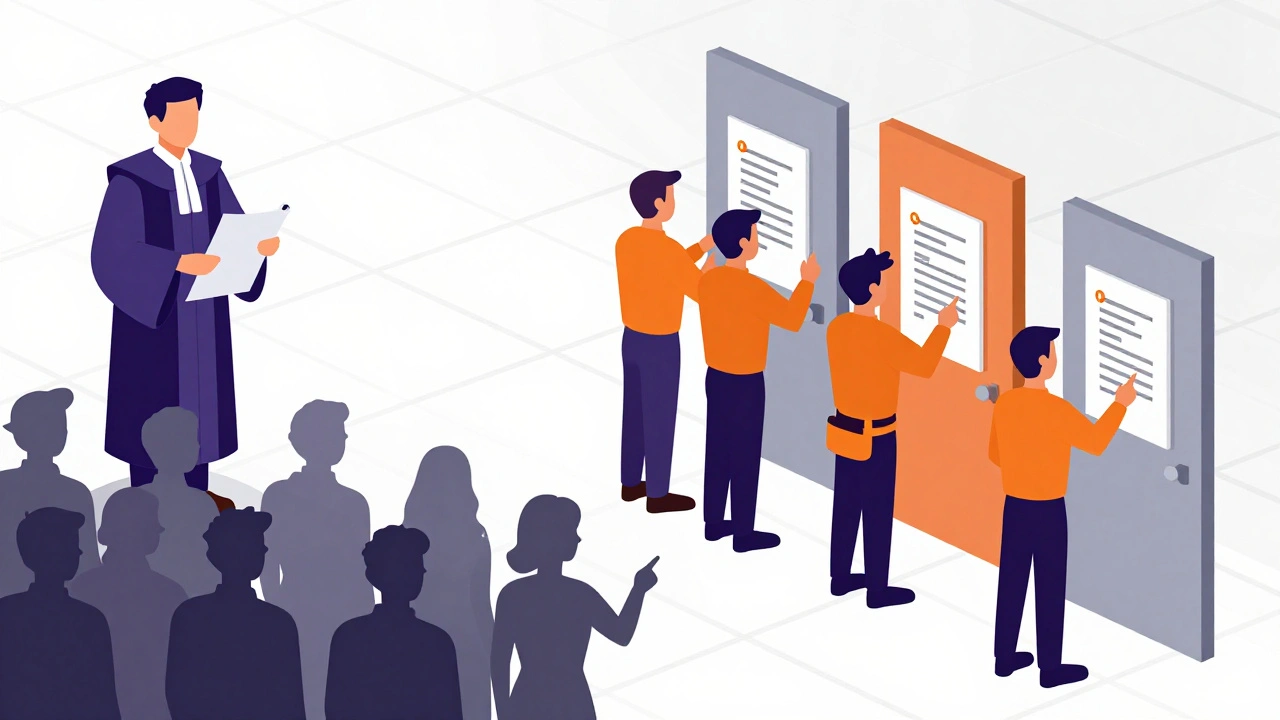
Think of ArbCom as the judge and the admins as the bailiffs. The judge writes the sentence; the bailiff locks the door. Without the bailiffs, the judge’s word is empty. This distributed model ensures that enforcement scales with the size of the project, but it also means consistency can vary depending on which admin sees the violation first.
Types of Sanctions and Their Execution
Not all sanctions are created equal. Some are easy to enforce; others require constant vigilance. Here is how the most common remedies play out in practice.
| Sanction Type | Description | Enforcement Difficulty | Key Tool Used |
|---|---|---|---|
| Full Block | User cannot edit any page. | Low | Block interface |
| Topic Ban | User cannot edit specific subjects (e.g., "Music"). | Medium | Page protection, User rights management |
| Civility Requirement | User must avoid personal attacks. | High | Manual review by other editors |
| Extended Confirmation | User account age/length requirements increased. | Low | Automated filter |
A full block is straightforward. An admin clicks a button, and the user is locked out. The challenge arises with topic bans. If a user is banned from editing "Biographies of Living People," does that include a biography of a musician? What about a list of musicians? Ambiguity creates friction. Admins often have to interpret the spirit of the law versus the letter of the law.
Civility requirements are the hardest to enforce. There is no software that can perfectly detect sarcasm or passive-aggression. This relies entirely on human judgment. Two admins might look at the same comment and disagree on whether it violates the sanction. This is why clear documentation is vital.
The Role of CheckUsers and SOCKPuppets
One of the biggest threats to enforcement is evasion. A banned editor doesn’t always stop editing. They might create a new account. This is known as a sockpuppet. If a sockpuppet continues the banned behavior, the entire arbitration process is undermined.
To combat this, Wikipedia has CheckUsers. These are special volunteers with access to private data, such as IP addresses and email hashes. They do not read emails or see passwords. They only check if two accounts share the same digital fingerprint.
If you suspect a banned user is back under a new name, you file a request with CheckUsers. If they confirm the link, the new account is blocked immediately. This process is strict because privacy is paramount. CheckUsers only act when there is strong evidence. False accusations against innocent editors using shared IPs (like libraries or cafes) are taken seriously and investigated.
Appeals and Modifications
Life changes. Editors grow. Sometimes, a sanction that was necessary six months ago is no longer appropriate. That is why appeals exist. However, appealing an arbitration decision is not a re-trial. You cannot simply say, "I disagree with the verdict."
You can appeal based on:
- New Evidence: Information that was not available during the original hearing.
- Changed Circumstances: The behavior that led to the ban has stopped, or the context has shifted significantly.
- Procedural Error: The committee made a mistake in applying the rules.
When you file an appeal, you are asking the committee to modify or lift the sanction. This requires a compelling argument. Vague pleas for mercy rarely succeed. You need to demonstrate concrete change. For example, showing a history of constructive edits on unrelated topics can help prove that you have moved past the conflict.
If an appeal is denied, the sanction stands. Repeated frivolous appeals can themselves become grounds for further restrictions. The system is designed to be fair, but it is also designed to be final.

What Should You Do If You See a Violation?
You are browsing an article and notice an edit that clearly violates an active arbitration sanction. Maybe a banned user is posting comments on a talk page. Here is your step-by-step guide:
- Document the Violation: Take screenshots or save the URL. Time-stamps matter. You need proof that the edit happened while the sanction was active.
- Notify an Administrator: Post a concise message on the Administrator Noticeboard. Include links to the relevant arbitration decision and the violating edit. Do not rant. Stick to the facts.
- Leave a Warning: If it is safe to do so, leave a polite note on the violator’s talk page. Use templates like {{uawarn}} or similar standard warnings. This creates a paper trail.
- Do Not Engage: Do not argue with the violator. Do not revert their edits in a way that escalates the conflict. Your job is to report, not to fight.
If you are the one being accused, stay calm. Check the dates. Was the sanction in effect? Did you actually violate the terms? If you believe it was a misunderstanding, explain it clearly to the admin handling the case. Defensiveness helps no one.
The Human Element: Burnout and Bias
Let’s be real. Enforcement is exhausting. Admins deal with harassment, legal threats, and endless bad faith edits. This leads to burnout. When admins are tired, they might make mistakes. They might block too quickly or miss subtle violations.
Bias is another factor. Everyone has preferences. An admin might unconsciously favor one side of a long-running dispute. This is why transparency is key. All blocks and unblocks are logged publicly. Other editors can review these actions. If an admin makes an error, the community can correct it.
Supporting the enforcers is part of the culture. Thank admins when they do good work. Don’t punish them for honest mistakes. The system only works if the people running it feel supported, not besieged.
Looking Ahead: The Future of Enforcement
As Wikipedia grows, the complexity of disputes increases. We are seeing more sophisticated evasion techniques and more nuanced conflicts. The community is constantly debating how to improve the system. Proposals for automated filters, better training for admins, and streamlined appeal processes are regular topics on meta-discussions.
For now, the core principles remain unchanged. Arbitration is a tool for protecting the encyclopedia, not for settling personal scores. Enforcement is about maintaining a safe space for collaboration. Whether you are a veteran editor or a newcomer, understanding these procedures helps you navigate the complex social dynamics of the world’s largest collaborative project.
Remember, the goal is never to win a fight. The goal is to build a reliable source of knowledge. Everything else is just noise.
Can I appeal an arbitration decision immediately?
You can file an appeal at any time, but it must be based on new evidence, changed circumstances, or procedural errors. Simply disagreeing with the outcome is not sufficient grounds for an appeal. The committee reviews appeals periodically, so there may be a delay before a response.
What happens if an admin refuses to enforce a sanction?
If an admin believes a sanction is unclear or unjust, they should discuss it with other admins or seek clarification from the Arbitration Committee. Refusing to enforce a clear, valid sanction can lead to the removal of their admin privileges. Consistency is maintained through community oversight and peer pressure among administrators.
How do CheckUsers protect user privacy?
CheckUsers operate under strict guidelines set by the Wikimedia Foundation. They only access limited technical data (IP addresses and email hashes) and only when there is a legitimate reason, such as investigating sockpuppetry. They do not read emails or view passwords. All requests are logged and subject to audit.
Is arbitration the same on all Wikipedia language editions?
No. Each language edition of Wikipedia operates independently. While many follow similar models inspired by the English Wikipedia, some have different dispute resolution systems, and others do not have an Arbitration Committee at all. Always check the local policies of the specific Wikipedia you are editing.
Can a non-admin enforce an arbitration decision?
Non-admins cannot block users or remove admin rights. However, they play a critical role by reporting violations, documenting evidence, and alerting administrators. In some cases, the community can vote to restrict certain powers, but direct enforcement actions require admin tools.