
You write a perfect article. You cite your sources. You follow the tone guidelines. Then, within minutes, it vanishes. A tag sits at the top of your page: db-A7 or db-A9. Your heart sinks. You didn’t do anything wrong-or so you thought. In the world of Wikipedia, these codes are not errors; they are automatic eject buttons for content that violates core policies on original research and verifiability.
If you contribute to online encyclopedias, understanding why your work gets flagged under CSD A7 (No significant coverage) or CSD A9 (Unverifiable) is the difference between being banned as a disruptive editor and becoming a valued community member. These aren't just technicalities. They are the gatekeepers of reliability. Let’s break down exactly what triggers them, why they happen even to good-faith editors, and how to fix them before they delete your hard work.
The Silent Killer: Understanding CSD A7
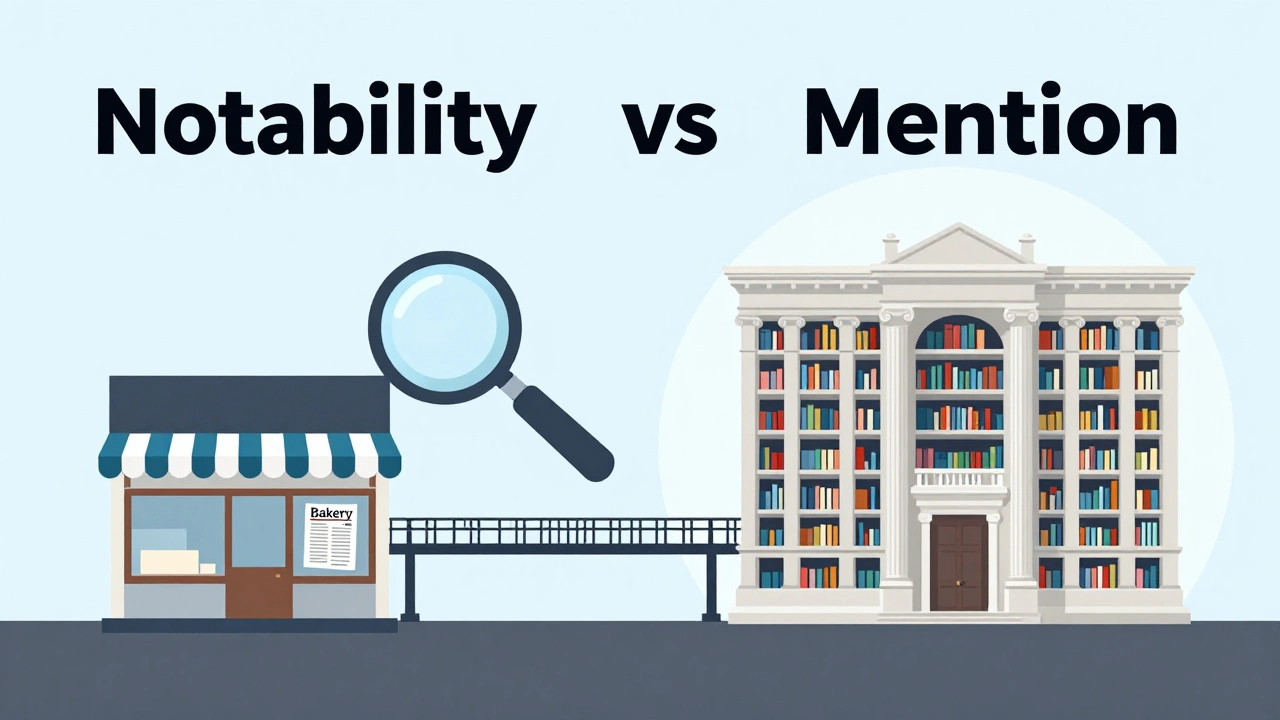
CSD A7 stands for "No significant coverage." This criterion targets articles about topics that simply don’t have enough independent, reliable sources to support an encyclopedia entry. It sounds simple, but it is where most new editors stumble. You might think, "I found three blog posts about this local bakery," and therefore, it deserves a page. Wikipedia disagrees.
The policy requires independent secondary sources. This means sources that analyze or discuss the subject, rather than just mentioning it in passing. If you are writing about a person, a company, or an event, you need substantial coverage in high-quality media-think major newspapers, academic journals, or reputable books-not press releases, personal websites, or social media shout-outs.
- The "Mention" Trap: Being mentioned in a news article does not equal significant coverage. If a celebrity buys a coffee at a shop, and the shop gets one sentence in the report, that is not enough for a standalone article about the shop.
- The "Primary Source" Error: Using the subject’s own website, LinkedIn profile, or self-published book as your main evidence violates the spirit of A7. Wikipedia needs outsiders to verify the importance.
- The "Niche Interest" Fallacy: Just because a topic has a passionate fan base does not mean it has general notability. Fan wikis exist for a reason; Wikipedia is not one of them.
If an editor tags your article with db-A7, they are saying the topic lacks the breadth of coverage required by WP:N (General Notability Guideline). The remedy isn’t to argue that the topic is important; it’s to find the missing secondary sources. If you can’t find them, the topic likely belongs in a broader article, not its own.
The Trust Vacuum: Decoding CSD A9
CSD A9 stands for "Unverifiable." This is perhaps the most frustrating criterion for contributors because it often feels like a lack of trust. The rule states that if an article contains information that cannot be verified through reliable sources, it may be deleted speedily. Unlike A7, which questions the *importance* of the topic, A9 questions the *truth* of the content.
Here is the critical distinction: Wikipedia does not require you to prove something is true in the real world; it requires you to prove that a reliable published source says it is true. If you write, "This software improves efficiency by 20%," without citing a study, review, or official benchmark from a credible tech publication, you trigger A9. Even if the statement is factually correct, if it is uncited and unverifiable, it is vulnerable.
Common pitfalls leading to CSD A9 include:
- Broken Links: You cited a source, but the link is dead, and no archive exists. The information becomes unverifiable instantly.
- Vague Citations: Writing "See [Source]" without specifying which page or paragraph contains the claim. Editors cannot verify what they cannot find.
- Original Synthesis: Combining two unrelated facts from different sources to create a new conclusion. For example, Source A says Person X likes jazz, and Source B says Person Y plays piano. You conclude Person X listens to Person Y. That is original research, and it is unverifiable.
A9 is a safety net against misinformation. When you see this tag, the editor is asking, "Where did this come from?" If you cannot answer that question with a stable, accessible URL or a clear book citation, the content goes.
Real-World Examples: What Goes Wrong?
To make this concrete, let’s look at two hypothetical scenarios that mirror thousands of actual deletions every month.
Case Study 1: The Local Hero (A7 Violation)
An editor creates an article for "John Smith, Community Volunteer." The article cites John’s volunteer organization’s newsletter, a Facebook post from his wife, and a brief mention in a town council meeting minutes. The editor argues John is well-known locally. However, there are no regional newspaper profiles, no awards from national organizations, and no independent analysis of his impact. The article is tagged db-A7. Why? Because local fame does not translate to encyclopedic notability without independent, secondary coverage.
Case Study 2: The Tech Startup (A9 Violation)
An editor writes about "ZetaTech Solutions." The article claims ZetaTech uses "proprietary AI algorithms that reduce server costs by 40%." The only citation is a press release from ZetaTech’s own website. Another sentence claims the CEO was named "Innovator of the Year" by a small, obscure industry blog with no editorial standards. The article is tagged db-A9. Why? Because self-promotional material is not a reliable source for verification, and the obscure blog lacks credibility. The claims are unverifiable by Wikipedia’s standards.
| Criterion | Core Issue | Common Trigger | Fix Strategy |
|---|---|---|---|
| CSD A7 | Lack of Notability | Only primary sources or minor mentions | Find independent secondary sources or merge into a broader topic |
| CSD A9 | Lack of Verifiability | Uncited claims, broken links, or unreliable sources | Add specific citations from reliable publications or remove the claim |

How to Save Your Article Before It’s Gone
Speedy deletion happens fast, but it is not always final. If you spot a db-A7 or db-A9 tag, act immediately. Do not ignore it. Deleting the tag yourself without addressing the underlying issue will result in the tag being reapplied, and it may damage your reputation as a contributor.
For A7 issues, spend time searching academic databases, library catalogs, and major news archives. Look for reviews, critiques, or detailed reports. If you find them, add them to the references section. If you cannot find them, consider merging your content into a related existing article. For example, instead of a standalone article for a minor character in a movie, add their details to the movie’s article.
For A9 issues, audit every single sentence. Does it have a citation? Is the citation working? Is the source reliable? If a sentence lacks a citation, either find one or delete the sentence. It is better to have a shorter, verifiable article than a longer, unverified one. Use tools like the Wayback Machine to recover broken links if possible.
Engage with the editor who tagged your article. Leave a polite message on their talk page explaining what you have done to address the concerns. Most editors are happy to remove the deletion tag if you show genuine effort to comply with policies.
Prevention: Building Resilient Articles
The best defense against CSD A7 and A9 is preparation. Before you start writing, perform a notability check. Search for the topic name plus keywords like "review," "analysis," or "profile." If you get fewer than five high-quality results, pause. Ask yourself if this topic truly warrants a standalone entry.
As you write, adopt a "cite-as-you-go" habit. Never leave a paragraph uncited. Verify each fact against a reliable source before typing it. Remember that Wikipedia’s audience includes skeptics, journalists, and academics. Your goal is to create a reference that withstands scrutiny, not just to share information.
Finally, understand that deletion is part of the process. Even experienced editors face CSD tags. It is not a personal attack; it is a quality control mechanism. By mastering these criteria, you shift from being a target of deletion to a guardian of Wikipedia’s integrity.
What is the difference between CSD A7 and CSD A9?
CSD A7 relates to notability, meaning the topic lacks sufficient independent coverage to warrant an article. CSD A9 relates to verifiability, meaning the information in the article cannot be confirmed by reliable sources, even if the topic itself is notable.
Can I remove a CSD tag myself?
You should only remove a CSD tag if you have fully addressed the underlying issue. For A7, this means adding significant secondary sources. For A9, this means adding valid citations or removing uncited claims. Simply deleting the tag without fixing the content will lead to re-tagging and potential blocking.
What counts as a reliable source for Wikipedia?
Reliable sources typically include peer-reviewed academic journals, major newspapers and magazines with editorial oversight, reputable books published by established presses, and official government documents. Social media, self-published blogs, press releases, and personal websites are generally not considered reliable.
How long do I have to save an article tagged with CSD?
Speedy deletion can happen within hours. You must act immediately upon seeing the tag. If you believe the tag was applied in error, you can contest it on the article's talk page, but you should still try to improve the article simultaneously to demonstrate good faith.
Is it okay to use primary sources on Wikipedia?
Primary sources can be used sparingly for factual data (like dates or names), but they cannot be used to establish notability or to support complex arguments. Secondary sources, which analyze or interpret the primary material, are required for most substantive claims.