Wikipedia is built on facts, not opinions. But too often, editors slip in language that sounds official but means nothing. Phrases like "some people believe", "it is widely thought", or "many experts suggest" don’t add clarity-they hide uncertainty. These are weasel words. And on Wikipedia, they undermine trust.
What Are Weasel Words?
Weasel words are vague, evasive phrases that make a claim sound stronger than it is-or make it sound like someone else said it, so you don’t have to take responsibility. On Wikipedia, they’re dangerous because the whole point is to state facts clearly, with sources.
Examples:
- "Many believe climate change is caused by humans." (Who? How many? When did they say this?)
- "It is often claimed that the economy improved under this policy." (Often? By whom? Where?)
- "Some experts argue that the results are inconclusive." (Which experts? What’s their credential? Where’s the source?)
These aren’t just sloppy writing-they violate Wikipedia’s core policies: verifiability, neutral point of view, and no original research. If you can’t point to a reliable source that says exactly what you’re claiming, then you shouldn’t say it at all.
Why Wikipedia Can’t Tolerate Vagueness
Wikipedia isn’t a blog. It’s not a forum. It’s not a place for "maybe," "sort of," or "I heard." It’s a reference work. Readers use it to find clear, accurate information-not guesses wrapped in polite language.
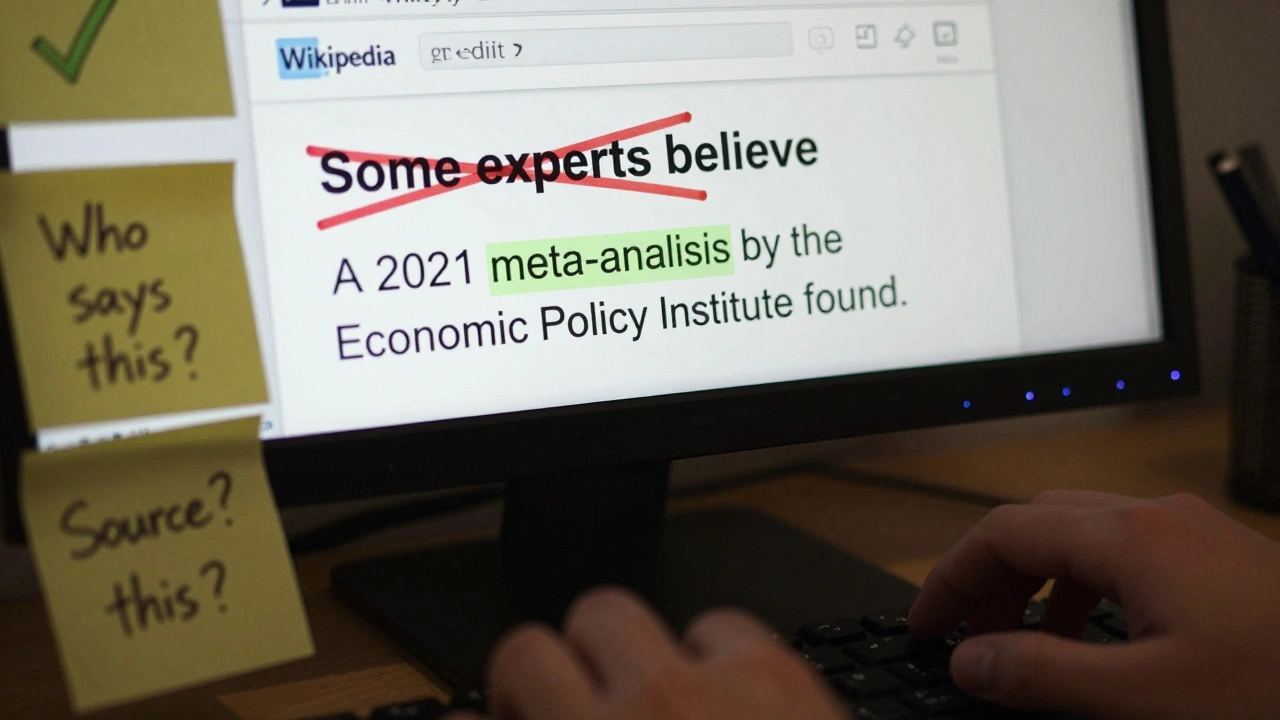
Imagine you’re a student writing a paper. You look up "effect of minimum wage on employment" on Wikipedia. You see: "Some economists think raising the minimum wage hurts small businesses." What do you do? You can’t cite that. You don’t know who "some" are. You can’t link to it. You’re stuck.
Now imagine you see: "A 2021 meta-analysis of 64 studies by the Economic Policy Institute found no significant negative effect on employment from minimum wage increases in the U.S. between 2000 and 2020." That’s usable. That’s citable. That’s Wikipedia.
Vague language doesn’t just confuse readers-it makes the whole encyclopedia unreliable. And once trust is lost, people stop using it.
How to Spot Weasel Words in Your Edits
Here’s a simple checklist to catch them before you save:
- Ask: "Who says this?" If the answer is "some people," "many," or "experts," it’s probably a weasel word.
- Ask: "Can I find a direct quote or data point from a reliable source?" If not, rewrite.
- Ask: "Does this phrase avoid naming a specific person, study, or organization?" If yes, delete it.
- Ask: "Is this sentence trying to sound authoritative without backing up the claim?" If yes, it’s a weasel.
Common weasel word patterns:
- "It is often said that..." → Replace with: "According to a 2023 report by the National Bureau of Economic Research..."
- "Many believe..." → Replace with: "A 2022 Pew Research survey found that 68% of U.S. adults believe..."
- "Some experts argue..." → Replace with: "Economist Janet Yellen stated in her 2020 testimony before Congress that..."
- "There is controversy over..." → Replace with: "The debate centers on whether [specific claim], with supporters citing [source] and critics citing [source]."
Don’t just remove the weasel word-replace it with something concrete. If you can’t find a source that supports a specific claim, don’t include it. Silence is better than vagueness.
What Counts as a Reliable Source?
Wikipedia doesn’t accept everything. You need sources that are:
- Published-books, peer-reviewed journals, major newspapers, government reports, academic websites.
- Independent-not written by the subject of the article (e.g., a company’s own press release isn’t reliable for claims about itself).
- Authoritative-written by experts in the field, with clear methodology and attribution.
Examples of reliable sources:
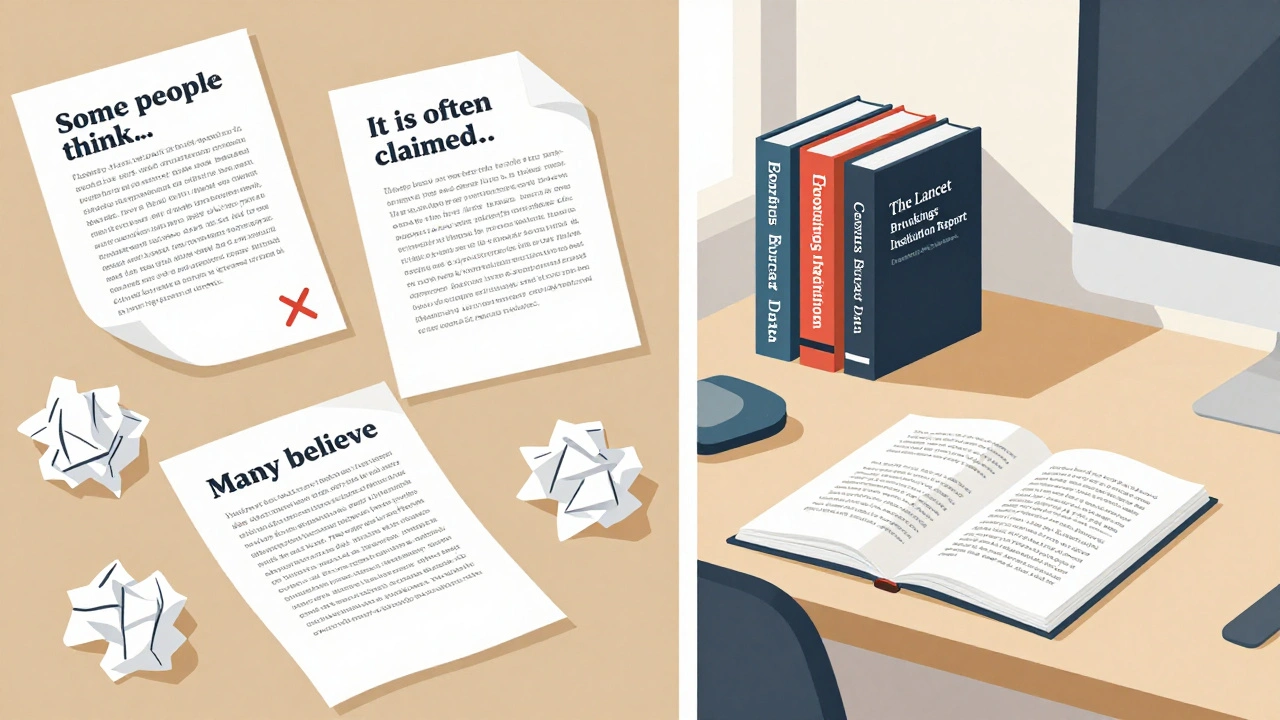
- The New York Times, The Guardian, BBC News
- The Lancet, Journal of the American Medical Association
- Reports from the U.S. Census Bureau, World Health Organization, or OECD
- Books published by university presses (e.g., Harvard University Press)
Examples of unreliable sources:
- Blog posts, personal websites, Reddit threads
- Wikipedia itself
- Press releases, marketing materials, company websites
- YouTube videos, TikTok clips, memes
If your source isn’t reliable, your claim isn’t valid-even if it’s true. Wikipedia doesn’t care if something is factually correct if you can’t prove it with a trusted source.
How to Rewrite Vague Sentences
Let’s take a real example from a Wikipedia draft:
"Some people think the new law will hurt small businesses, but others say it will help the economy. There’s no clear consensus."
This is full of weasel words. Here’s how to fix it:
"A 2024 study by the Brookings Institution found that the law reduced small business profits by an average of 7% in the first year, citing data from 1,200 businesses. However, a separate analysis by the Economic Policy Institute concluded that the law increased consumer spending by 3.2%, which offset losses for some sectors. The Congressional Budget Office projected a net positive effect on GDP by 2026."
Now you have:
- Specific sources
- Quantifiable data
- Clear attribution
- No ambiguity
That’s what Wikipedia wants.
The Neutral Point of View Isn’t About Balance-It’s About Accuracy
Many new editors think "neutral" means giving equal space to every opinion. That’s wrong. Neutral means representing views in proportion to their prominence in reliable sources.
If 95% of peer-reviewed studies show that a certain drug is effective, you don’t give 50% of the section to the 5% that disagree. You mention the minority view briefly-with its source-and explain why it’s not widely accepted.
Wikipedia doesn’t give equal time to conspiracy theories, pseudoscience, or fringe opinions just because they exist. It gives space based on what reliable sources say.
So when you see: "Some scientists believe aliens built the pyramids"-you delete it. Not because it’s offensive, but because no credible source supports it. That’s not neutrality. That’s misinformation dressed up as balance.

What to Do When You Can’t Find a Clear Source
Not every fact has a perfect source. Sometimes, you just don’t know. That’s okay.
If you can’t find a reliable source to back up a claim, don’t make it up. Don’t soften it with weasel words. Just leave it out.
Wikipedia’s motto isn’t "Say everything." It’s "Say what you can prove."
For example, if you’re writing about a local politician’s impact but can’t find any studies or major news coverage, don’t write: "Many residents feel she improved the city." Instead, write: "Public opinion on the mayor’s performance has not been formally surveyed by a major news organization or academic institution."
That’s honest. That’s accurate. That’s Wikipedia.
Final Checklist Before Saving Your Edit
Before you hit "Save page," run through this:
- Did I replace "some people," "many," or "experts" with specific sources?
- Did I remove all phrases like "it is believed," "it is thought," or "there is controversy"?
- Is every claim backed by a reliable, published source?
- Does every sentence stand on its own as a verifiable fact?
- If I removed the source, would the sentence still make sense?
If you answer "yes" to all five, your edit is ready. If not, keep revising.
Why This Matters Beyond Wikipedia
Learning to avoid weasel words on Wikipedia doesn’t just help the encyclopedia. It trains you to think more clearly.
Every time you replace "some experts say" with "a 2023 study by the University of Chicago found," you’re practicing critical thinking. You’re learning to demand evidence. You’re learning to separate opinion from fact.
These are skills that matter everywhere-in school, at work, in politics, in daily life. Wikipedia is the training ground. And if you’re editing it, you’re not just writing an article. You’re helping build a global standard for truth.
What’s the difference between weasel words and neutral language on Wikipedia?
Neutral language presents facts clearly and attributes claims to reliable sources. Weasel words avoid naming sources, making claims sound general or vague. For example, "A 2022 study by Johns Hopkins found..." is neutral. "Some experts think..." is a weasel word.
Can I use "according to" on Wikipedia?
Yes, but only if you follow it with a specific source. "According to the World Health Organization" is fine. "According to some people" is not. Always name the source-publication, author, or institution.
Are weasel words ever acceptable on Wikipedia?
No. Wikipedia’s guidelines explicitly prohibit vague, unattributed language. Even if it sounds polite or diplomatic, weasel words violate verifiability and neutral point of view policies. If you can’t cite a source, leave it out.
How do I handle disputed claims without using weasel words?
State the dispute directly, with sources. For example: "Some researchers argue X, citing [source]. Others argue Y, citing [source]. A 2023 meta-analysis found that 78% of peer-reviewed studies support Y." This shows balance without vagueness.
What if I can’t find any reliable sources for a fact?
Don’t include it. Wikipedia doesn’t require every fact to be in every article. If you can’t verify it with a reliable source, omit it. Silence is better than a vague or unsupported claim.