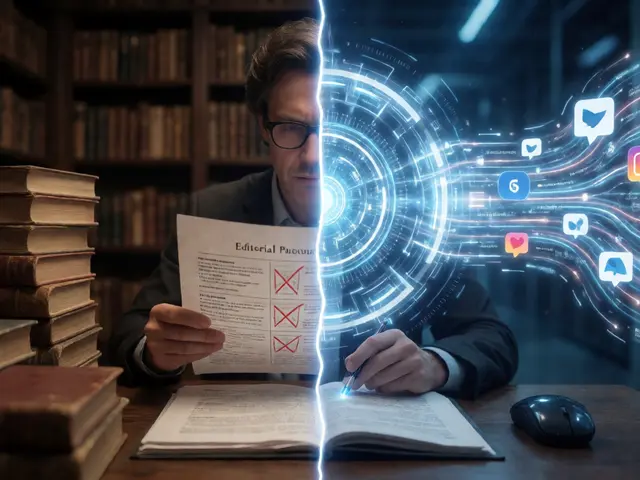
Wikipedia is the first place many people look for information. It’s also the first place many journalists look - and that’s a problem if your newsroom doesn’t have clear rules about how to use it. Too many reporters treat Wikipedia like a source. It’s not. It’s a starting point. Without a policy, your stories risk spreading misinformation, misattributing facts, or looking unprofessional when editors catch a Wikipedia quote in a published article.
Why Your Newsroom Needs a Wikipedia Policy
Wikipedia has over 66 million articles in over 300 languages. It’s updated constantly. Someone edits a page every 1.5 seconds. That means a fact you verified yesterday might be gone today - or replaced with a rumor. A 2023 study by the Tow Center for Digital Journalism found that 42% of U.S. newsrooms had no formal policy on Wikipedia use. Of those, 68% had published at least one story that incorrectly cited Wikipedia as a source.
Wikipedia is not a primary source. It’s a summary. It doesn’t have original reporting. It doesn’t interview sources. It aggregates what others have written - and sometimes, what they’ve written is wrong. A 2021 investigation by The Guardian showed that false claims about political candidates had appeared on Wikipedia for weeks before being corrected - and some reporters had already quoted them.
A policy isn’t about banning Wikipedia. It’s about using it the right way. Your journalists need to know when to look, what to check, and how to trace facts back to the real sources.
What a Good Wikipedia Policy Should Include
A strong policy has five core parts: when to use it, how to verify, what to avoid, how to cite it internally, and what happens if rules are broken.
- When to use it: Only for background, context, or to find leads. Never as a source.
- How to verify: Every fact from Wikipedia must be traced to its cited source - the original report, study, book, or interview. Check the references at the bottom of the page.
- What to avoid: Never copy text. Never quote Wikipedia directly. Never rely on unsourced claims, even if they’re popular.
- Internal citation: If a reporter uses Wikipedia to find a source, they must log it in their notes as: "Found reference to [source] via Wikipedia article [title], verified through [original source]."
- Consequences: Publishing a story that cites Wikipedia as a source should trigger a correction and mandatory training.
These rules aren’t theoretical. In 2024, a major U.S. newspaper had to retract a story after quoting Wikipedia’s claim that a city council member had been "convicted of fraud." The conviction never happened. The Wikipedia entry had been edited by a local activist and wasn’t cited to any court records. The reporter didn’t check the references.
How to Train Your Staff
Training isn’t a one-time webinar. It’s built into daily work. Start with a 20-minute module for every new reporter. Show them:
- How to open the "View history" tab on a Wikipedia page to see who edited it and when.
- How to click on a citation and open the original source - not just the link, but the actual document, video, or transcript.
- How to spot "citation needed" tags and what they mean.
- How to use Wikipedia’s "Talk" page to see disputes over a claim.
Then, give them a real-world quiz. Take three Wikipedia articles with known inaccuracies - like the ones about election fraud or health myths - and ask them to trace each fact back to a primary source. If they can’t, they don’t pass. This isn’t about being harsh. It’s about building a habit.
Include this in your style guide. Add a section called "Wikipedia Use" next to "Attribution" and "Anonymous Sources." Make it as official as any other editorial rule.
What Not to Do
Don’t tell your reporters to "just be careful." That’s not a policy. It’s a wish.
Don’t say "Wikipedia is unreliable." That’s not true. It’s often accurate - but accuracy isn’t the same as credibility. A Wikipedia article might be 95% correct, but if you cite it, you’re saying your newsroom endorses it as a source. That’s not your job.
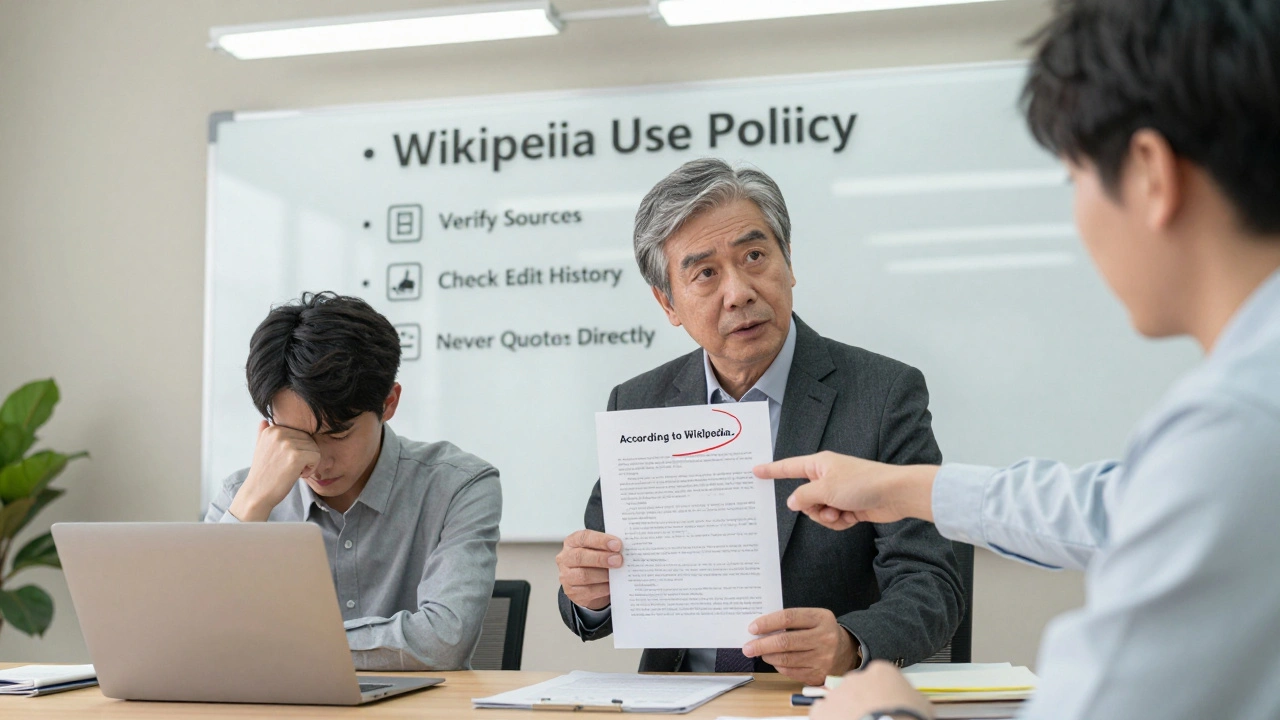
Don’t let editors approve stories that say "According to Wikipedia..." That’s a red flag. If a reporter writes that, the story should be sent back. Period.
Don’t assume your veteran reporters know better. One Pulitzer Prize-winning journalist cited Wikipedia in a 2023 feature on climate policy. He thought the article was "well-sourced." He didn’t check the references. He was wrong.
How to Build the Policy Document
Start with a one-page template. Keep it simple. Use bullet points. Make it easy to print and hang on the newsroom wall.
Wikipedia Use Policy - Newsroom Edition
- Wikipedia is a research tool, not a source.
- Never quote Wikipedia directly.
- Always trace every fact to its original source.
- Check the references, talk pages, and edit history before using any claim.
- If you use Wikipedia to find a source, document it in your notes.
- Any story citing Wikipedia as a source will be pulled and reviewed.
- Violations require mandatory training and a formal review.
Sign it. Post it. Make it part of your onboarding checklist. Every new hire gets a copy. Every editor gets a reminder every quarter.
Real-World Examples
Here’s how it works in practice:
A reporter reads a Wikipedia article about a new law. It says the law was "modeled after legislation in Germany." They click the citation. It links to a German government PDF from 2021. They read it. They find the exact section. They call the German ministry for comment. Now they have a real quote, a real document, and a real source. They never mention Wikipedia in the article.
Another reporter sees a Wikipedia entry claiming a politician donated $500,000 to a charity. The citation links to a press release from the charity. The press release says $50,000. The reporter calls the charity. They confirm the error. The Wikipedia entry is fixed. The reporter writes the story with the correct figure - and notes the correction in their internal log.
Wikipedia didn’t give them the answer. It gave them a clue. That’s all it’s meant to do.
What Happens When You Don’t Have a Policy
In 2025, a regional newspaper published a story about a school board election. One candidate was accused of plagiarism. The article cited Wikipedia’s claim that the candidate’s thesis had been flagged by a university. The university had no record of it. The Wikipedia entry had been edited by a rival campaign staffer. The story was retracted. The newspaper paid damages. The reporter was fired.
That didn’t happen because the reporter was lazy. It happened because there was no policy. No one had taught them how to use Wikipedia properly. No one had said, "This is not a source."
That’s the cost of silence.
Next Steps for Your Newsroom
Here’s what to do next:
- Assign one editor to draft a one-page Wikipedia policy by the end of the week.
- Share it with your team. Get feedback.
- Post it on your internal wiki and in your style guide.
- Run a training session within 10 days.
- Review your last 20 published stories. How many cited Wikipedia? How many could have been fixed with better sourcing?
Wikipedia isn’t going away. But your newsroom can control how you use it. A clear policy doesn’t stop you from using it - it makes you better at using it. And in journalism, that’s the only thing that matters.
Can journalists cite Wikipedia in their articles?
No. Wikipedia is not a primary or reliable source. It’s an aggregator. Citing it directly undermines your credibility. Always trace facts back to the original source - a study, a document, an interview - and cite that instead.
Is Wikipedia ever accurate?
Yes, often. Studies show Wikipedia’s accuracy rate on factual topics is comparable to Encyclopedia Britannica. But accuracy doesn’t equal reliability for journalism. Your job isn’t to report what’s on Wikipedia - it’s to report what’s true, verified, and traceable. Wikipedia can help you find the truth, but it’s not the truth itself.
What should reporters do if they find a false claim on Wikipedia?
If a reporter spots a false claim, they should edit the Wikipedia page - but only if they have a reliable source to back it up. They should also inform their editor. Many newsrooms now have formal processes to correct Wikipedia entries that affect their reporting. This isn’t just about fixing the article - it’s about protecting the public record.
Can I use Wikipedia to find sources?
Absolutely. Wikipedia’s reference section is one of the best tools for finding books, academic papers, government reports, and news articles. Use it to find leads, then verify each one independently. That’s exactly how professional researchers use it.
Why not just say "Wikipedia is bad" and ban it?
Because banning it doesn’t work. Journalists will still use it - secretly. A policy that says "use it right" is more effective than one that says "don’t use it." The goal isn’t to eliminate Wikipedia. It’s to make sure your reporters use it responsibly - and never mistake it for a source.