Wikipedia is everywhere. You’ve probably used it to quickly check a date, understand a concept, or get a basic overview of a topic. But when it comes to academic writing, citing Wikipedia is a minefield. Many professors outright ban it. Others allow it-if you do it right. The truth? You can cite Wikipedia in academic papers, but only under very specific conditions-and never as a primary source.
Why Professors Don’t Like Wikipedia Citations
Wikipedia isn’t peer-reviewed. Anyone can edit it. A student in Tokyo, a retired professor in Toronto, or a bot running on a server in Iowa can change a sentence at any moment. That means the information you see today might be gone tomorrow-or already wrong.
A 2014 study by the University of Oxford compared Wikipedia articles on medical topics with peer-reviewed sources. They found that 74% of Wikipedia entries were accurate, but 26% contained significant errors. That’s not a failure-it’s a feature. Wikipedia works because it’s constantly corrected. But that also means it’s unstable for academic use.
Academic papers need sources you can trust to stay the same. Journals, books, government reports-these are fixed. Wikipedia isn’t. That’s why most universities treat it like a starting point, not a destination.
When Is It Okay to Cite Wikipedia?
There are only two situations where citing Wikipedia is acceptable in academic work:
- You’re writing about Wikipedia itself-its history, reliability, editing culture, or impact on education.
- You’re using it to find a credible source, then citing that original source instead.
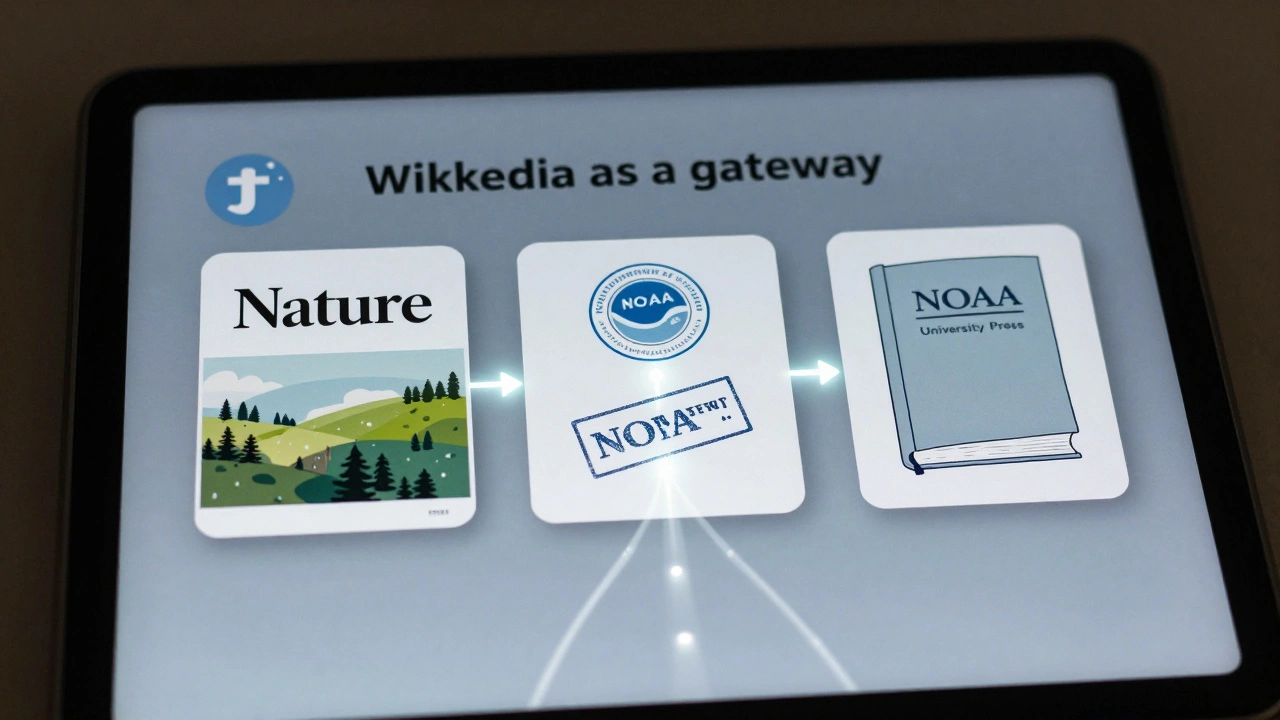
Let’s say you’re writing a paper on climate change and you read on Wikipedia that the Arctic is warming three times faster than the global average. That’s a useful fact. But you don’t cite Wikipedia. You click the citation link at the bottom of the Wikipedia paragraph. It leads you to a 2021 report from the National Oceanic and Atmospheric Administration (NOAA). Now you cite NOAA.
This is called the “Wikipedia as a gateway” method. It’s not cheating. It’s smart research.
How to Cite Wikipedia (If You Absolutely Must)
If your professor allows it-or you’re writing about Wikipedia-here’s how to cite it properly in three major styles.
APA Style (7th Edition)
APA doesn’t recommend citing Wikipedia, but if you must:
Author. (Year, Month Date). Title of article. Wikipedia. URL
Example:
Wikipedia contributors. (2025, January 10). Climate change in the Arctic. Wikipedia. https://en.wikipedia.org/wiki/Climate_change_in_the_Arctic
Note: Use “Wikipedia contributors” as the author since there’s no single writer. Include the exact date you accessed the page, not the publication date. The date changes every time someone edits it.
MLA Style (9th Edition)
MLA is more flexible:
“Title of Article.” Wikipedia, Wikimedia Foundation, Day Month Year, URL.
Example:
“Climate Change in the Arctic.” Wikipedia, Wikimedia Foundation, 10 Jan. 2025, https://en.wikipedia.org/wiki/Climate_change_in_the_Arctic.
MLA requires the publisher (Wikimedia Foundation) and the access date. No author needed.
Chicago Style (17th Edition, Notes-Bibliography)
Chicago allows Wikipedia citations with a footnote and a bibliography entry:
Footnote:
1. “Climate Change in the Arctic,” Wikipedia, last modified January 10, 2025, https://en.wikipedia.org/wiki/Climate_change_in_the_Arctic.
Bibliography:
“Climate Change in the Arctic.” Wikipedia. Last modified January 10, 2025. https://en.wikipedia.org/wiki/Climate_change_in_the_Arctic.
Always use “last modified” to reflect the dynamic nature of the page.
What to Avoid
Here are the biggest mistakes students make when citing Wikipedia:
- Using Wikipedia as your only source. Even one citation from Wikipedia can make your paper look lazy.
- Citing a Wikipedia page without checking the references. You’re skipping the hard part of research.
- Using the “cite this page” button on Wikipedia. It often generates incorrect or incomplete citations.
- Citing a Wikipedia page that’s flagged as “incomplete,” “needs citation,” or “controversial.” If the page itself warns you, don’t use it.
Also, never cite Wikipedia for statistics, legal definitions, medical advice, or historical claims without verifying the original source. A 2023 study in Science Communication found that 31% of Wikipedia citations in undergraduate papers were used for claims that couldn’t be verified elsewhere.
How to Find the Real Source Behind a Wikipedia Fact
Every good Wikipedia article has references at the bottom. Click them. Go to the original.
Look for:
- Peer-reviewed journals (e.g., Nature, The Lancet)
- Books from university presses (e.g., Oxford University Press, Cambridge University Press)
- Government or institutional reports (e.g., CDC, WHO, NASA, UNESCO)
- Reputable news organizations (e.g., BBC, Reuters, The New York Times)
If the reference is a blog, a personal website, or a YouTube video, it’s not reliable. Skip it. Find another source.
Pro tip: Use Google Scholar. Copy a phrase from the Wikipedia article, put it in quotes, and search. You’ll often find the original study.
When You Should Never Cite Wikipedia
Some topics are too sensitive to rely on Wikipedia-even as a starting point:
- Legal statutes or court rulings
- Medical diagnoses or treatment guidelines
- Historical events with contested interpretations
- Political claims or partisan analysis
- Technical specifications for engineering or software
For these, go straight to official sources: government websites, peer-reviewed journals, manufacturer manuals, or legal databases like LexisNexis or Westlaw.
What Professors Really Want
They don’t hate Wikipedia. They hate lazy research.
If you use Wikipedia to find a source, then cite that source properly, you’re doing it right. If you copy a Wikipedia paragraph and slap a citation on it, you’re cutting corners.
Academic writing isn’t about avoiding Wikipedia. It’s about showing you can dig deeper.
Here’s a simple rule: If you can’t trace the idea back to a stable, authoritative source, don’t use it.
Final Checklist: Citing Wikipedia Responsibly
- ✅ Did you use Wikipedia only to find a better source?
- ✅ Did you verify the original source is credible?
- ✅ Did you cite the original source, not Wikipedia?
- ✅ If you must cite Wikipedia, did you use the correct style (APA, MLA, Chicago)?
- ✅ Did you include the exact date you accessed the page?
- ✅ Did you avoid citing Wikipedia for sensitive or technical topics?
Following this checklist turns a risky habit into a smart research strategy.