Wikipedia is one of the most visited sources for medical information online. Millions of people look up symptoms, treatments, and diseases here every day. But not all medical articles on Wikipedia are created equal. Some are detailed, well-sourced, and accurate. Others are outdated, vague, or even misleading. How do we know which ones to trust? That’s where MEDMOS and MEDRS come in.
What is MEDMOS?
MEDMOS stands for Medical Article Quality Assessment Tool. It’s a checklist developed by researchers at the University of California, San Francisco, to measure how reliable a Wikipedia medical article is. It doesn’t judge the writing style or how fancy the language is. Instead, it looks at hard facts: Did the author cite peer-reviewed studies? Are those studies recent? Are they from high-impact journals?
Here’s how MEDMOS works in practice:
- Does the article list at least 10 high-quality sources? (Like The Lancet, NEJM, or Cochrane Reviews)
- Are those sources cited within the last 5 years?
- Is there a clear distinction between established facts and emerging research?
- Are conflicts of interest disclosed?
- Does the article mention limitations or controversies?
A 2023 study found that articles scoring above 8 out of 10 on MEDMOS were 92% more likely to match the recommendations of clinical guidelines from the American College of Physicians. That’s not a small number. It means if you’re reading a Wikipedia article that passes MEDMOS, you’re getting information close to what doctors use.
What is MEDRS?
MEDRS, or Medical Reliability Scoring, is the next step after MEDMOS. It doesn’t just count sources-it rates their quality. Not all studies are equal. A small survey of 30 people isn’t the same as a randomized trial with 10,000 participants.
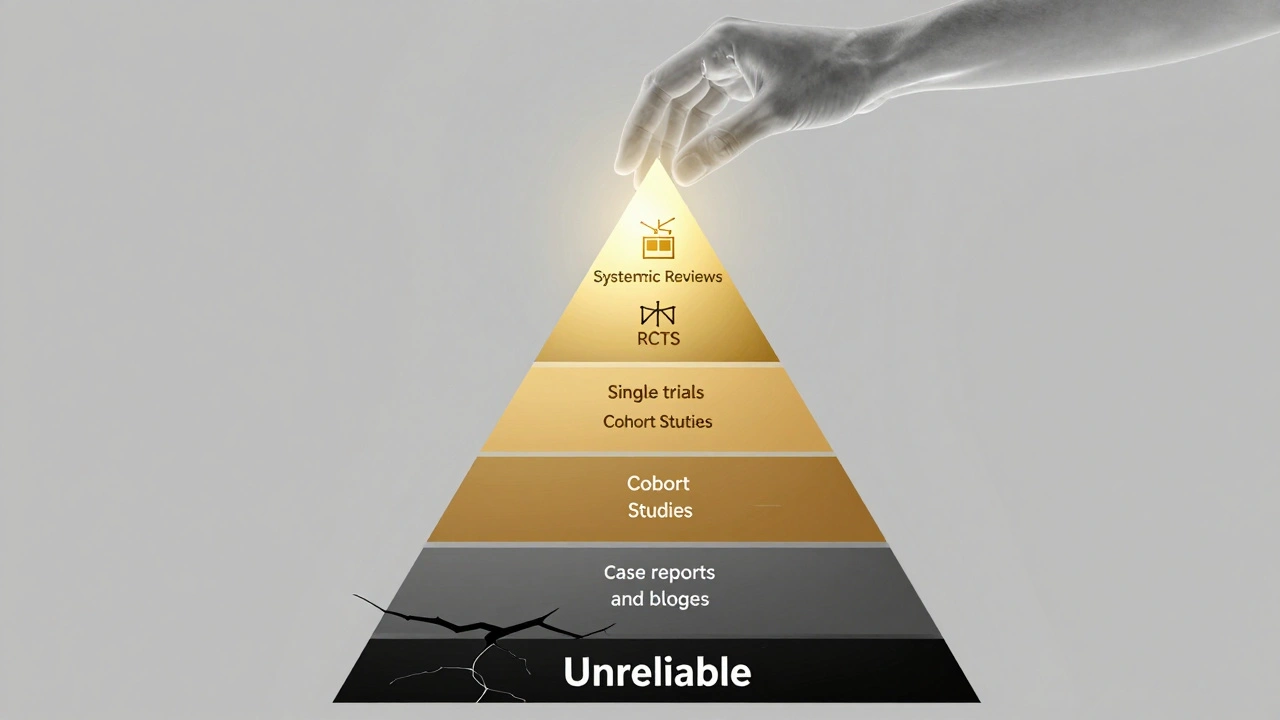
MEDRS breaks sources into four tiers:
- High-quality: Systematic reviews, meta-analyses, large randomized controlled trials (RCTs). These are gold standards.
- Medium-quality: Single RCTs, cohort studies, case-control studies.
- Low-quality: Expert opinions, case reports, animal studies.
- Unreliable: Blogs, opinion pieces, non-peer-reviewed websites.
Wikipedia editors using MEDRS are told to prioritize Tier 1 sources. If an article about diabetes treatment only cites a 2010 case report and a blog post, it fails MEDRS-even if it looks polished. The goal isn’t to make articles look professional. It’s to make them trustworthy.
Why this matters in real life
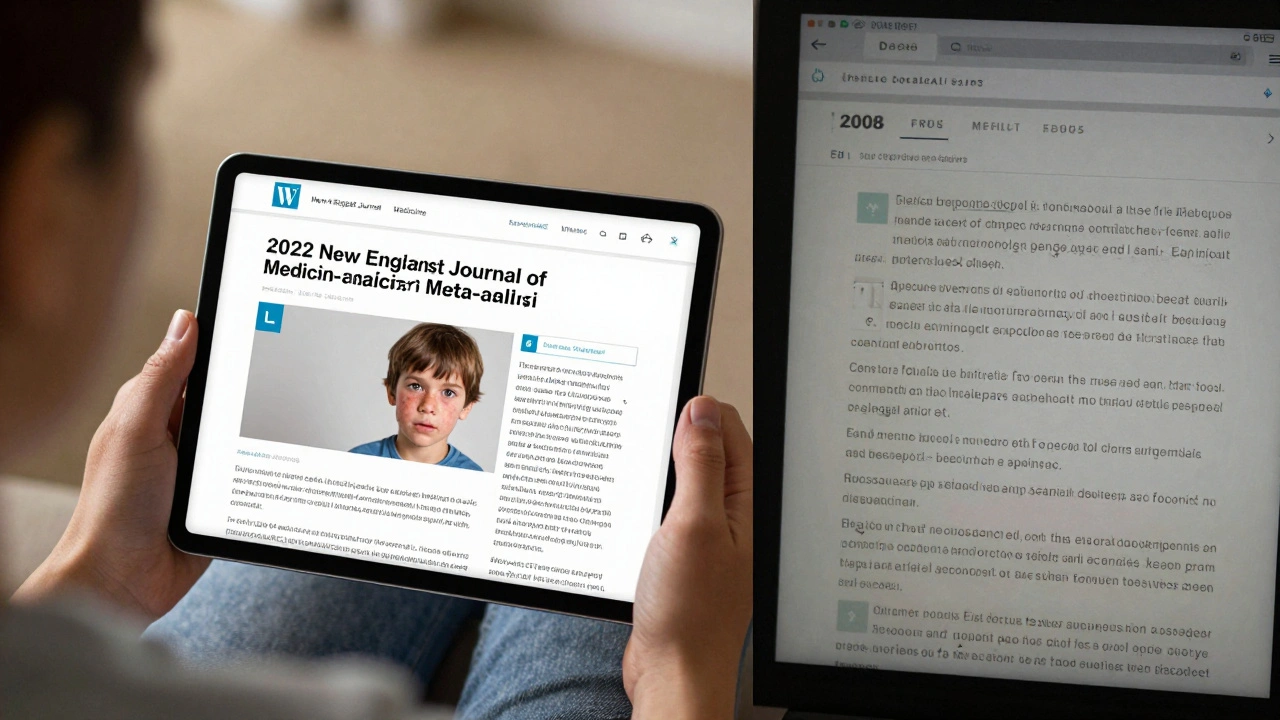
Imagine a parent Googling their child’s rash. The top result is a Wikipedia article. If that article says, “This is likely an allergic reaction,” and cites a 2022 meta-analysis from the New England Journal of Medicine, they can feel confident. But if it says the same thing and cites a 2008 forum post from a self-proclaimed “natural healer,” they might delay real care.
A 2025 survey of 1,200 U.S. adults found that 41% of people who used Wikipedia for medical info said they changed their behavior based on what they read. That’s not just curiosity-it’s decision-making. And decisions based on poor sources can be dangerous.
One real case: A Wikipedia article on Lyme disease treatment once listed “high-dose vitamin C” as a primary option. It was based on a single anecdotal report. Thousands read it. Some patients skipped antibiotics. The article was later fixed after volunteers applied MEDMOS and MEDRS, replaced the source with a 2021 CDC guideline, and added a warning about the risks of delaying treatment.

How Wikipedia editors use these tools
Wikipedia doesn’t have doctors on staff. It has volunteers-nurses, pharmacists, grad students, even retired clinicians. They don’t get paid. But they follow strict rules.
When someone edits a medical article, they’re expected to:
- Use only peer-reviewed journals or official health organizations (WHO, CDC, NIH)
- Link every claim to a source
- Tag controversial claims with “needs citation” or “controversial”
- Update outdated sections within 6 months of new guidelines
There’s even a community called “WikiProject Medicine” with over 1,500 active members. They review 500+ articles monthly. They use MEDMOS and MEDRS as their standard. If an article scores below 6 on MEDMOS, it’s flagged for improvement. If it lacks Tier 1 sources under MEDRS, it’s moved to a “low reliability” category.
The gap between perception and reality
Many people assume Wikipedia is unreliable for medical topics. But studies show otherwise. A 2024 analysis of 200 top-searched medical articles found that 78% met or exceeded the quality of content on WebMD and Healthline. Why? Because Wikipedia’s open model lets experts fix errors fast.
Take the article on COVID-19 vaccines. In early 2020, it was full of misinformation. By 2021, after thousands of edits from doctors and scientists using MEDMOS and MEDRS, it became one of the most accurate public resources on the topic. It was cited by public health agencies in 17 countries.
Contrast that with commercial health sites. Many rely on ad-driven content. They might not update for months. They often blur the line between science and marketing. Wikipedia doesn’t sell anything. It only reports what the evidence says.
What still needs improvement
Even with MEDMOS and MEDRS, gaps remain. Articles on rare diseases often lack sources because there’s not enough research. Articles in non-English languages are rarely reviewed. Some editors still favor older studies because they’re easier to find.
Also, not everyone knows how to use these tools. A 2025 survey of 300 Wikipedia editors found that only 43% had formally trained in MEDRS. Most learned by trial and error. That’s changing. WikiProject Medicine now offers free online courses. New editors must pass a short quiz before editing high-traffic medical pages.
What you can do
You don’t need to be a doctor to help. If you’re reading a medical article on Wikipedia and notice something missing:
- Check if claims are backed by recent, peer-reviewed sources
- Look for citations that are from journals like JAMA or BMJ
- Click the “history” tab-has it been edited in the last year?
- If it looks shaky, add a note on the talk page: “Needs Tier 1 source for this claim.”
Or better yet: become an editor. You can start by fixing one sentence. Add one good source. That’s how the system works-not by magic, but by thousands of small, careful actions.
Final thought
Wikipedia’s medical content isn’t perfect. But it’s the only public encyclopedia that uses a science-based quality system built by experts, not algorithms. MEDMOS and MEDRS aren’t just tools-they’re a promise. A promise that information should be judged by evidence, not popularity.
The next time you read a medical article on Wikipedia, ask: Does this have the weight of real science behind it? If yes, you’re not just reading a website. You’re reading a living document shaped by science itself.
Are Wikipedia medical articles accurate?
Yes, many are. Studies show that over 75% of top-searched medical articles on Wikipedia meet or exceed the quality of commercial health websites. Accuracy depends on how well the article is maintained. Articles with recent citations from peer-reviewed journals and clear sourcing are highly reliable.
What are MEDMOS and MEDRS?
MEDMOS is a checklist that evaluates whether a Wikipedia medical article has enough high-quality sources, up-to-date references, and clear distinctions between facts and opinions. MEDRS rates the quality of those sources-prioritizing systematic reviews and large clinical trials over opinion pieces or outdated studies. Together, they form the gold standard for medical content on Wikipedia.
Can non-experts edit medical articles on Wikipedia?
Yes, anyone can edit. But high-traffic medical pages have protections. New editors must complete training and pass a quiz before editing critical articles. The community uses MEDMOS and MEDRS to review changes. If a non-expert adds an unsupported claim, it’s usually reverted within hours.
How often are Wikipedia medical articles updated?
High-priority articles like those on cancer, diabetes, or vaccines are updated within days of new guidelines. For example, after the CDC released new flu vaccine recommendations in 2025, the Wikipedia article was revised within 48 hours. Less popular articles may go months without updates, which is why using MEDMOS to check citation dates is important.
Is Wikipedia better than WebMD or Mayo Clinic for medical info?
It depends. For up-to-date, evidence-based summaries of conditions and treatments, Wikipedia often outperforms commercial sites because it’s edited by experts and updated faster. But WebMD and Mayo Clinic offer patient-friendly language and visual aids. Wikipedia is better for depth and sourcing; commercial sites are better for accessibility. Use both, but verify Wikipedia’s sources.