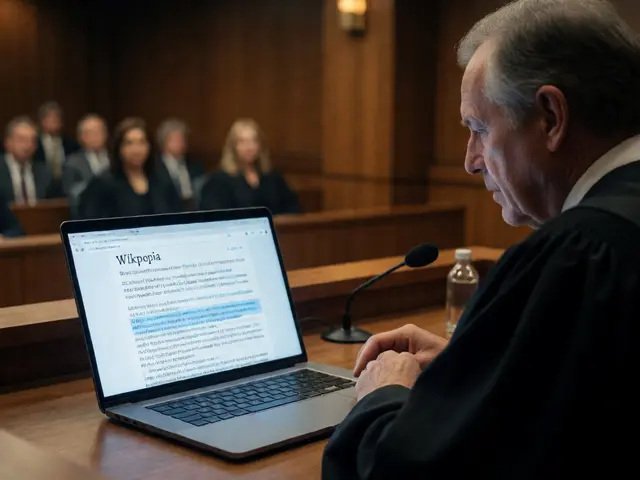
Imagine you are writing a research paper or preparing a presentation, and you find a striking statistic on Wikipedia is a free online encyclopedia that anyone can edit, known for its collaborative model and vast coverage of topics.. The number looks solid. But how do you know it’s still true? How do you know the editor who added it wasn’t just guessing? This is where most people stop. They copy the text, paste it into their work, and move on. That’s risky. To truly verify claims, you need to look under the hood. Specifically, you need to master two hidden tools: the Page History is a chronological log of every edit made to a specific Wikipedia article, showing who changed what and when. and the Talk Page is a discussion forum associated with each Wikipedia article where editors debate content accuracy and sourcing..
These features don’t just show you the current state of an article; they reveal the journey. They show you the arguments, the deletions, and the consensus-building process. If you treat Wikipedia as a starting point rather than a final destination, these tools transform it from a potentially shaky source into a powerful research aid.
Why the Current Article Isn’t Enough
The main body of a Wikipedia article is a snapshot. It shows you the agreed-upon version of events at this exact moment. But agreement doesn’t always mean truth; sometimes it means one side won the argument, or both sides compromised in a way that obscures nuance. For academic use, you need to know if a claim is stable or contested. A fact that has been edited five times in the last month is far less reliable than one that hasn’t been touched in three years. By checking the Page History, you can see the frequency of changes. If you notice a cluster of edits around a specific date, that’s a red flag. It suggests active debate or recent controversy. Conversely, a long period of stability indicates that the community has settled on this information, making it safer to cite (provided you check the original sources).
Reading the Talk Page Like a Detective
The Talk Page is often overlooked because it looks messy. It’s full of threads, signatures, and technical jargon. But it’s also the most honest place on Wikipedia. Here, editors argue about citations. They point out bias. They request references. When verifying a claim, start by searching the talk page for keywords related to your topic. Look for phrases like "citation needed," "disputed," or "unsourced." If you find a thread where an editor challenges a specific sentence and no response follows, that sentence is weak. If there is a detailed back-and-forth with links to primary sources, that’s gold. You aren’t just reading the conclusion; you’re reading the evidence behind the conclusion.
There is a specific type of tag you should look for: the Dispute Tag is a template placed on Wikipedia articles to indicate that a section contains disputed facts requiring attention or resolution.. These tags appear directly in the article text, but the context lives on the talk page. If you see a dispute tag, do not cite that section without extensive cross-referencing. It means the community hasn’t reached a consensus yet. Your job is to find out why they haven’t. Is it missing data? Is it conflicting interpretations?
Tracing Edits Through Page History
Now, let’s look at the mechanics of the Page History. Every edit has a timestamp, an editor name, and a summary. Clicking on the diff link (the difference between versions) allows you to see exactly what was added or removed. This is crucial for verifying claims. Suppose an article states that a company earned $10 million in revenue in 2024. You click the history for that paragraph. You see that the figure was changed from $8 million to $10 million last week. Who made the change? Was it a new user with only ten edits, or a veteran editor with thousands? While edit count isn't a guarantee of quality, it provides context. More importantly, did the editor leave a note? Did they add a citation? If the change was made without a source, the claim is vulnerable. You now know that the $10 million figure is unverified. You would then need to find the original financial report yourself to confirm it.

Identifying Reliable Contributors
Not all Wikipedia editors are created equal. Some are casual contributors who make minor typo fixes. Others are domain experts who maintain specific categories of articles. By looking at an editor's profile via their username in the history, you can gauge their expertise. Does the editor have a focus area listed? Do they have a history of contributing to similar topics? An editor who specializes in medical history is more likely to provide accurate dates for historical treatments than a generalist. This doesn't replace peer review, but it adds a layer of credibility. In academic contexts, citing a well-sourced Wikipedia entry maintained by subject matter experts is often acceptable as a secondary reference, provided you trace back to the primary sources cited in the article.
Practical Steps for Verification
To make this process efficient, follow this simple workflow:
- Locate the Claim: Identify the specific sentence or statistic you want to verify.
- Check the Talk Page: Search for keywords. Look for unresolved disputes or requests for citations.
- Review Recent History: Check the last six months of edits for that section. Note any frequent changes.
- Analyze the Diff: If a key fact was changed recently, view the diff to see if a source was added.
- Trace the Source: Click the citation link in the current article. Ensure the source actually supports the claim. Don't assume; read the abstract or relevant section.
- Cross-Reference: Find one independent source outside of Wikipedia to confirm the fact.
Common Pitfalls to Avoid
One major mistake is relying on the "good faith" assumption. Just because an edit looks clean doesn't mean it's correct. Another pitfall is ignoring the timeline. A fact might be true today but false tomorrow. For fast-moving topics like technology or politics, the half-life of a fact is short. Always check the date of the latest edit. If the article was last updated in 2023 and you are writing in 2026, the information might be outdated, even if it was accurate when written. Finally, avoid citing Wikipedia for primary data. Use it to find the primary data. If the article cites a journal study, go to the journal. If it cites a government report, go to the government website. Wikipedia is a map, not the territory.
| Method | Effort Level | Reliability Indicator | Best For |
|---|---|---|---|
| Skimming Article Text | Low | Low | General curiosity only |
| Checking Citations Only | Medium | Medium | Confirming basic facts |
| Reviewing Talk Page Disputes | High | High | Contested or sensitive topics |
| Analyzing Page History Diffs | High | Very High | Academic research and fact-checking |
Building a Habit of Critical Reading
Using these tools takes practice. At first, navigating the history and talk pages feels clunky. But once you get the hang of it, you’ll find it empowering. You stop being a passive consumer of information and become an active investigator. You learn to distinguish between established knowledge and emerging debates. This skill transfers beyond Wikipedia. It teaches you how to evaluate any digital source critically. In an age of misinformation, that is a valuable asset. Whether you are a student, a journalist, or a professional, knowing how to dig deeper ensures that your work stands on solid ground. Don’t just trust the surface. Look at the layers beneath.
Is it okay to cite Wikipedia in an academic paper?
It depends on your institution's guidelines. Many universities allow Wikipedia as a secondary source for background information but require you to cite the primary sources found within the Wikipedia article. Always check with your professor or department head. Using the talk pages and history helps ensure the primary sources are valid before you cite them.
What does a 'Citation Needed' tag mean?
A 'Citation Needed' tag indicates that a statement lacks a reliable source. Until a source is added, the claim is considered unverified. If you see this tag on a key fact, do not rely on it unless you find the source yourself through other research methods.
How far back should I check the page history?
For most topics, checking the last 6 to 12 months is sufficient to identify recent controversies. For fast-changing topics like technology or breaking news, check the last 3 months. For historical topics, the history may be less critical, but checking for recent corrections is still wise.
Can anonymous users edit Wikipedia?
Yes, anyone can edit Wikipedia, including anonymous users identified by their IP address. This is why checking the editor's reputation is important. Anonymous edits are more prone to vandalism or error, so scrutinize changes made by unknown users more carefully.
What is the difference between a draft and a published article?
Drafts are works in progress that are not yet ready for the main namespace. They are less reliable because they haven't undergone the same level of community review. Try to verify claims using published articles whenever possible, as they have passed stricter quality control checks.