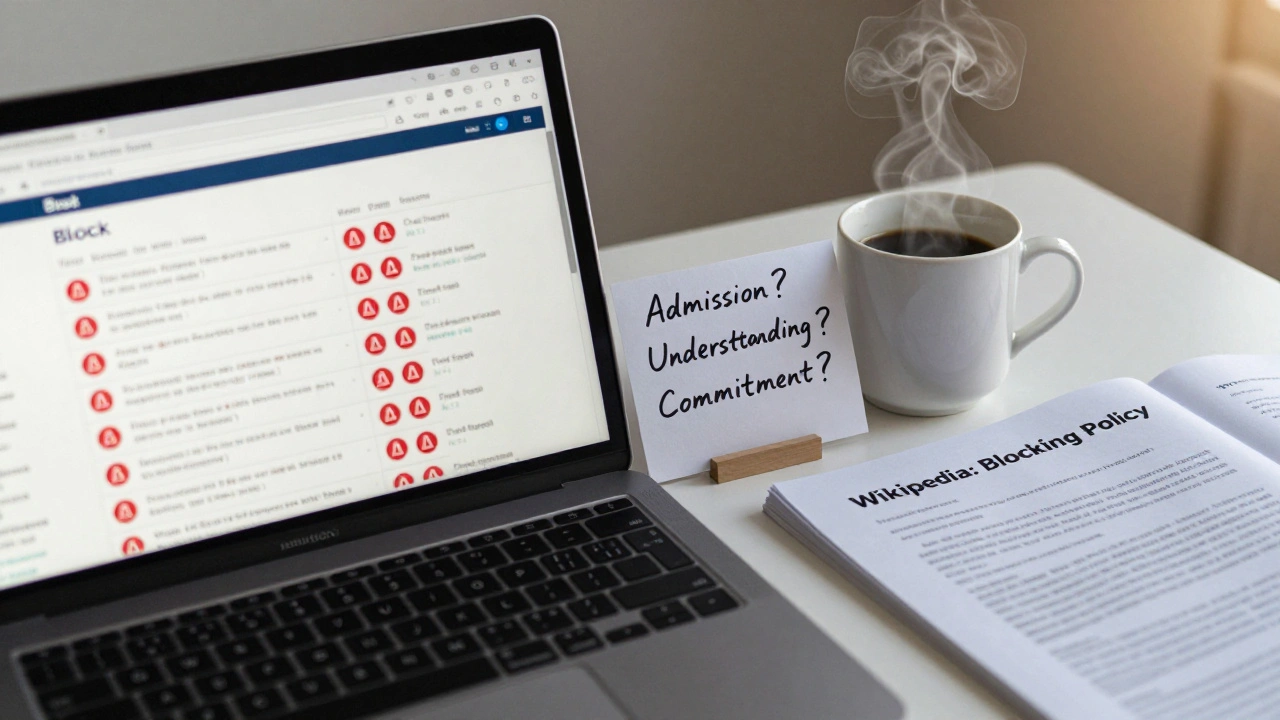
Every day, Wikipedia administrators receive dozens of unblock requests. Some come from users who made a single mistake. Others come from people who’ve repeatedly violated policies, sometimes for years. The difference between granting and denying an unblock request isn’t just about rules-it’s about judgment, context, and whether the user shows real change.
What triggers an unblock request?
A user gets blocked on Wikipedia when they violate community policies. Common reasons include vandalism, edit warring, personal attacks, spamming, or sockpuppetry. Once blocked, they can’t edit. But they can still send an unblock request through the Unblock Ticket System or by posting on their talk page. Most requests are automated or copied-paste templates. The real work starts when an administrator reads between the lines.Not all requests deserve attention. A user who says, “I didn’t do anything wrong” without acknowledging any behavior is unlikely to change. But someone who says, “I didn’t understand how citation rules worked, and I’ve read the guidelines since”-that’s a different story. The tone matters. The effort matters. The history matters.
Check the block log first
Before responding to any request, check the user’s block log. This isn’t just a list of dates-it’s a pattern. Look for:- How many times have they been blocked before?
- Were the blocks for the same issue, or different ones?
- Did they appeal after each block, or only now?
- Did they edit during a previous block (sockpuppetry)?
A single block for a minor edit war might be forgiven. Three blocks in six months for harassment? That’s a red flag. Wikipedia’s Blocking Policy says blocks should be long enough to prevent harm and give time to reflect. Repeated offenses mean the block didn’t work-and the next one needs to be stronger.
Read the unblock request like a letter
A good unblock request has three parts:- Admission: They recognize what they did wrong.
- Understanding: They explain why it violated policy.
- Commitment: They say how they’ll do better.
Example: “I edited articles about my company to make them sound better. I didn’t realize that was a conflict of interest. I’ve read the COI guidelines and now I know not to edit anything related to me or my employer. I’ll only contribute on unrelated topics from now on.” That’s a strong request.
Compare that to: “I’m sorry I got blocked. Can you unblock me? I just want to fix my articles.” No admission. No understanding. No plan. That’s a no.
Look for signs of genuine change
Wikipedia doesn’t punish people-it tries to fix behavior. So look for evidence of change, not just promises.- Did they read the relevant policy pages? Check their contribution history. If they’ve visited Wikipedia:Conflict of interest or Wikipedia:No personal attacks, that’s a good sign.
- Have they edited in good faith elsewhere? A user who’s been blocked for vandalism but now helps clean up vandalism on other pages shows they’re learning.
- Are they engaging with other editors respectfully? Look at their talk page replies. Are they defensive? Or open to feedback?
One administrator I know unblocked a user who had been blocked six times over three years. Why? Because after the last block, the user spent months editing in the Wikipedia:WikiProject on Historical Articles, fixing citations, asking for feedback, and never once edited a topic they had a personal stake in. That’s transformation.
Don’t unblock just to be nice
It’s tempting to unblock someone who seems “nice” or “sorry.” But Wikipedia isn’t a social club. A polite tone doesn’t cancel out a pattern of disruption. If a user has a history of edit warring, unblocking them without conditions is just inviting more conflict.Instead, consider a conditional unblock. This means:
- They’re unblocked, but only to edit specific topics (e.g., “You may edit only articles in the Science category”)
- They must submit their edits for review for 30 days
- They must participate in a mediation session with another editor
Conditional unblocks work. A 2023 study of 1,200 unblock cases showed that users who received conditional unblocks were 68% less likely to be blocked again within six months compared to those who got full, unconditional unblocks.
When to say no
Sometimes, unblocking is the wrong choice. Say no if:- The user denies any wrongdoing and blames others
- They’ve been blocked multiple times for the same behavior
- They’ve used sockpuppets to bypass previous blocks
- They’ve made threats or engaged in harassment
- They’ve been blocked for over a year and never reached out until now
There’s no shame in a permanent block. Wikipedia’s goal is to protect the integrity of its content. If someone can’t or won’t follow the rules, they shouldn’t be editing.
Document your decision
Always leave a clear explanation on the user’s talk page. Don’t just say “Denied.” Say why:“Your request was denied because you’ve been blocked three times in the past year for edit warring. Your message did not acknowledge the disruptive nature of your edits or show any effort to understand the policy. Until you can demonstrate that you’ve learned from past mistakes, further blocks will remain in place.”
This isn’t just for the user-it’s for other administrators who might review the case later. Transparency keeps the system fair.
What happens after unblocking?
Unblocking isn’t the end-it’s the start of a new probation period. Monitor their edits for the next 14 to 30 days. Watch for:- Returning to the same controversial topics
- Using the same language or edit patterns from before
- Ignoring feedback from other editors
If they slip, don’t wait. A quick reminder on their talk page, followed by a short block if needed, can prevent a full relapse. Most users who are genuinely trying to change will appreciate the guidance.
Resources for administrators
Wikipedia provides tools to help:- Administrators’ Noticeboard - for advice on tricky cases
- Mediation Committee - for conflict resolution
- Blocking Policy - the official guidelines
- CheckUser requests - to detect sockpuppets
Don’t try to handle every case alone. Use the community. Ask for help. The best administrators aren’t the ones who block the most-they’re the ones who know when to pause, when to listen, and when to give someone a second chance.
How long should a block last before considering an unblock request?
There’s no fixed rule. Minor infractions might be resolved with a 24-hour block. Repeated or serious violations often require weeks or months. The goal is to give enough time for reflection-not punishment. If a user hasn’t reached out after six months, they likely aren’t interested in returning in good faith.
Can I unblock someone who was blocked for sockpuppetry?
Almost never. Sockpuppetry undermines trust in the entire editing system. Even if someone claims they were “just testing” or “didn’t know it was against policy,” it’s a serious breach. Permanent blocks are standard unless there’s overwhelming evidence of rehabilitation over years-not weeks.
What if the user says they’re a student and didn’t know the rules?
Being a student doesn’t excuse policy violations. But it does mean they might need education, not punishment. Offer them links to beginner guides, suggest they join the Teahouse, and require them to complete a simple quiz on core policies before editing again. Many students become some of Wikipedia’s most reliable editors after a gentle introduction.
Do I have to respond to every unblock request?
You’re not required to respond to every single one, but you should respond to those that show any effort or clarity. Ignore template requests that say nothing. But if someone took time to write a thoughtful message, even if flawed, acknowledge it. Silence feels like dismissal.
What if another administrator unblocked someone I disagreed with?
Disagreements happen. If you believe the unblock was a mistake, raise it on the Administrators’ Noticeboard. Don’t re-block the user without discussion. Let the community weigh in. Consistency matters more than individual authority.