You type a major event into the search bar-maybe a sudden political resignation or a natural disaster-and you expect an instant summary. Instead, you often get a red link or a bare-bones stub that looks nothing like a CNN article. This isn't a bug; it's a feature of how Wikipedia handles breaking news articles. The platform operates on a fundamental tension: it wants to be current, but it refuses to be speculative.
Most people misunderstand this friction. They think editors are slow or bureaucratic. In reality, the system is designed to filter out noise. When a story breaks, the goal isn't to write the first draft of history; it's to wait until there is enough verified consensus to create a stable encyclopedia entry. This approach relies on strict policy governance, specifically regarding reliable sources and notability.
The Core Conflict: Timeliness vs. Verifiability
News outlets thrive on speed. If they miss the scoop, they lose readers. Wikipedia thrives on accuracy. If it publishes unverified rumors, it loses credibility. This creates a specific workflow for breaking events. Editors don't just start typing when Twitter explodes. They look for what the community calls "secondary coverage." This means waiting for established news organizations to report on the event, analyze it, and provide context.
Why the delay? Because early reports are often wrong. Remember the initial confusion during major terrorist attacks or election nights? Headlines change every ten minutes. Wikipedia’s governance model dictates that content must reflect a settled understanding of facts. Until multiple independent, reputable sources agree on the basic details, the article remains in limbo. This prevents the "edit wars" that occur when fans or partisans try to insert their preferred narrative before the dust settles.
Governance Tools: Notability and Sourcing
The two pillars holding up this structure are Notability Guidelines and Verifiability Policy. These aren't suggestions; they are enforceable rules used by administrators to delete or protect pages.
Notability asks a simple question: Is this topic significant enough to deserve its own article? For breaking news, the bar is high. A minor local accident might make the front page of a city blog but won't pass Wikipedia's threshold unless it has broader implications. Conversely, a global pandemic or a major legislative change clears the bar quickly because the impact is undeniable and widely reported.
Verifiability requires that every claim be backed by a citation. You can't just say "The president resigned." You need a source from a trusted outlet like The New York Times, BBC, or Reuters. During breaking news, editors often face a dilemma: primary sources (like press releases) are available instantly, but secondary sources (analysis pieces) take time. Wikipedia prioritizes secondary sources because they offer perspective and fact-checking that raw data lacks.
The Role of WikiProject Current Events
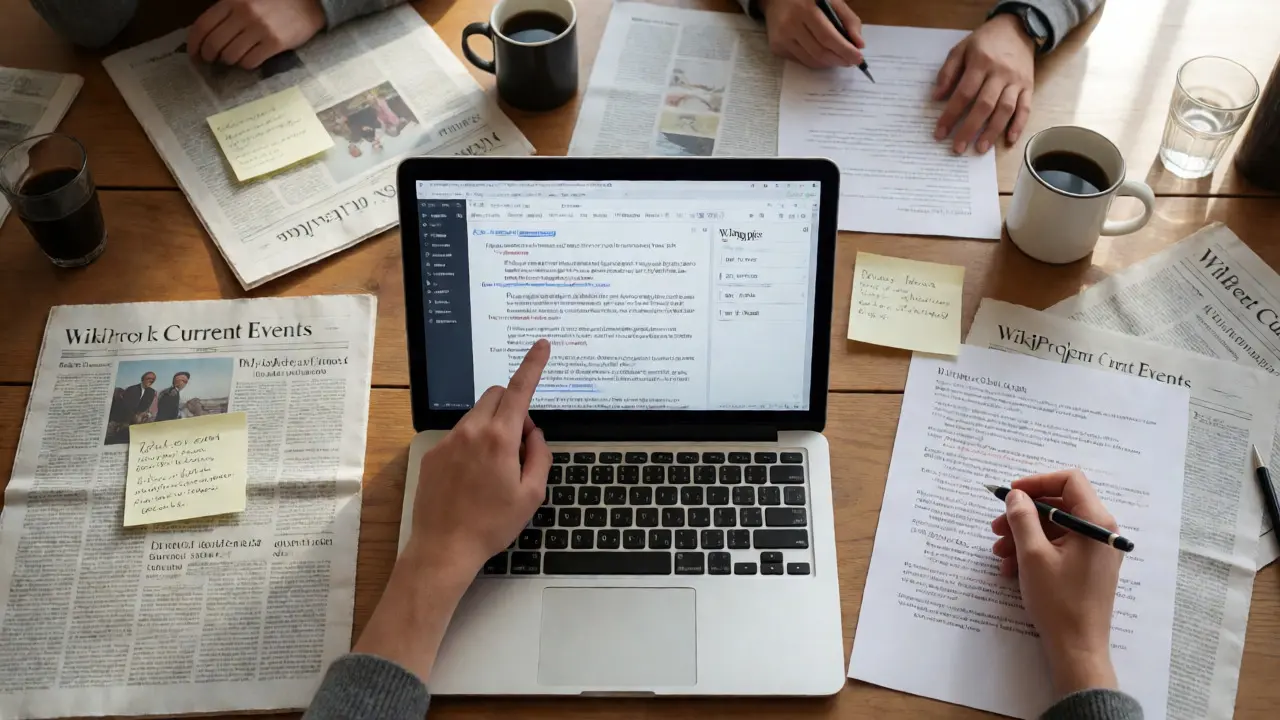
Who actually does this work? It’s not a paid staff. It’s a decentralized network of volunteers coordinated through groups like WikiProject Current Events. This project acts as the nerve center for fast-moving topics. Members monitor news feeds, flag emerging stories, and assess whether a new article is warranted.
When a major event unfolds, experienced editors often lock the main article to prevent vandalism. This is called Article Protection. Only autoconfirmed users (those with a certain edit count and account age) can make changes. This stops bots and trolls from flooding the page with false information during the chaotic first few hours. Meanwhile, discussions happen on the Talk Page, where editors debate which sources are credible and how to phrase neutral descriptions.
| Source Type | Speed of Availability | Reliability Score | Use Case in Breaking News |
|---|---|---|---|
| Primary Sources (Press Releases) | Instant | Low (Biased) | Basic facts only; rarely used alone |
| Social Media (X/Twitter) | Real-time | Very Low | Leads to find sources; not cited directly |
| Wire Services (AP, Reuters) | Minutes | High | Core factual backbone of the article |
| Major Newspapers (NYT, WaPo) | Hours | Very High | Context, analysis, and confirmation |
Navigating Bias and Neutrality
Breaking news is inherently polarizing. People want their side of the story told immediately. Wikipedia’s Neutral Point of View (NPOV) policy demands that articles represent all significant published perspectives without favoring one. In practice, this means avoiding loaded language. Instead of saying "The controversial leader made a disastrous decision," an editor writes "Critics argued the decision had negative economic impacts, citing data from X."
This neutrality is hard to maintain under pressure. Editors often engage in "reverts"-undoing edits that introduce bias. If you’ve ever seen a page flicker between versions, that’s the NPOV enforcement mechanism at work. It’s messy, but it ensures the final product isn’t a partisan pamphlet. The goal is to reach a consensus version that reflects the broadest agreement among reliable sources.
From Stub to Stable Article
What happens after the initial chaos? Once the event stabilizes, the article transitions from a "stub" to a comprehensive entry. Editors expand the background, add historical context, and clean up the citations. Dead links are repaired, and redundant sections are merged. This process can take days or weeks, depending on the complexity of the event.
For ongoing situations, such as conflicts or elections, Wikipedia uses templates like "As of August 2026" to indicate the currency of the information. This transparency helps readers understand that the article is a snapshot in time, not a final verdict. Over time, as more books and academic papers are published, the article may be revised again to include deeper scholarly analysis, moving beyond the immediate news cycle.
Practical Tips for Contributors
If you want to contribute to breaking news articles, here is how to avoid common pitfalls:
- Check existing drafts: Before creating a new page, search for existing stubs. Duplicate articles fragment discussion and dilute sourcing.
- Cite properly: Use inline citations for every fact. Don't rely on memory or social media screenshots.
- Avoid speculation: Do not predict outcomes. State what has happened, not what might happen.
- Respect protection levels: If a page is protected, discuss your proposed changes on the Talk Page before editing.
Understanding this governance model changes how you read Wikipedia. It’s not a live feed; it’s a curated archive. The delays aren’t failures-they’re safeguards. By demanding reliable sources and neutral phrasing, Wikipedia ensures that once a breaking news story enters the encyclopedia, it stays accurate long after the headlines fade.
Why does Wikipedia delete breaking news articles?
Editors often delete them if they lack sufficient reliable sources or fail to meet notability guidelines. Early articles are frequently created based on speculation rather than verified facts, leading to rapid deletion until the event gains broader coverage.
Can I cite a tweet for a breaking news article?
Generally, no. Tweets are considered primary sources and are often unreliable or taken out of context. Wikipedia prefers secondary sources like major news outlets that have verified the information independently.
How long does it take for a breaking news story to appear on Wikipedia?
It varies. For major global events, a stub may appear within hours once wire services report. However, a fully developed article usually takes days to weeks as editors gather diverse sources and resolve neutrality disputes.
What is 'Article Protection' during breaking news?
It is a technical restriction applied by administrators to prevent vandalism and edit warring. Only experienced users with established accounts can edit protected pages, ensuring stability during volatile periods.
Does Wikipedia update live like a news site?
No. While edits happen constantly, Wikipedia does not function as a real-time news ticker. It updates as soon as reliable, sourced information becomes available, which introduces a slight lag compared to live blogs.