Imagine you are a native speaker of Basque or Swahili. You want to add an article about your local history to Wikipedia. But wait-does the English rule on "notability" apply to your small-town hero? Who decides what counts as "reliable sources" in your language? It’s not Jimmy Wales in San Francisco calling the shots. The real power lies with the Local Wikipedia communities, which operate as independent governance bodies that create and enforce their own editorial policies tailored to linguistic and cultural contexts.
This decentralized model is one of the most fascinating aspects of the Wikimedia ecosystem. While the global foundation sets the broad legal and technical framework, each language edition functions like its own micro-nation. They draft their own rules, elect their own administrators, and resolve their own disputes. If you’ve ever wondered how a community of unpaid volunteers manages to maintain order across hundreds of languages without a central police force, you’re in the right place.
The Core Principle: One Wiki, One Community
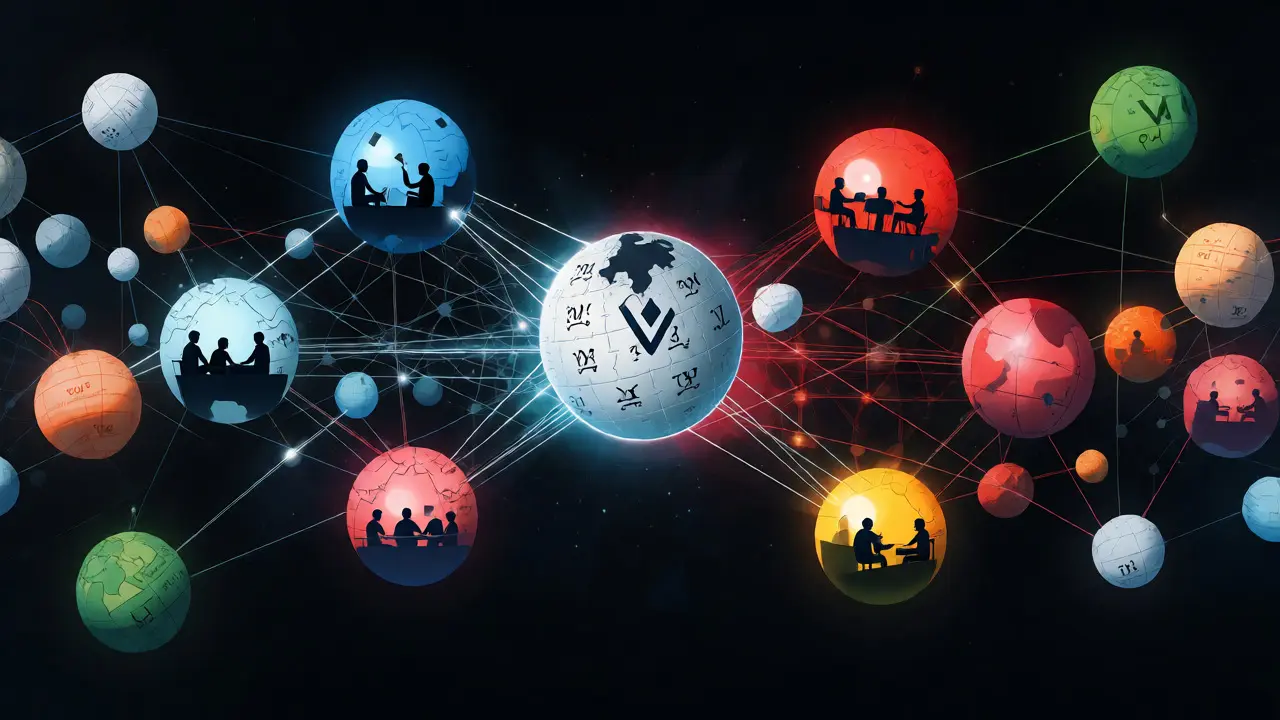
To understand how policy gets made, you first need to grasp the structure. Wikipedia is not a single monolithic website but a federation of language editions, each hosted on its own domain (like es.wikipedia.org or ja.wikipedia.org). Each edition has its own community of editors who self-govern through consensus-based decision-making processes.
Why does this matter? Because culture dictates context. A source considered reliable in Germany might be viewed with skepticism in Japan due to different journalistic traditions. A topic notable in Brazil might seem trivial in Canada. The global Wikipedia project recognizes that a "one-size-fits-all" approach fails when dealing with 300+ distinct languages. Therefore, the Wikimedia Foundation delegates authority, allowing each language community to interpret core principles like Neutral Point of View (NPOV) within their specific cultural framework.
How Policies Are Born: From Proposal to Consensus
Policies don’t appear out of thin air. They emerge from messy, often heated discussions on talk pages. Here is the typical lifecycle of a new rule in a local Wikipedia:
- The Spark: An editor encounters a recurring problem. Maybe there’s a flood of low-quality articles about minor football players, or perhaps there’s confusion over whether social media posts count as sources.
- The Proposal: The editor drafts a proposal on a dedicated page, usually titled something like "Proposed Policy: Notability for Athletes." They outline the problem, suggest a solution, and cite examples.
- The Discussion: This is the engine room of governance. Editors comment, argue, and refine the text. In smaller wikis, this might happen in a few days. In larger ones like the German or French Wikipedia, it can take months.
- The Consensus Test: There is no formal vote in most cases. Instead, experienced editors assess whether a clear consensus has formed. If the majority supports the idea and no strong objections remain, the proposal is adopted.
- Codification: Once accepted, the text is moved to the main namespace as official policy. Violating it now carries weight; editors can revert changes or block users who ignore it.
It’s crucial to note that Consensus is defined as the general agreement among active community members, rather than a simple majority vote. This nuance prevents large groups of casual voters from overwhelming expert consensus.
The Role of Administrators and Bureaucrats
While everyone can edit, not everyone can delete pages or block users. These tools are granted to trusted individuals known as Administrators, who are volunteers elected by the community to perform maintenance tasks such as deleting pages, blocking vandals, and protecting articles.
How do they get these powers? Through a process called Request for Adminship (RfA). In many local wikis, candidates must have a track record of constructive editing. The community reviews their history, looking for signs of good judgment, calmness under pressure, and adherence to existing policies. If the community trusts them, they gain the "sysop" flag.
Above administrators are Bureaucrats, who have the additional ability to grant admin rights to other users and rename accounts. Bureaucrats are typically more senior figures who help manage the human resources aspect of the wiki. They ensure that the pipeline of new admins remains healthy and that no single group dominates the leadership.
| Role | Primary Responsibility | Selection Method | Key Powers |
|---|---|---|---|
| Editor | Creating and improving content | Self-registered | Edit pages, discuss on talk pages |
| Administrator | Maintenance and conflict resolution | Community election (RfA) | Delete pages, block users, protect articles |
| Bureaucrat | User management | Elected by community or appointed | Grant admin rights, rename users |
| Steward | Cross-wiki coordination | Global election | Override local decisions in rare cases, global blocks |
Cultural Nuances in Policy Interpretation
This is where things get interesting. Two wikis might have identical written policies but apply them differently. Take the concept of "Reliable Sources." In the English Wikipedia, mainstream news outlets are generally preferred. However, in some indigenous language wikis, oral histories or community elders might be considered equally valid if written records are scarce. The local community decides how strictly to interpret the guideline.
Consider the Spanish Wikipedia versus the Catalan Wikipedia. Both share similar linguistic roots, yet their political sensitivities differ. The Catalan community might have stricter rules regarding neutrality on topics related to independence movements, reflecting the intense local debate. Meanwhile, the Spanish edition might handle those same topics with a broader national perspective. These differences aren’t bugs; they’re features of Language Community Governance, which allows for localized adaptation of global standards to fit regional realities.
Another example involves image licensing. Some countries have fair use laws that allow copyrighted images in encyclopedias. Others, like Japan, have much stricter copyright regimes. The Japanese Wikipedia had to develop unique workarounds and policies because they couldn’t rely on the American-style fair use doctrine. Their community negotiated complex agreements to display album covers or movie posters legally.
Conflict Resolution: When Consensus Breaks Down
What happens when two groups of editors refuse to agree? Or when an administrator abuses their power? Most local wikis have escalation paths.
- Talk Page Mediation: First, try to talk it out. Often, explaining your reasoning clearly resolves the issue.
- Third Opinion: Inviting neutral editors to review the dispute can break a deadlock.
- Arbitration Committee (ArbCom): Larger wikis have an elected committee that acts like a supreme court. They hear binding cases about serious misconduct or policy interpretations. Their decisions are final within that wiki.
- Meta-Wiki Intervention: In extreme cases, if a local wiki is dysfunctional or violating fundamental Wikimedia values, stewards from the global Meta-Wiki can intervene. This is rare and usually reserved for situations where the local community has collapsed.
The existence of an Arbitration Committee signals maturity. Smaller wikis might not have one, relying instead on informal mediation by senior editors. As a community grows, formalizing dispute resolution becomes necessary to prevent burnout among key contributors.

The Impact of Global Tools on Local Autonomy
In recent years, the introduction of global tools has slightly shifted the balance of power. Features like Visual Editor and Flow were developed centrally but rolled out locally. Communities could opt-in or opt-out, preserving their autonomy.
However, some changes have been imposed. For instance, the shift to mobile-friendly interfaces affected all wikis simultaneously. While beneficial for readers, it sometimes disrupted local editing workflows. Communities had to adapt quickly, showing the tension between global efficiency and local preference.
Currently, there is an ongoing debate about "Unified Login," which allows a single account to work across all wikis. While convenient, some smaller communities worry it dilutes their distinct identity. Will a user who edits primarily on English Wikipedia care about the specific formatting norms of the Yoruba Wikipedia? Local governance struggles to maintain engagement when users become "global citizens" rather than dedicated local contributors.
How to Participate in Your Local Wikipedia
If you speak another language, you can influence how your local Wikipedia works. Here’s how to get started:
- Lurk First: Spend time reading the Village Pump (or equivalent forum) in your target language. See what issues are currently being debated.
- Learn the Norms: Every wiki has unspoken rules. Watch how experienced editors interact. Do they sign their comments? How do they cite sources?
- Start Small: Fix typos or add references. Build trust before proposing major policy changes.
- Join the Discussion: When you feel comfortable, contribute to policy debates. Even a well-reasoned comment from a newcomer can sway a discussion.
- Run for Office: If you’ve been active for a while, consider running for Administrator. It’s a great way to serve your community.
Your voice matters. Unlike traditional encyclopedias where editors are hired professionals, Wikipedia relies on the collective intelligence of its speakers. By participating in governance, you help shape how your language and culture are represented online.
Frequently Asked Questions
Can I change a policy on my local Wikipedia?
Yes, any registered user can propose a change. You start by creating a proposal page and inviting the community to discuss it. If consensus forms, the policy is updated. It doesn’t require special permissions, just persistence and clear communication.
Do all Wikipedia languages follow the same rules?
No. While they all adhere to the five pillars of Wikipedia, each language community creates its own detailed guidelines. What is acceptable in one language edition might be prohibited in another due to cultural or legal differences.
Who owns the content on a local Wikipedia?
The content is licensed under Creative Commons Attribution-ShareAlike. No single person or entity owns it. The local community governs how it is managed, but the copyright remains with the individual authors who contributed the text.
What happens if a local community becomes inactive?
If a wiki lacks active editors, it may fall into disrepair. Stewards or other community members might step in to help clean up vandalism or update outdated policies. In severe cases, the project might be merged or archived, though this is rare for established languages.
Is voting used to make decisions?
Rarely. Wikipedia prefers consensus over voting. Voting can lead to polarization and ignores minority viewpoints. Decisions are based on the strength of arguments and the level of agreement among active participants, not just a headcount.