You open a news site, and within seconds, you know its slant. The headline choices, the adjectives used, the experts quoted-it all signals whether you’re reading Wikinews or a partisan outlet. But what happens when the news is written by volunteers trying to strip away that slant entirely? That’s the core experiment behind Wikinews, a free-content news project hosted by the Wikimedia Foundation. Its central promise isn’t just speed or coverage; it’s the Neutral Point of View (NPOV) policy. This approach aims to present facts without favoring any side in a controversy. It sounds simple on paper. In practice, it’s a rigorous, often frustrating discipline that changes how stories are reported, sourced, and consumed.
The Core Philosophy Behind NPOV
NPOV isn’t about pretending opinions don’t exist. It’s about acknowledging them fairly. If two sides disagree on why a bridge collapsed, Wikinews doesn’t pick a winner. It reports both claims, attributes them to their sources, and lets readers decide. This differs sharply from traditional investigative journalism, where a reporter might conclude one theory is more plausible based on evidence. Here, the goal is proportionality. If 90% of scientists agree on climate change causes, the article reflects that weight. It doesn’t give equal space to a fringe view just for the sake of "balance," which can create false equivalence. Instead, it describes the consensus and notes dissent where significant.
This method relies heavily on attributable sourcing. Every claim needs a link to a reliable source. You won’t find anonymous leaks driving narratives here unless those leaks are cited via established media outlets. This transparency allows readers to verify facts independently, turning news consumption into an active research task rather than passive reception.
How NPOV Changes Story Structure
Traditional news articles often lead with the most dramatic angle. A Wikinews piece typically leads with the verifiable event itself. Consider a political scandal. A mainstream outlet might headline "Senator Caught in Cover-Up," implying guilt before trial. Wikinews might use "Senator Faces Allegations of Misconduct." The difference is subtle but powerful. It removes the editor’s judgment about guilt or innocence.
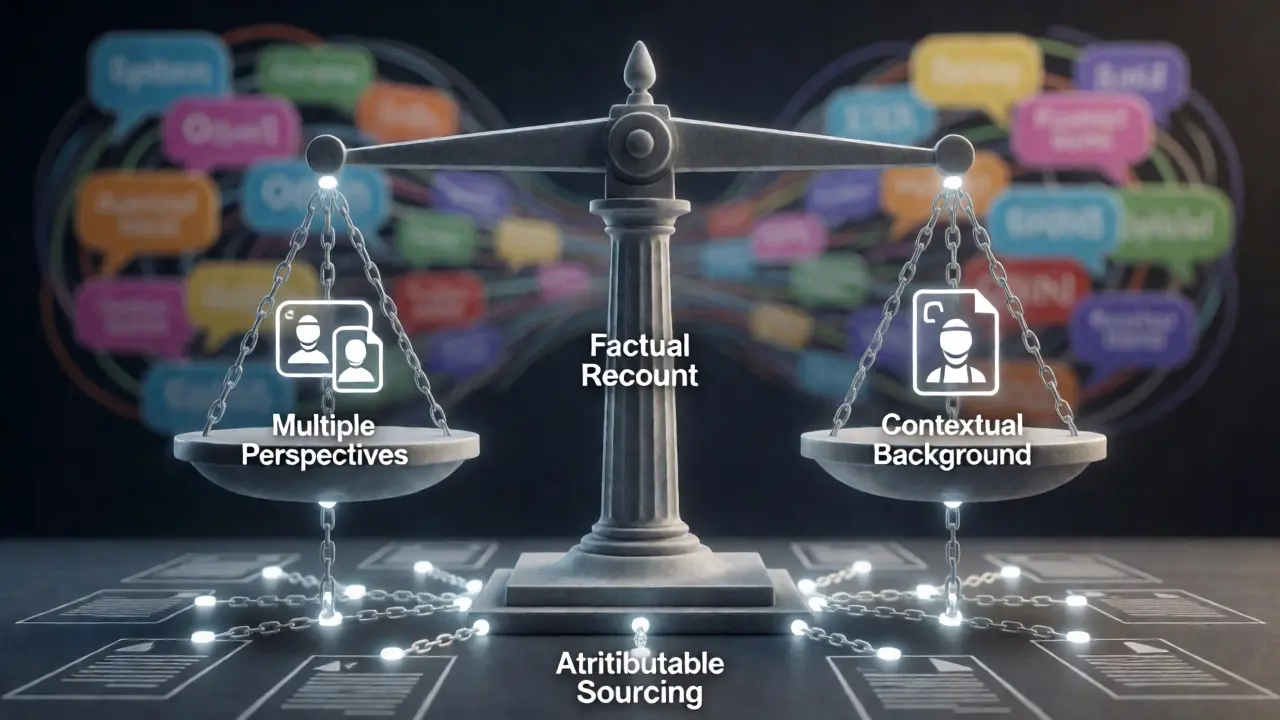
The body of the article follows a specific pattern:
- Factual Recount: What happened, when, and where, using neutral verbs like "stated" or "reported" instead of loaded terms like "claimed" or "admitted."
- Contextual Background: Relevant history provided without interpretation.
- Multiple Perspectives: Statements from all involved parties, presented in order of prominence or relevance, not preference.
- Sourcing: Inline citations linking to primary documents or reputable secondary reports.
This structure forces writers to separate observation from interpretation. For example, if a protest turns violent, the writer describes the actions-"police deployed tear gas," "demonstrators threw stones"-rather than labeling the group "rioters" or "freedom fighters." Those labels carry emotional baggage that NPOV strips away.
The Challenge of Bias in Selection
Critics often argue that true neutrality is impossible. Even choosing which story to cover introduces bias. Why report on this election and not that local council meeting? Wikinews addresses this through community-driven topic selection. Editors vote on what gets featured, aiming for broad interest rather than niche ideological appeal. However, the volunteer nature means certain regions or languages may be overrepresented depending on who is active at the time.
Bias also creeps in through word choice. The phrase "terrorist attack" versus "militant operation" can shift reader perception instantly. Wikinews style guides encourage using terms preferred by the subjects themselves or neutral international bodies like the UN, whenever possible. When no consensus exists, the term most widely used in reliable English-language media is chosen, with footnotes explaining alternatives.
Comparing Editorial Approaches
To understand where Wikinews fits, look at how different models handle conflict reporting. Below is a comparison of common approaches found in digital media today.
| Feature | Traditional Investigative Journalism | Opinion-Driven Media | Wikinews (NPOV Model) |
|---|---|---|---|
| Primary Goal | Uncover truth/conclusion | Persuade audience | Report verifiable facts |
| Handling Controversy | Evidence-based verdict | Advocates one side | Presents all significant views proportionally |
| Source Transparency | Often confidential sources | Selective citation | Mandatory public links |
| Writer Role | Expert interpreter | Commentator | Curator of information |
| Reader Effort | Low (guided narrative) | Low (reinforces beliefs) | High (requires verification) |
This table highlights the trade-offs. Wikinews demands more effort from readers because it doesn’t hand them a conclusion. In exchange, it offers higher resistance to manipulation. If you want to know what actually happened, not what someone wants you to think happened, this model shines.
Community Governance and Quality Control
Who decides if an article meets NPOV standards? At Wikinews, it’s the community. Articles undergo peer review before publication. Users flag biased language or missing sources. Disputes are resolved through discussion pages attached to each article. This mirrors the process used on Wikipedia, but adapted for the faster pace of news.
Because news decays quickly, the review window is shorter. An article about a breaking earthquake must be checked for accuracy and neutrality within hours, not days. This creates tension. Speed often compromises depth. To mitigate this, editors prioritize high-impact events where multiple independent sources confirm details. Single-source stories are often held back until corroboration appears.
Volunteer editors come from diverse backgrounds, which helps counteract individual biases. A European editor might catch assumptions a US editor misses, and vice versa. This diversity acts as a natural check against cultural blind spots.

Practical Tips for Reading NPOV Content
If you’re new to this style, it can feel dry or incomplete. Here’s how to get the most out of it:
- Follow the Links: Don’t just read the text. Click the citations. See if the original source supports the summary. This builds your own critical thinking muscles.
- Check Talk Pages: Look for discussions on the article’s talk page. These often reveal disagreements about wording or context that didn’t make it into the final text.
- Compare Outlets: Read the same story on Wikinews and a major newspaper. Notice what details the newspaper emphasizes or omits compared to the neutral report.
- Watch for Passive Voice: Sometimes, avoiding blame leads to passive constructions like "mistakes were made." Recognize this as a stylistic choice, not necessarily evasion.
These steps transform reading from a passive activity into an analytical exercise. You become less reliant on the journalist’s framing and more confident in your own assessment.
Limitations and Criticisms
No system is perfect. Wikinews faces valid criticisms. Some argue that strict neutrality can obscure moral realities. Describing a genocide neutrally might feel emotionally detached. Others point out that "significant views" are subjective. Who decides what counts as significant? Usually, it’s the dominant media narrative, which can reinforce existing power structures.
Additionally, the reliance on other media for sourcing means Wikinews inherits their biases. If all major newspapers frame a protest as "violent," Wikinews likely will too, even if eyewitness accounts suggest otherwise. It aggregates rather than investigates deeply. This makes it excellent for factual summaries but weaker for uncovering hidden truths requiring exclusive access.
Why NPOV Matters in the Age of AI
As artificial intelligence generates more content, distinguishing human-curated neutrality from algorithmic bias becomes crucial. Large Language Models often mimic the tone of their training data, which includes opinion-heavy news. Wikinews provides a dataset of explicitly neutral writing, useful for training AI to summarize events without hallucinating conclusions. For humans, it serves as a benchmark for what unbiased reporting looks like in practice, offering a contrast to the increasingly polarized media landscape.
Is Wikinews completely free of bias?
No publication is entirely free of bias. Wikinews minimizes it through strict adherence to Neutral Point of View guidelines, requiring proportional representation of significant viewpoints and mandatory sourcing. However, biases can still enter through story selection, word choice, and the inherent limitations of relying on external sources for verification.
How does Wikinews differ from Wikipedia?
While both are Wikimedia projects using similar collaborative editing models, Wikipedia focuses on encyclopedic knowledge with a long-term perspective, while Wikinews covers current events with a focus on immediacy. Wikipedia articles evolve slowly; Wikinews articles capture moments in time and are often archived after a period, serving as historical records of daily news.
Can I trust the sources cited on Wikinews?
Wikinews requires reliable sources, typically established news organizations, government reports, or academic publications. However, since these sources may have their own biases, it is best practice to click through to the original citation. This allows you to assess the credibility of the underlying information yourself.
What happens if there is only one side to a story?
If a story involves a clear fact with no legitimate dispute (e.g., a scheduled train delay), Wikinews reports it directly. If a controversy exists but one side refuses to comment or provide evidence, the article will note this absence. Neutrality does not mean inventing a counter-argument where none exists; it means accurately reflecting the available evidence and statements.
Who writes for Wikinews?
Articles are written by volunteer contributors from around the world. These individuals range from students and retirees to professional journalists. All contributions are subject to community review to ensure they meet the project's quality and neutrality standards before being published.