Imagine a major political scandal breaks at 2:00 PM. By 3:00 PM, three different newspapers have published contradictory accounts. One says the leader resigned; another claims it was a temporary suspension; a third reports no change in status. Where do you go for the truth? Many people instinctively open Wikipedia is a free, web-based collaborative project that aims to compile and summarize knowledge from around the world under a free license or public domain. But how does an encyclopedia handle chaos when facts are still shifting?
The answer isn't magic-it's a rigid set of community rules, automated tools, and a culture of skepticism. Wikipedia doesn't try to be first; it tries to be right. Here’s how the machine works when the ground is shaking.
The Core Problem: Speed vs. Accuracy
In traditional journalism, editors gatekeep information before it reaches readers. On Wikipedia, anyone can edit. This openness is its greatest strength but also its biggest vulnerability during breaking news is events that are currently happening or have just happened, where facts are not yet fully established or verified. The central conflict is simple: speed creates errors, and accuracy takes time.
When a story breaks, the first edits are often frantic. Users rush to add details based on tweets, press releases, or early TV segments. These edits frequently lack citations. Without a source, a statement is just an opinion. The community’s primary defense against this noise is the principle of Neutral Point of View (NPOV) is a policy on Wikipedia that requires articles to present significant viewpoints fairly, proportionately, and with as little bias as possible. NPOV doesn’t mean “no opinion”; it means every claim must be backed by a reliable source that reflects a significant viewpoint.
The Role of Reliable Sources
Not all sources are created equal. Wikipedia has a hierarchy of reliability. For breaking news, the gold standard is Independent Journalism is news reporting from organizations that are not directly involved in the event, such as major wire services or established newspapers. Agencies like Reuters, Associated Press, and BBC are considered highly reliable because they have fact-checking processes and editorial standards.
However, even these sources can conflict. If Reuters says “arrested” and CNN says “detained,” which one wins? Neither, initially. The editor must find a third, more authoritative source or wait until the legal status is clarified. This is where the concept of Consensus is the process by which Wikipedia editors reach agreement on article content through discussion and compromise rather than voting comes into play. Editors discuss on the talk page, compare sources, and agree on the most defensible wording. If consensus can’t be reached quickly, the article might revert to a safer, more general statement until clarity emerges.
Tools That Keep Order: Templates and Tags
You’ve probably seen yellow boxes on Wikipedia pages. These aren’t decorations; they’re warning signs. The most common is the Citation Needed Tag is a template used to mark statements that lack a reliable source, prompting editors to provide evidence. When a new fact appears without a link to a newspaper article, a user places this tag. It acts as a flag saying, “This hasn’t been proven yet.”
Another critical tool is the Disputed Template is a notice placed on sections of an article where editors disagree about the content or its sourcing. If two editors keep changing a sentence back and forth, they place this tag to freeze the section temporarily while they debate on the talk page. This prevents what’s known as an Edit War is a conflict between editors who repeatedly undo each other’s changes without reaching a consensus. Edit wars drain community energy and can lead to reverts that lose valuable context. The goal is always to stop the war and start a conversation.
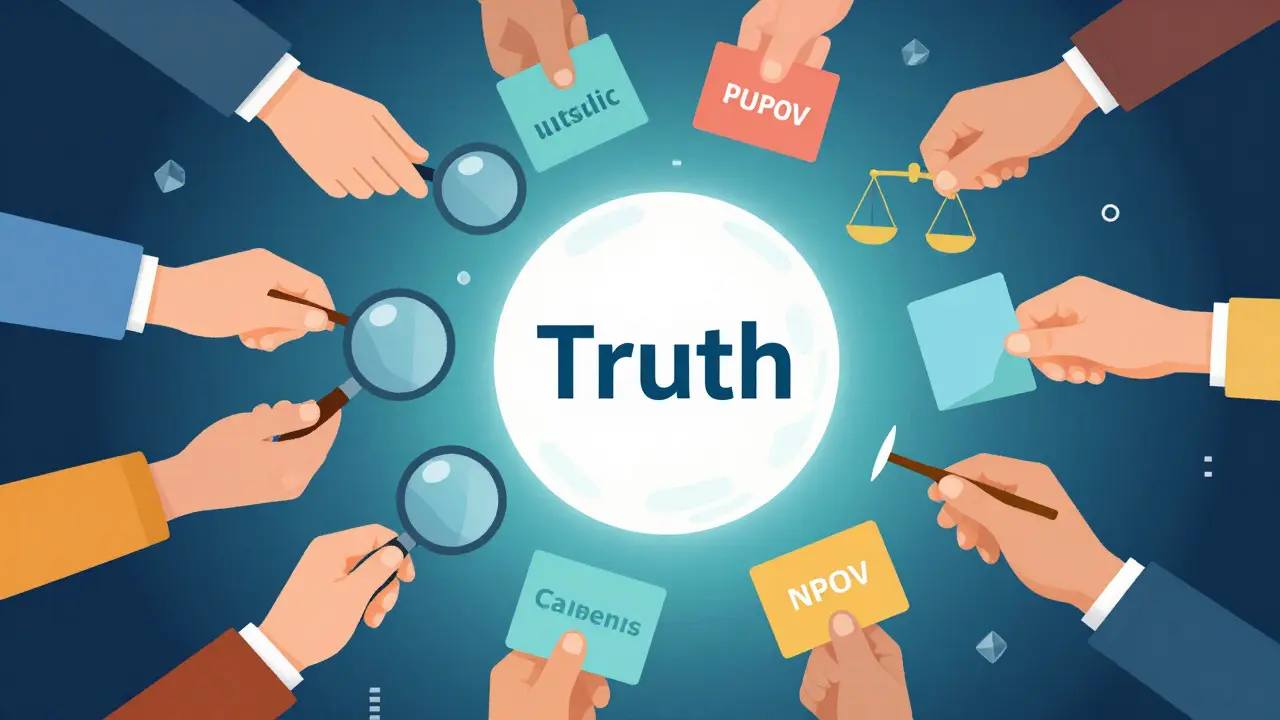
The Process of Verification
Here’s a step-by-step look at how a conflicting report gets resolved:
- Detection: A user adds a new claim based on Source A. Another user notices Source B contradicts it.
- Tagging: The second user adds a “Disputed” or “Citation Needed” tag to the specific paragraph.
- Discussion: Both users move to the article’s talk page. They post links to their respective sources.
- Evaluation: The community evaluates the reliability of both sources. Is Source A a blog? Is Source B a major wire service? Usually, the more independent and established source wins.
- Revision: The article is rewritten to reflect the consensus. If the facts are still unclear, the text is softened (e.g., changing “was fired” to “is reported to have left his position”).
- Stabilization: Once the facts settle, the tags are removed, and the article becomes stable again.
This process can take hours or days. During this time, the article may seem incomplete or cautious. That’s intentional. It’s better to say less than to say something wrong.
Comparison: Wikipedia vs. Traditional News
To understand why Wikipedia handles conflicts differently, let’s compare it to a traditional news outlet.
| Feature | Wikipedia | Traditional News Outlet |
|---|---|---|
| Primary Goal | Accuracy over time | Speed and exclusivity |
| Decision Maker | Community consensus | Editorial board / Editor-in-Chief |
| Error Correction | Public revision history | Correction column or update |
| Source Hierarchy | Openly debated per article | Fixed internal standards |
| Transparency | High (all edits visible) | Moderate (editorial decisions hidden) |
Notice that Wikipedia’s transparency is a double-edged sword. You can see exactly who changed what and why. In traditional media, you only see the final product. This makes Wikipedia easier to audit but harder to read if you’re not familiar with the editing conventions.
Pitfalls to Avoid for Readers
If you’re using Wikipedia during a breaking story, keep these pitfalls in mind:
- Don’t trust the lead summary blindly. The top of the page summarizes the current state. If the story is evolving, the summary might lag behind the detailed sections.
- Check the talk page. If there’s a big dispute, the talk page will tell you what’s being argued. It’s often more informative than the article itself during crises.
- Look for recent updates. Use the “History” tab to see when the last significant change was made. If the last edit was 10 minutes ago, expect more changes soon.
- Beware of fan sites. Sometimes, editors with strong personal biases (like sports fans or political activists) push their narrative. Check the sources they cite-if they’re citing blogs or social media, be skeptical.
Why This Matters for Knowledge Integrity
Wikipedia isn’t just a reference book; it’s a living document of human knowledge. Its ability to navigate conflicting reports sets a precedent for how digital communities manage truth. The system relies on collective intelligence rather than individual authority. It assumes that given enough eyes, errors will be found and fixed. This model has survived decades of criticism, proving that structured collaboration can outperform isolated expertise in dynamic environments.
For researchers, students, and curious minds, understanding this process helps you use Wikipedia more effectively. You stop seeing it as a static database and start seeing it as a real-time negotiation of facts. And in a world where misinformation spreads faster than verification, that skill is invaluable.
Is Wikipedia accurate during breaking news?
It is generally accurate but often cautious. Because it relies on consensus and reliable sources, it may lag behind immediate news feeds. However, once the facts stabilize, it tends to be more comprehensive and balanced than single-source news reports.
What is an edit war on Wikipedia?
An edit war occurs when two or more editors repeatedly undo each other’s changes without discussing the issue first. It disrupts the article’s stability and usually leads to administrative intervention or a mandatory discussion period.
How do I know if a Wikipedia article is up-to-date?
Check the “Last edited” timestamp at the bottom of the page or in the sidebar. Also, look for “Breaking news” banners or “Disputed” tags, which indicate that the content is still being actively revised.
Can anyone edit a breaking news article?
Yes, any registered or anonymous user can edit. However, experienced editors often monitor high-traffic articles closely and may lock them temporarily if vandalism or severe conflict arises.
Why does Wikipedia prefer wire services over social media?
Wire services like AP and Reuters have professional fact-checking teams and legal liability for errors. Social media posts are often unverified, ephemeral, and prone to bias. Wikipedia’s policies prioritize sources with established editorial standards.