The Core Philosophy: NPOV
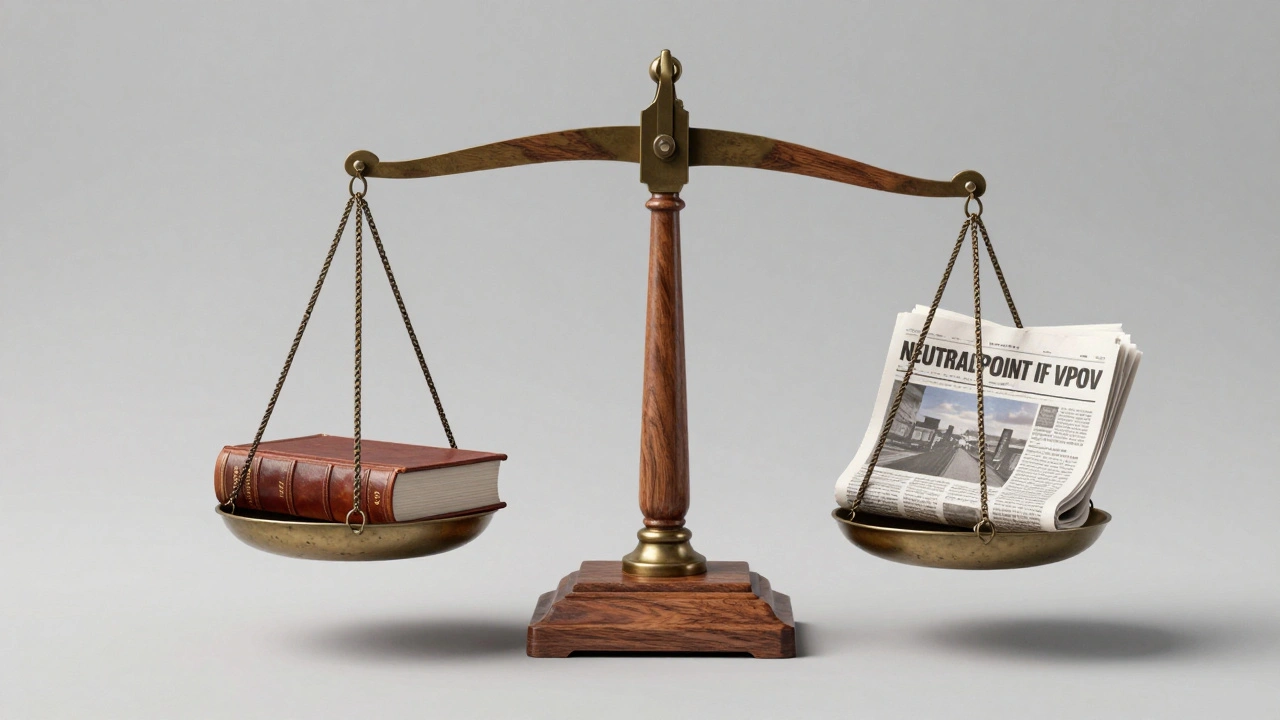
Before looking at the mechanics, you have to understand Neutral Point of View (or NPOV) is the foundational policy that requires articles to be written neutrally, presenting all significant views fairly and without bias. In the world of Wikipedia sourcing, NPOV means the editor's job isn't to decide who is right, but to report what the reliable sources say. If a high-quality academic journal and a well-regarded newspaper clash, the editor shouldn't pick a favorite. Instead, they write: "Sources disagree on the date; Source A claims 1920, while Source B claims 1922." This shifts the article from a statement of fact to a report on the state of the literature.
Defining the 'Reliable Source' Hierarchy
Not all sources are created equal. To resolve conflicts, editors use a mental (and documented) hierarchy of reliability. A peer-reviewed paper in Nature generally carries more weight than a local news report, which in turn beats a press release from a company. This is where the Verifiability policy comes in. This policy states that information must be attributable to a reliable source, regardless of whether the information is actually true. The focus is on the *source*, not the *truth*.
| Source Type | Weight | Typical Use Case |
|---|---|---|
| Peer-Reviewed Journals | Very High | Scientific data, academic consensus |
| Major National News (e.g., NYT, BBC) | High | Current events, biographical facts |
| Specialized Books/Monographs | Medium-High | Deep historical analysis |
| Local Press / Niche Blogs | Medium-Low | Hyper-local events, early reports |
| Self-Published/Press Releases | Low/None | Usually ignored unless quoted |
The Process of Resolving a Conflict
When two editors clash over which source to trust, they don't just keep hitting the 'undo' button in an edit war. There is a structured escalation path to stop the cycle. First, they move to the Talk Page, which is the behind-the-scenes discussion forum attached to every article where editors debate changes. Here, they share links and argue why one source is more credible than another. If the debate hits a wall, they might use a "Request for Comment" (RFC) to bring in more experienced editors from across the community to vote or provide guidance.
If the disagreement is fundamentally about the nature of the topic-like a political or religious dispute-the community uses a process called Consensus. Consensus isn't a simple majority vote; it's a process of moving toward a version of the text that the most people can live with, even if they don't love it. This often results in the "Both Sides" approach, where the article explicitly mentions the conflicting viewpoints to maintain neutrality.

Dealing with the 'Weight' of Sources
A common pitfall is giving equal space to opposing views when one view is overwhelmingly dominant. This is called "False Balance." For example, if 99% of scientists agree on a fact and 1% disagree, Wikipedia won't give them 50/50 space. The Due Weight principle requires that the proportion of the article dedicated to a view reflects the proportion of support it has among reliable sources. If a conflict exists but one side is clearly more substantiated, the article will lead with the dominant view and mention the minority view as a secondary point.
The Role of Administrators and Arbitration
Sometimes, the Talk Page becomes a battlefield. When a conflict turns toxic or an edit war persists, Wikipedia Administrators step in. These are users with special technical tools who can lock a page (protection) to prevent further edits until a resolution is reached. However, admins don't usually decide the *content* of the article; they manage the *behavior* of the editors.
For the truly unsolvable disputes, there is the Arbitration Committee (ArbCom). This is essentially the Supreme Court of Wikipedia. They don't rule on whether a source is right or wrong, but rather on whether the editors are following the site's policies. If an editor keeps ignoring the consensus or harassing others over a source conflict, ArbCom can ban them from editing specific topics or the entire site.

Practical Examples of Conflict Resolution
Think about a page for a controversial politician. One source (a government report) says they spent $1 million on a project, while another (an investigative journal) says they spent $5 million. In this case, the editor will likely write: "Government records indicate a spend of $1 million, although an investigation by [Journal Name] suggests the figure was closer to $5 million." By doing this, the editor avoids the trap of picking a side and instead provides the reader with the evidence from both reliable sources. This preserves the integrity of the entry and protects the editor from accusations of bias.
What happens if two sources are equally reliable but contradict each other?
In this scenario, Wikipedia follows the Neutral Point of View (NPOV) policy. Instead of choosing one, the article will state that there is a conflict among reliable sources and present both perspectives. The goal is to document the disagreement rather than resolve it.
Can an editor just delete information they think is wrong?
Generally, no. If the information is backed by a reliable source, deleting it without a strong policy-based reason is considered 'vandalism' or a violation of the consensus. Editors are encouraged to discuss changes on the Talk page first.
Who decides what counts as a 'reliable source'?
Reliability is determined by community consensus based on the general standards of scholarship and journalism. Peer-reviewed academic sources are the gold standard, followed by established news organizations with a history of fact-checking.
Does Wikipedia believe the most recent source is always the best?
Not necessarily. While timeliness is important for current events, for historical or scientific facts, a comprehensive book or a peer-reviewed study from ten years ago might be more reliable than a breaking news tweet from today.
What is an 'edit war' and how is it stopped?
An edit war occurs when two or more editors repeatedly undo each other's changes. It is stopped when a third party intervenes or when administrators protect the page, forcing the editors to resolve the dispute on the Talk page.
Next Steps for New Contributors
If you've found a conflict in an article and want to help, don't just change the text. Start by checking the citations. Are they both really "reliable"? If they are, go to the Talk page and politely point out the discrepancy. Suggest a wording that acknowledges both sources. If you're new, avoid the most controversial pages-often called "protected" or "semi-protected" pages-until you've got a feel for how the community handles the NPOV and Verifiability rules. The best way to learn is to watch an ongoing discussion on a Talk page and see how the consensus is built over time.