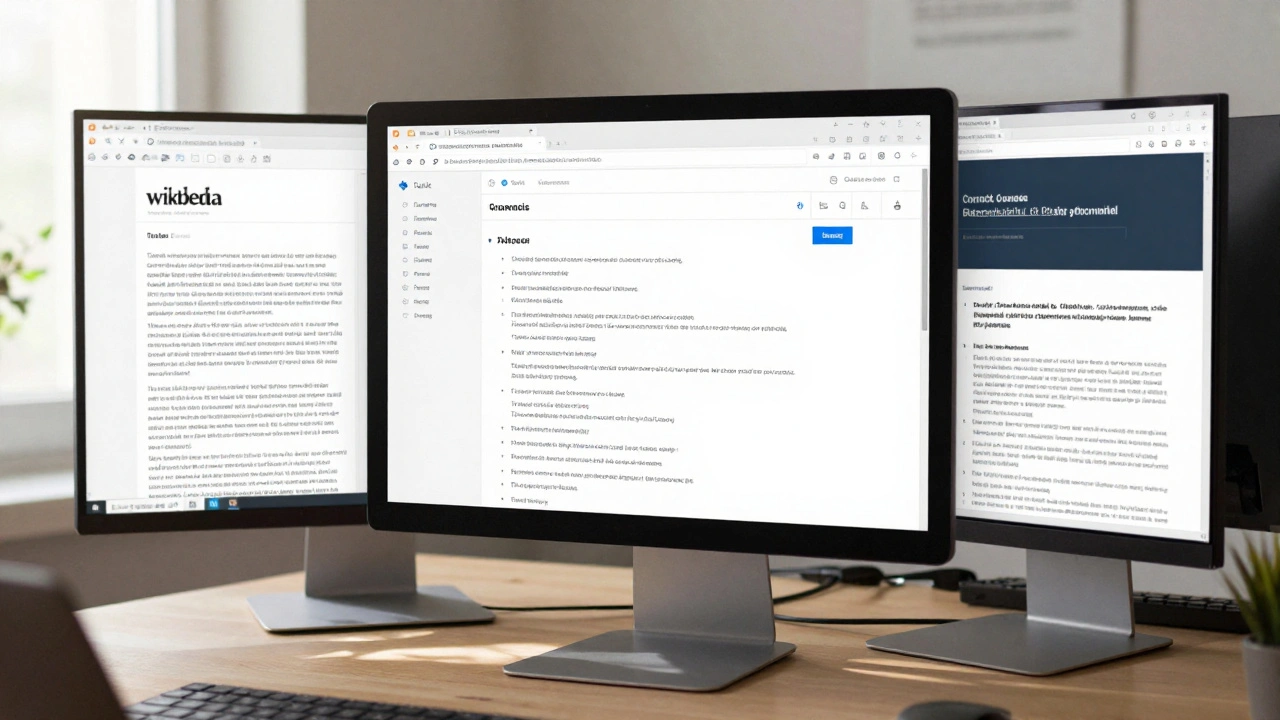
Ever wonder how Wikipedia stays accurate when thousands of people are editing the same article at once? It’s not magic. It’s not a single editor in charge. It’s editorial consensus-a quiet, messy, and surprisingly effective system built on rules, patience, and real human conversation.
What Editorial Consensus Actually Means
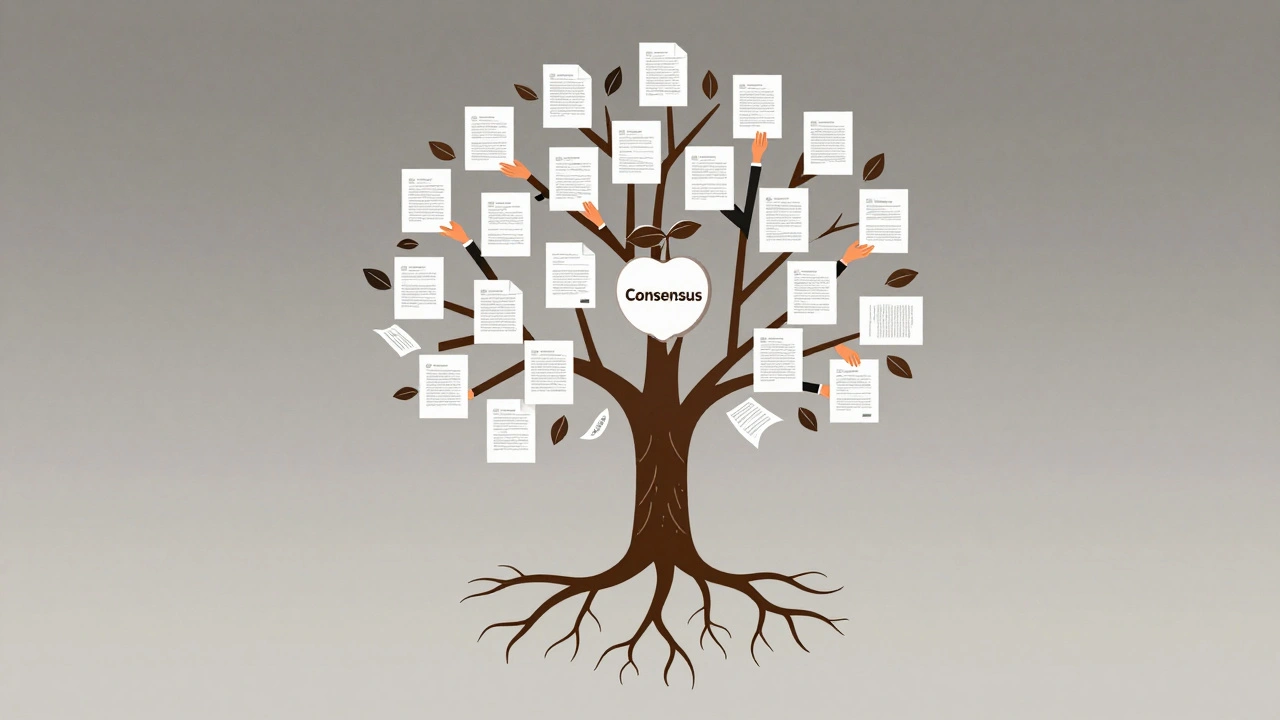
Editorial consensus on Wikipedia isn’t a vote. It’s not a majority rule. It’s not even a formal decision. It’s the point where enough editors agree-without needing to argue anymore-that a change is fair, well-sourced, and follows Wikipedia’s core policies. Think of it like neighbors deciding whether to install a new fence: no one has to say "yes" out loud, but if no one objects for weeks, and everyone’s been talking it through, the fence goes up.
Wikipedia’s policies-like Neutral Point of View, Verifiability, and No Original Research-are the foundation. Editors don’t just argue about facts; they argue about how to present them fairly. A claim like "X causes Y" isn’t accepted just because someone says so. It needs a reliable source. And if two editors can’t agree on which source is better, the discussion doesn’t end. It moves to the article’s talk page.
Where Disagreements Play Out: The Talk Page
Every Wikipedia article has a companion talk page. This is where the real work happens. That’s where editors post their concerns, cite sources, ask questions, and try to find common ground. You won’t see this unless you click "Talk" at the top of the page. Most readers never see it. But it’s where consensus is built-or broken.
Let’s say someone edits a page about climate change and removes a paragraph citing a peer-reviewed study. Another editor reverts it. Instead of a back-and-forth edit war, they leave a comment on the talk page: "I removed this because the study was retracted in 2023. Here’s the retraction notice: [link]." The first editor checks the link, sees it’s valid, and says, "You’re right. I’ll update the wording to reflect that." That’s consensus in action.
Not every dispute ends that cleanly. Sometimes, editors disagree on interpretation. One might say a source is "not reliable enough." Another says it’s "the best we have." That’s when the conversation gets longer. More editors join in. They bring in more sources. They quote policy. They wait. And if no one can prove their version is clearly better, the status quo often holds.
The Role of Policies: Not Rules, But Guidelines
Wikipedia doesn’t have laws. It has policies-and they’re flexible. The key is that they’re not arbitrary. They’re the result of years of debate, documented in hundreds of pages of community discussion. For example, the Verifiability policy doesn’t say "only use academic journals." It says: "Material challenged or likely to be challenged must be attributed to a reliable, published source."
That means a newspaper article can be enough for a fact about a local election. A blog post? Not usually. But if five independent bloggers with track records in journalism all report the same thing-and no credible source contradicts them-it might be acceptable. The policy guides, but doesn’t dictate. The editors decide.
When editors cite policy, they’re not trying to win. They’re trying to align. If someone says, "This violates Neutral Point of View," they’re expected to show how. Not just "it’s biased," but "this wording implies guilt without evidence, and the source doesn’t support that tone." That kind of specificity turns emotion into evidence.
When Consensus Breaks Down: Mediation and Arbitration
Not every disagreement ends with a polite talk page exchange. Sometimes, it gets heated. Personal attacks creep in. Editors stop listening. That’s when Wikipedia’s formal dispute resolution kicks in.
First comes mediation. A neutral third-party editor-someone with no stake in the topic-steps in. They don’t decide who’s right. They help both sides reframe their arguments, find common ground, and draft a compromise version. Mediators are volunteers, trained by the community, and they’re respected because they’re seen as fair, not powerful.
If mediation fails, the case can go to Arbitration Committee (ArbCom). This is Wikipedia’s last resort. A small group of experienced editors reviews months of talk page archives, edit histories, and policy violations. They issue binding rulings. They can block users. They can restrict editing on an article. They’ve even banned entire sockpuppet networks.
ArbCom doesn’t handle every dispute. Only the worst ones. In 2024, they closed 127 cases out of over 300 requests. Most never reach this stage. And that’s by design. The system is built to solve problems at the lowest level possible.
Why This System Works-And Why It Doesn’t
Wikipedia’s consensus model works because it’s transparent. Everything is public. You can see every edit, every comment, every policy citation. That transparency builds trust. If you’re skeptical of a claim, you can dig into the history yourself.
It also works because editors care. Most aren’t paid. They’re students, retirees, scientists, librarians. They edit because they believe in the mission: a free, accurate, collaboratively built encyclopedia. They want the article to be right-not to "win."
But it’s not perfect. Small groups can dominate. Niche topics-like obscure video games or local history-often get edited by just a handful of people. If those people agree on a skewed version, consensus can become bias. Wikipedia’s coverage of women in science, for example, was historically thin because most early editors were men, and they focused on topics they knew.
That’s why initiatives like "WikiProject Women in Red" exist-to fix those gaps. The system self-corrects, but slowly. It needs nudges.
What Happens When a Source Is Disputed?
One of the most common flashpoints is a source. Someone adds a quote from a right-wing blog. Another editor removes it. Why? Because Wikipedia requires reliable sources. But what counts as reliable?
Wikipedia doesn’t list approved websites. Instead, it evaluates sources based on reputation, fact-checking, editorial standards, and independence. A peer-reviewed journal? High reliability. A corporate press release? Low. A mainstream newspaper? Usually high, unless it’s known for sensationalism.
If a source is controversial-say, a think tank with political ties-editors will ask: "Has this source been cited by other reliable outlets?" "Is it peer-reviewed?" "Does it have a history of distortion?" If the answer is no, the source gets flagged. Not deleted. Flagged. And then the discussion begins.
In 2023, a major update to the "Reliable Sources" guideline clarified that think tanks can be used-but only if they’re transparent about funding and methodology. That change came after months of discussion across dozens of articles.
How New Editors Fit In
Newcomers often feel intimidated. They make a simple edit-fix a typo, add a date-and get reverted. They’re told to "read the policies." It feels hostile.
But here’s the truth: most reverts aren’t personal. They’re about protecting the article’s integrity. The best way for a new editor to contribute is to start small. Fix a broken link. Add a citation from a book you have. Then, if you want to make a bigger change, talk first. Leave a comment on the talk page. Say: "I noticed this section might need an update. Here’s a source I found. What do others think?"
Wikipedia rewards patience. It doesn’t reward speed. The most trusted editors aren’t the ones who make the most edits. They’re the ones who listen, cite sources, and help others understand the system.
What You Can Do
You don’t need to be an expert to help. If you see a page with a broken link, fix it. If you know a fact that’s missing-like a scientist’s correct title or a date that’s wrong-add it with a source. If you’re unsure, ask on the talk page. Most editors will help you learn.
Wikipedia’s strength isn’t in perfection. It’s in the process. It’s in the way a disagreement between two strangers in Tokyo and Toronto can lead to a better, more accurate article for everyone. That’s editorial consensus: not a battle, but a conversation that never really ends.
Is Wikipedia’s editorial consensus system democratic?
No, it’s not a vote. Consensus means editors reach agreement through discussion, evidence, and policy-not by counting heads. One well-reasoned argument from a long-time editor can outweigh ten emotional posts from newcomers. The goal is accuracy, not popularity.
Can anyone change any Wikipedia article?
Yes, anyone can edit most articles. But edits can be reverted if they violate policies like neutrality or verifiability. Some high-profile or frequently vandalized pages are protected-meaning only experienced editors can change them. That’s not censorship. It’s damage control.
What happens if two editors can’t agree on a fact?
If they can’t resolve it on the talk page, they can request mediation. A neutral third party helps them find common ground. If that fails, the case can go to the Arbitration Committee. But most disagreements are settled before that stage-with better sources, clearer wording, or a compromise edit.
Are Wikipedia’s policies the same worldwide?
Yes. Wikipedia’s core policies-like Neutral Point of View and Verifiability-are applied globally. But local context matters. A source that’s reliable in the U.S. might not be in India. Editors consider regional norms, but the policies remain consistent. The goal is global accuracy, not local bias.
Why do some Wikipedia articles look biased?
Because consensus isn’t perfect. If a small group of editors with similar views dominates a topic, their perspective can become the default. That’s why Wikipedia has projects like WikiProject Countering Systemic Bias-they actively work to fix gaps in coverage, especially for underrepresented groups and topics.
How long does it take to build consensus on a Wikipedia article?
It can take hours, weeks, or even years. Simple edits-like fixing a typo-happen instantly. Complex topics, like climate science or political history, can take months of discussion. Some articles are still being refined after a decade. Consensus isn’t fast. But when it happens, it’s durable.
What Comes Next
If you’re curious about how Wikipedia works under the hood, start by visiting the talk page of any article you use often. Look at the edit history. See how changes were discussed. You might be surprised by how much thought goes into what seems like a simple sentence.
Wikipedia isn’t flawless. But it’s one of the few places on the internet where strangers come together-not to argue, but to build something better. And that’s worth understanding.