Most people think Wikipedia is a free online encyclopedia that anyone can edit just means anyone can post anything. But there is a hidden layer of quality control that separates the good entries from the great ones. It’s called the Featured Article program. This isn’t just a badge for show; it represents the highest standard of writing, accuracy, and neutrality on the platform. Understanding how these articles get reviewed and promoted reveals the real engine behind reliable information.
You might have seen the small star icon next to certain article titles. That star signals that the piece has passed a rigorous peer-review process. It’s not an algorithm doing this work. Real humans-volunteers with deep subject knowledge-read every word. They check citations, debate interpretations, and enforce strict editorial guidelines. If you want to understand how open-source knowledge maintains credibility, you need to look at the mechanics of this promotion system.
The Core Criteria for Excellence
Before an article even enters the review queue, it must meet specific benchmarks. These aren't vague suggestions; they are hard rules defined in the Featured Article criteria. An article must be well-written, neutral, verifiable, complete, stable, and illustrated. Let’s break down what those terms actually mean in practice.
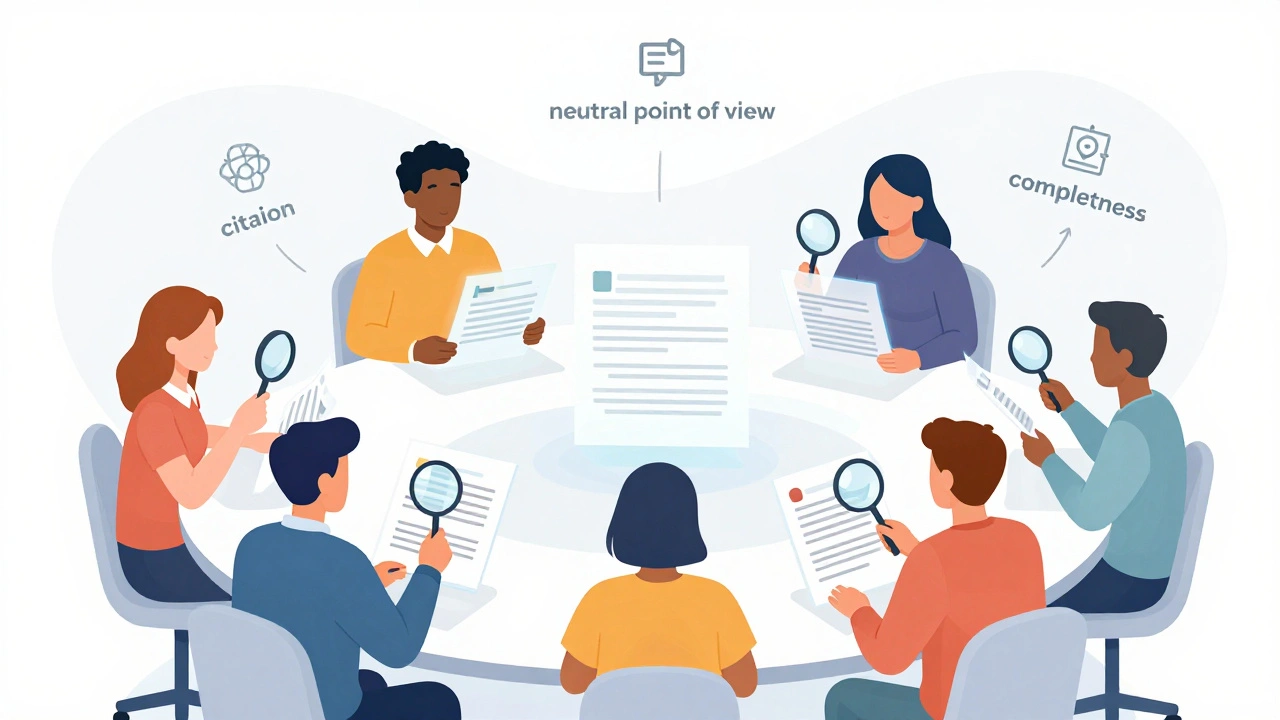
First, "well-written" means more than just correct grammar. The prose needs to flow logically. Sentences should connect smoothly, avoiding jargon unless it is clearly explained. Editors look for encyclopedic tone-not too dry, but definitely not conversational or promotional. Second, "neutral point of view" (NPOV) is non-negotiable. Every significant viewpoint on the topic must be represented fairly, without bias toward any one side. If an article about a controversial political figure only cites sources favorable to them, it fails immediately.
Verification is the backbone of trust. Every claim, no matter how obvious, needs a citation to a reliable source. Op-eds, blogs, and self-published material usually don’t cut it. Peer-reviewed journals, major news outlets, and established books are preferred. Completeness means covering all major aspects of the topic. You can’t write a Featured Article about the French Revolution and ignore the role of the bourgeoisie. Stability ensures the article isn’t under active dispute or constant editing wars. Finally, illustrations help visualize complex ideas, provided they have proper licensing and captions.
The Nomination Process: Starting the Journey
So, how does an article get into the spotlight? It starts with a nomination. Any editor can nominate an article, but usually, the authors themselves do it after months of refinement. Before nominating, most editors send their draft to the Article Feedback Tool or request a Peer Review. This pre-screening step catches obvious errors early. It saves everyone time because the formal review board doesn’t have time to fix basic formatting issues.
Once ready, the editor posts the nomination on the Featured Article Candidates page. This is a public forum where other volunteers can comment. The nomination stays here for at least two weeks. During this period, reviewers leave comments like "Citation needed," "This section feels biased," or "Great job on the introduction." The author responds to each comment, making changes or explaining why a change isn’t necessary. It’s a dialogue, not a monologue. If the feedback is positive, the discussion moves forward. If there are unresolved issues, the nomination might be stalled or declined.
The Review Board: Who Decides?
After the initial candidate phase, if enough support is gathered, the article moves to the Featured Article Review (FAR). This is the final hurdle. The FAR is handled by a rotating group of experienced editors known as Reviewers. These aren’t employees of the Wikimedia Foundation. They are dedicated volunteers who have earned the right to make these decisions through years of consistent, high-quality contributions.
A reviewer will read the entire article, checking against the criteria list. They look for subtle biases, weak sourcing, or structural flaws that earlier reviewers missed. For example, a reviewer might notice that while the article cites many sources, none of them are primary sources for a key historical event. Or they might find that the lead paragraph summarizes the conclusion rather than introducing the topic. The reviewer leaves detailed comments. The author must address every single one. Ignoring a reviewer’s concern is a quick way to get rejected.
The decision isn’t always binary. Sometimes, an article is "promoted" with minor reservations. Other times, it’s "declined" with advice to try again later. This iterative process ensures that only the best content gets the star. It also builds community trust. When readers see a Featured Article, they know a team of experts has vetted it.
Common Pitfalls in the Promotion Path
Many nominations fail because authors misunderstand the expectations. Here are the most common reasons articles get rejected:
- Lack of Reliable Sources: Using personal websites, social media posts, or press releases as primary evidence. Wikipedia requires independent, third-party verification.
- Original Research: Synthesizing existing data to create new conclusions. Wikipedia reports what others have said; it doesn’t generate new theories.
- Promotional Tone: Writing about a company, person, or product like an advertisement. Words like "innovative," "leading," or "best" trigger immediate scrutiny unless backed by critical analysis from reliable sources.
- Incomplete Coverage: Missing major events, figures, or controversies related to the topic. A biography that ignores a subject’s legal troubles is incomplete.
- Copyright Violations: Copying text from another website or book. All content must be original writing based on sourced facts.
Avoiding these pitfalls requires discipline. Authors often need to step back and ask, "Would a skeptic accept this argument?" If the answer is no, more work is needed.
The Role of Community Consensus
Wikipedia operates on consensus, not authority. No single person, not even a founder, can force an article to become Featured. The community decides. This decentralized model has strengths and weaknesses. On the plus side, it prevents individual bias from dominating. On the minus side, it can be slow. Debates over interpretation can drag on for weeks. Different reviewers might have conflicting views on what constitutes "completeness."
To manage this, Wikipedia uses Consensus-building tools. Discuss pages allow structured arguments. Summaries help clarify positions. If a deadlock occurs, a Neutral Point of View dispute resolution process may be invoked. Experienced mediators step in to guide the conversation toward a compromise. This ensures that the final article reflects the broadest possible agreement among knowledgeable editors.

Maintaining Quality After Promotion
Becoming a Featured Article isn’t the end of the story. Standards change. New information emerges. Old sources become outdated. To keep up, Wikipedia has a demotion process. If a Featured Article deteriorates-say, due to vandalism or neglect-it can be removed from the list. Regular patrols monitor these articles. Editors also periodically revisit old Favorites to update them. This lifecycle management ensures that the "Featured" label remains meaningful over time.
This continuous improvement cycle is vital. It shows that Wikipedia isn’t static. It’s a living document that evolves with new knowledge. The review process isn’t just about gatekeeping; it’s about nurturing excellence. By setting high bars and providing clear paths to reach them, Wikipedia encourages contributors to produce their best work.
| Class | Quality Level | Review Process | Icon |
|---|---|---|---|
| Stub | Minimal | None | None |
| Good Article | High | Good Article Nomination | Green Star |
| Featured Article | Highest | Featured Article Review | Blue Star |
| List Article | Comprehensive List | List Article Review | Blue Star |
Why This Matters for Readers
For everyday users, understanding this process builds confidence. When you cite a Wikipedia article in school or work, knowing it’s a Featured Article adds weight to your reference. It signals that multiple experts have checked the facts. It reduces the risk of spreading misinformation. In an era of fake news, this transparent, community-driven verification system is a rare gem. It proves that collaboration, when guided by clear policies, can produce trustworthy knowledge.
Can I nominate my own article for Featured status?
Yes, you can. In fact, most Featured Articles are nominated by their primary authors. However, you must ensure the article meets all criteria before submitting. It’s highly recommended to get informal feedback first through the Article Feedback Tool or by asking colleagues in relevant WikiProjects.
How long does the Featured Article review process take?
The timeline varies. The initial candidate phase lasts at least two weeks. The final review phase can take anywhere from a few days to several months, depending on the complexity of the topic and the responsiveness of the author. Complex topics with many viewpoints often take longer.
What happens if my article is declined?
Declination isn’t permanent. Reviewers provide specific reasons for rejection. You can address these issues, improve the article, and nominate it again later. Many current Featured Articles were previously declined.
Who are the reviewers?
Reviewers are volunteer editors who have demonstrated expertise and adherence to Wikipedia policies. They are not paid employees. Their authority comes from community recognition of their judgment and experience.
Can a Featured Article lose its status?
Yes. If an article significantly degrades in quality, becomes outdated, or violates policies, it can be demoted. Regular maintenance helps prevent this, but vigilance is required from the community.