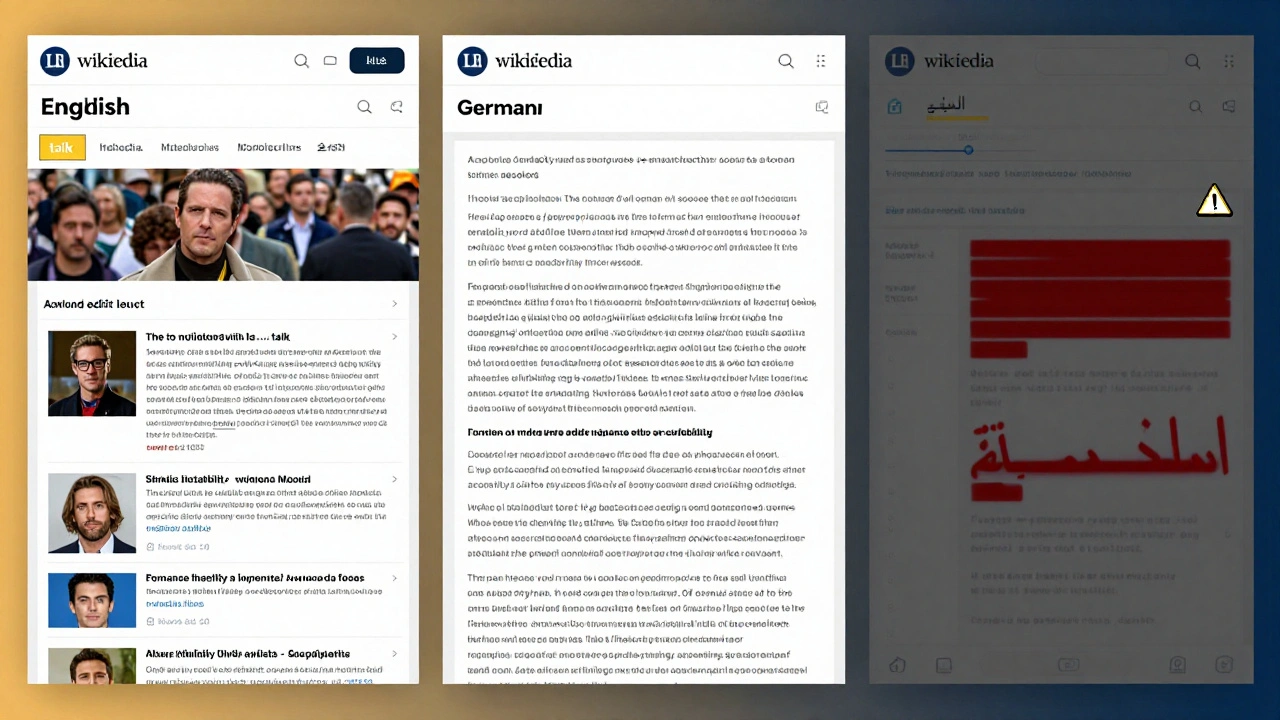
Wikipedia isn’t one website. It’s hundreds - each with its own rules, culture, and way of deciding what gets published. The English version might ban a certain type of opinion piece, but the Spanish version lets it through. The Japanese edition might require three independent sources for a claim, while the Russian edition accepts one if it’s from a trusted local outlet. These aren’t accidents. They’re the result of local policies evolving separately from global guidelines.
Wikipedia’s Structure: One Platform, Many Communities
Wikipedia runs on a single software platform, but every language edition operates like its own independent republic. The English Wikipedia has over 6 million articles. The Cebuano edition has over 10 million - but most are short bot-generated entries. The Arabic Wikipedia has fewer than 1 million, yet it’s one of the most strictly moderated. Why? Because each community decides for itself what matters.
There’s no central authority forcing uniformity. The Wikimedia Foundation sets basic technical rules - no ads, no paid editing, no hate speech - but beyond that, each language group writes its own policies. That means what’s allowed on Wikipedia changes drastically depending on whether you’re reading it in Bengali, German, or Swahili.
How Local Policies Form
Local policies don’t come from headquarters. They’re hammered out in discussion pages, edit wars, and community votes. Take the English Wikipedia’s notability guideline. To be included, a topic must have received significant coverage in independent, reliable sources. That sounds simple. But in practice, it’s messy. A small-town mayor might be notable in the U.S. if covered by three local newspapers. In India, the same person might need coverage in national media. In Nigeria, community recognition might count more than press coverage.
The German Wikipedia takes notability even further. It demands two independent, high-quality sources before even considering an article. That’s stricter than English. Why? Because German editors prioritize depth over volume. They’d rather have 100 well-researched articles than 10,000 shallow ones. This isn’t just preference - it’s a cultural value baked into their policy.
Meanwhile, the Chinese Wikipedia (which exists in simplified Chinese) avoids topics that could trigger censorship. Articles about Taiwan, Tibet, or historical events like Tiananmen Square are either heavily edited or deleted entirely. Not because of technical rules - but because editors there live under legal pressure. Their policy isn’t written in a handbook. It’s written in fear.
Global Rules vs. Local Reality
Wikipedia’s global rules are clear: no original research, no plagiarism, neutral point of view. But how you apply them? That’s local.
Take neutral point of view. In the English Wikipedia, neutrality means balancing opposing views. If 60% of scientists support climate change, you say that - then mention the 40% who don’t, with equal weight. In the French Wikipedia, neutrality means sticking to what’s widely accepted by experts. The minority view gets mentioned only if it’s academically credible - not just popular.
The Russian Wikipedia? It often reflects state narratives. Articles on Ukraine, NATO, or LGBTQ+ rights are rewritten to align with official positions. Editors there don’t see this as bias - they see it as accuracy. Their sources are state media. Their definition of "reliable" is different.
And then there’s citation. The English Wikipedia demands footnotes. The Vietnamese Wikipedia? It often uses inline references. The Korean Wikipedia sometimes accepts personal blogs if they’re from recognized experts. The Portuguese Wikipedia allows citations from academic journals in any language - as long as they’re peer-reviewed. The Arabic Wikipedia? It often relies on Arabic-language academic databases, which are less accessible to Western editors.
Who Gets to Decide?
Policy isn’t made by bots. It’s made by people - and those people aren’t evenly distributed.
English Wikipedia has over 100,000 active editors. The Indonesian edition has about 5,000. The Tamil edition? Around 300. That means decisions on the Tamil Wikipedia are made by a tiny, tight-knit group. If three editors agree that a topic isn’t notable, it’s gone. On English Wikipedia, it takes months of debate, dozens of edits, and sometimes a formal vote.
That’s why some language editions are more stable. The Japanese Wikipedia has a strong culture of consensus. Disputes are resolved quietly. The English edition? It’s a battleground. Every policy change triggers lawsuits in talk pages. That’s why English Wikipedia has 15 different guidelines on what counts as a reliable source. Other editions? One.
What Gets Deleted - And Why
Think about what you’ve read on Wikipedia. Maybe a celebrity’s page. Maybe a local landmark. Now imagine that same page on the Arabic Wikipedia.
In 2023, the English Wikipedia deleted over 80,000 articles for lack of notability. The Persian Wikipedia deleted 12,000 - but 7,000 of those were about Iranian musicians and poets. Why? Because the community there values cultural representation. They see those entries as vital. The English community sees them as obscure.
The Korean Wikipedia keeps articles on K-pop idols that the English version deletes. Why? Because in South Korea, K-pop is national culture. In the U.S., it’s entertainment. The difference isn’t about quality. It’s about relevance.
And then there’s images. The German Wikipedia bans all non-free images unless they’re absolutely necessary. The English Wikipedia allows them freely. The Hindi Wikipedia? It avoids images of religious figures altogether. Why? Because of cultural sensitivity. That’s not a global rule. It’s a local one.
The Hidden Cost of Fragmentation
This system works - but it’s not perfect. A fact that’s true on the English Wikipedia might be false on the Russian one. A person who’s notable in Brazil might not exist at all on the Chinese edition.
That’s why Wikipedia’s reliability varies. A student in Mexico City might cite Wikipedia for a school project, only to find that the English version contradicts the Spanish one. A researcher in Nigeria might struggle to find local history because the Hausa Wikipedia has only 500 articles - and most are incomplete.
Wikipedia’s greatest strength - decentralization - is also its biggest weakness. There’s no central fact-checker. No global audit. No way to force consistency. What you get is a mosaic of truths - each shaped by local history, politics, language, and culture.
What This Means for You
If you use Wikipedia for research, don’t assume all editions are the same. Check the language you’re most comfortable with - and if possible, compare it to others.
For example:
- If you’re researching climate change, compare the English, German, and Arabic editions. You’ll see how framing changes.
- If you’re studying gender equality, look at the Bengali, Swedish, and Arabic versions. The tone, sources, and emphasis will be wildly different.
- If you’re checking a historical event, cross-reference at least two language editions. You’ll often find gaps - or outright contradictions.
Wikipedia isn’t a single source. It’s a collection of hundreds of conversations - each happening in a different language, shaped by different values. Understanding that difference isn’t just useful. It’s essential.