Ever wonder how Wikipedia keeps its millions of pages accurate without a single editor checking every single change? The answer isn't magic; it's machine learning. While most people think of Wikipedia as a purely human-driven project, the backbone of its stability is actually a complex web of algorithms working silently in the background. These systems handle everything from catching vandalism to suggesting related articles, ensuring that the world's largest encyclopedia remains reliable despite having over 6 million editors contributing daily.
The relationship between Wikimedia Foundation and artificial intelligence has evolved significantly since the early 2010s. What started as simple regex scripts for formatting errors has grown into sophisticated neural networks capable of understanding context. For a user reading an article on quantum physics or the history of Rome, this technology is invisible. But for the infrastructure team, it is the critical layer that prevents chaos. If you've ever wondered why a bad edit gets reverted within minutes while a good one stays put, you're looking at the direct output of these models.
The Core Problem: Scale and Volatility
To understand why machine learning is necessary here, you have to look at the sheer volume of data. Wikipedia receives thousands of edits per hour. Not all of them are malicious, but many are careless. Some are typos, some are outdated facts, and some are outright vandalism. In the early days, this required armies of human volunteers to patrol recent changes. That model broke down when the site grew too large for humans to keep up with.
The core challenge isn't just speed; it's consistency. Human reviewers get tired, bored, or biased. An algorithm doesn't. It treats a typo in a biography the same way it treats a typo in a technical manual. This consistency is what allows Wikipedia to maintain its reputation for neutrality. Without automated assistance, the signal-to-noise ratio would drop so low that finding accurate information would become a lottery rather than a science.
Key Machine Learning Systems in Action
Several distinct systems run under the hood, each solving a specific part of the puzzle. They don't work in isolation; they form an ecosystem where one system's output often becomes another's input.
- ORES (Objective Revision Evaluation Service): This is perhaps the most visible tool. ORES predicts the probability that a given edit is "good" or "bad" before it even goes live. It uses features like the length of the diff, whether references were added, and the history of the editor. If an edit scores high on the "bad" scale, it might be flagged for review immediately. This reduces the burden on human patrollers by about 30% according to internal metrics.
- WikiTextDiff: This system focuses on detecting meaningful changes versus cosmetic ones. It helps distinguish between a substantive update to a fact and a simple reformatting of text. This is crucial for tracking the actual evolution of knowledge on the platform.
- Language Detection Models: With contributors from over 200 countries, language mixing is common. These models ensure that articles are tagged correctly, preventing a French paragraph from accidentally appearing in an English article due to a copy-paste error.
- Image Captioning and Tagging: When users upload images, ML models automatically suggest captions and tags. This improves searchability and helps visually impaired users access content through better alt-text descriptions.
How the Technology Works Under the Hood
You might assume these systems use massive, opaque deep learning models. In reality, the approach is more pragmatic. Many of the core tools rely on gradient boosting machines and linear classifiers because they are fast, interpretable, and require less computational power than huge neural networks. Speed matters here because the system needs to evaluate an edit in milliseconds, not seconds. If there was a delay, the user experience would suffer, and the feedback loop would break.
For example, the ORES model looks at specific features extracted from the edit diff. It checks if citations were added, if the word count increased significantly, or if the edit touches sensitive sections like lead paragraphs. Each feature has a weight assigned based on historical data. Over time, as more edits are reviewed by humans, the weights adjust. This is classic supervised learning, where the "labels" come from human consensus on whether an edit was accepted or reverted.
| Tool Name | Primary Function | Algorithm Type | Impact Metric |
|---|---|---|---|
| ORES | Predict edit quality | Gradient Boosting | Reduces reviewer load by ~30% |
| WikiTextDiff | Detect semantic changes | Sequence Alignment | Improves change tracking accuracy |
| Language Detector | Identify article language | N-gram Classifier | Maintains linguistic integrity |
| Image Tagger | Auto-generate metadata | Convolutional Neural Network | Enhances search and accessibility |
The Role of Community Feedback
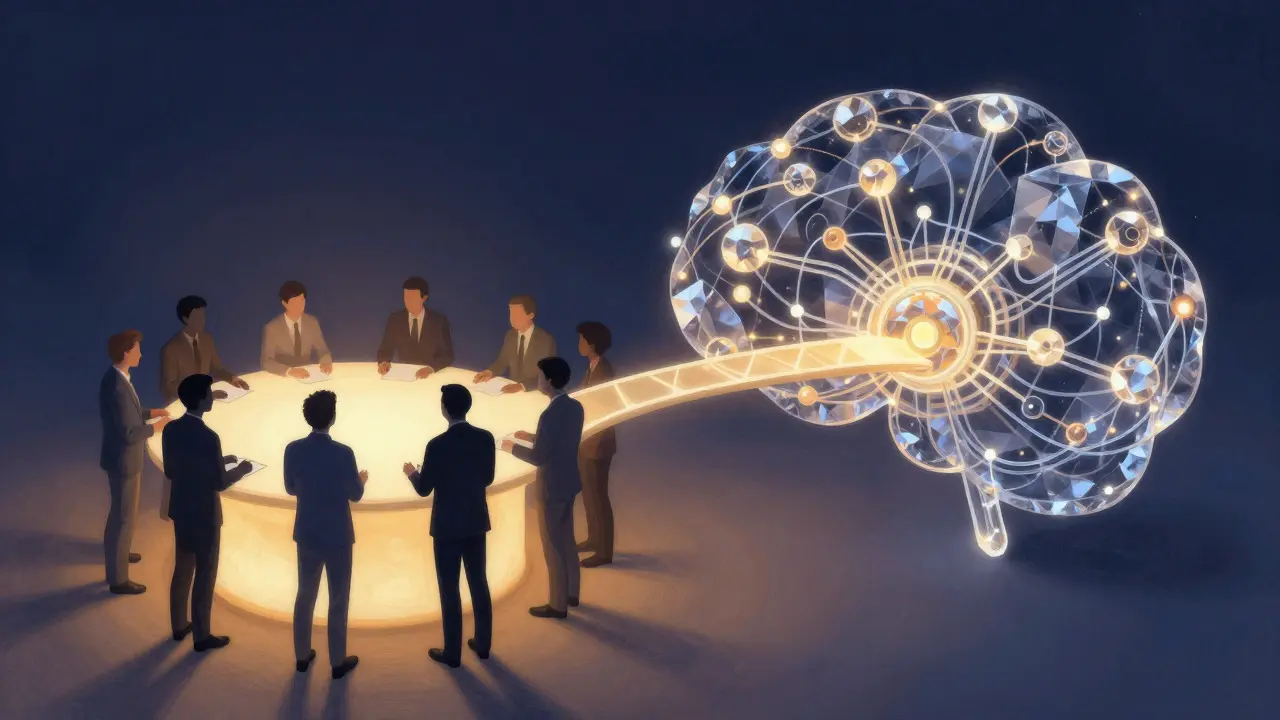
A common misconception is that these algorithms make final decisions. They don't. They only suggest. The ultimate authority still lies with the community. However, the feedback loop is tight. When a human rejects an edit that ORES predicted was "good," that instance becomes a new training data point. This continuous improvement cycle means the models get smarter with every interaction.
This symbiosis is vital. Pure automation would lead to robotic, inflexible curation. Pure human curation would lead to bottlenecks and inconsistency. By blending the two, Wikipedia achieves a balance that neither could reach alone. The algorithms handle the repetitive, high-volume tasks, freeing up human energy for nuanced editorial judgments that require cultural context or ethical reasoning.

Challenges and Limitations
No system is perfect, and Wikipedia's ML infrastructure faces unique hurdles. One major issue is bias. Since the training data comes from past human decisions, any biases in those decisions are baked into the model. For instance, if certain topics were historically edited more aggressively, the model might learn to flag similar edits more harshly in the future. Correcting this requires careful auditing of the training sets, which is an ongoing effort for the development team.
Another challenge is the "black box" problem. While gradient boosting models are more interpretable than deep neural networks, they can still be opaque to casual users. If an edit is flagged, editors sometimes struggle to understand *why* the algorithm reacted that way. Transparency is a key goal, and efforts are underway to provide clearer explanations alongside predictions, helping users trust the process.
Future Directions: From Correction to Creation
Where does this go next? The current focus is heavily on maintenance and correction. The future, however, points toward generative applications. Imagine an AI assistant that doesn't just flag errors but suggests improvements based on missing sources or structural gaps. We are already seeing early experiments with summarization tools that help readers digest long articles quickly. There is also potential for real-time translation enhancement, making multilingual collaboration smoother than ever.
As natural language processing advances, the line between human writing and machine-assisted writing will blur further. The goal isn't to replace editors, but to empower them. By handling the drudgery of format checking and basic fact verification, machine learning allows the volunteer community to focus on what they do best: curating knowledge with care and precision.
Does Wikipedia use AI to write articles?
Not directly. Most articles are written by humans. However, AI tools assist in structuring, referencing, and maintaining quality. Generative AI is currently being tested for summarization and translation support, but full article generation is not yet standard practice.
How accurate are the machine learning predictions on Wikipedia?
Accuracy varies by task. For vandalism detection, accuracy is very high, often above 90%. For predicting the long-term quality of an edit, accuracy is lower, around 75-85%, because "quality" is subjective and depends on community consensus.
Can I turn off machine learning checks for my edits?
No, the checks are applied globally to ensure consistency. However, you can see the results in your edit summary. If you disagree with a prediction, you can explain your reasoning in the talk page, which may influence future model training.
What happens if the algorithm makes a mistake?
Human moderators can override any algorithmic decision. The system is designed to be advisory, not authoritative. Mistakes are logged and used to improve the model in subsequent updates.
Is the code for these tools open source?
Yes. Most of the machine learning tools developed for Wikipedia are open-source projects hosted on GitHub. This transparency allows external developers to audit the code and contribute improvements.