You’re editing a page about a controversial political event in a country with strict press controls. You find three news articles that all say the same thing, but they all come from state-run outlets like TASS or Xinhua News Agency. Do you cite them? If you do, does it make your article look like propaganda? If you don’t, are you ignoring the only available data?
This is the daily reality for many Wikipedia editors who work on topics involving authoritarian regimes, conflict zones, or nations with limited independent journalism. The core problem isn't just about accuracy; it's about perception and Neutrality of Point of View (NPOV). Using state media incorrectly can skew an article toward a specific narrative, while excluding them entirely can leave gaps that other editors fill with less reliable blogs or partisan commentary.
Why State Media Is Tricky on Wikipedia
State media outlets are government-owned or heavily influenced by the ruling party. Unlike independent newspapers that might have a slight political lean, state media often functions as a mouthpiece for official policy. This creates two distinct issues for encyclopedia editors: reliability and bias.
First, consider reliability. In countries like North Korea or Iran, the state media might be the only source reporting on domestic events. If a protest happens in Tehran, and no independent journalists were present, the footage and reports from IRNA (Islamic Republic News Agency) might be the primary record of what occurred. Ignoring this source doesn't make the article neutral; it makes it incomplete.
Second, consider bias. State media rarely reports facts neutrally. They frame events to support the government’s narrative. A military action might be called a "peacekeeping operation" by state TV, while independent analysts call it an "invasion." If you simply copy the text from the state outlet without context, you’re importing their spin into Wikipedia. That violates the NPOV policy, which requires representing significant views fairly and proportionately.
The Core Rule: Use for Facts, Not Framing
The golden rule here is simple: use state media for undisputed factual claims, not for interpretation. What does this mean in practice?
- Facts: Did the president give a speech? Yes. What date was it? Tuesday. How long did it last? 45 minutes. These are verifiable facts that state media can confirm, even if their tone is biased.
- Framing: Was the speech successful? Did the audience cheer because they were happy or because they were forced to? These are interpretations. State media will say the crowd erupted in joy. Independent sources might note the presence of security guards ensuring applause. Wikipedia needs both perspectives, not just the state’s version.
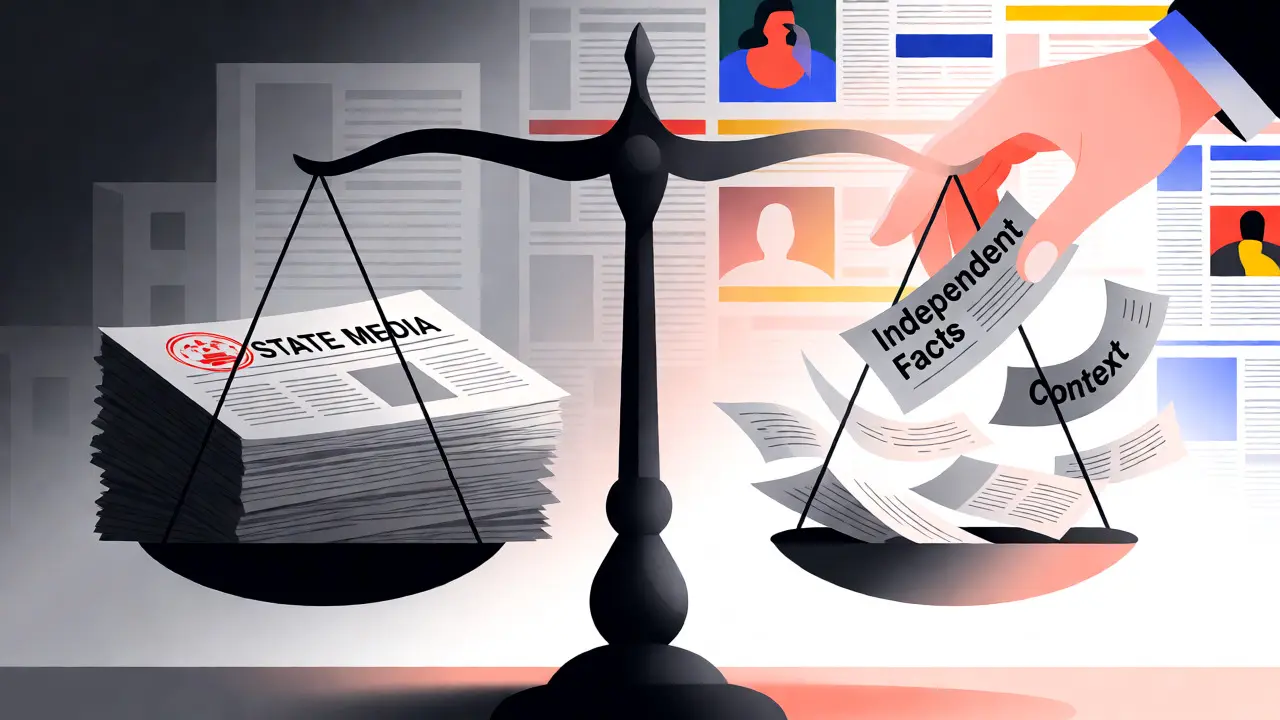
When you cite a state source for a fact, attribute it clearly. Instead of writing "The economy grew by 5%," write "According to state-run Rossiya Segodnya, the economy grew by 5%." This small change signals to the reader that the number comes from a specific perspective, inviting them to check for corroborating independent data.
How to Cite State Media Correctly
Citation style matters. It’s not enough to just add a reference at the bottom. You need to contextualize the source within the sentence. Here’s how experienced editors handle it:
- Attribution in Text: Always name the source in the body of the article when using state media. "The Chinese government stated via Xinhua that..." is better than "It was reported that..."
- Contextualize Conflicts: If state media contradicts independent reports, mention both. "While Reuters reported 10 casualties, state-controlled CCTV claimed there were none." This shows the dispute rather than hiding it.
- Avoid "Truth" Language: Don’t treat state media statements as absolute truth. Use verbs like "claimed," "stated," "announced," or "reported" instead of "confirmed" or "proved" unless multiple independent sources agree.
Consider this example table showing how to adjust language based on the source type:
| Scenario | Weak Phrasing (Biased) | Strong Phrasing (Neutral) |
|---|---|---|
| Election Results | The incumbent won 90% of the vote. | The state electoral commission reported the incumbent won 90% of the vote. |
| Protest Size | Thousands marched in the capital. | Independent estimates placed attendance at 5,000, while police claimed 20,000. |
| Foreign Policy | The nation supports peace. | The Foreign Ministry described its stance as supportive of regional stability. |
When to Avoid State Media Entirely
There are times when citing state media hurts more than helps. If a claim is highly subjective and no independent verification exists, adding a state source might clutter the article without adding value. For instance, if a state newspaper calls a leader "the greatest visionary of our time," that’s pure propaganda. It belongs in a section about public perception or media coverage, not in the lead paragraph describing the leader’s biography.
Also, avoid using state media for breaking news where independent wire services (like AP or AFP) are active. If CNN has already reported on a natural disaster in Turkey, citing Anadolu Agency (Turkey’s state news agency) adds little new information unless you are specifically analyzing the Turkish government’s response.

Dealing with Editor Disputes
You’ll often see edit wars over this issue. One editor removes a state source, calling it "unreliable propaganda." Another restores it, arguing it’s the "only available source." Who is right?
Usually, neither extreme is correct. Removing the source creates a gap. Keeping it without attribution creates bias. The solution is compromise through proper sourcing. If an editor challenges your citation, explain why you used it. Was it for a hard fact? Did you attribute it? Show them the difference between "Source says X" and "X is true."
If you’re new to editing these topics, start by looking at high-quality articles on countries like Russia, China, or Saudi Arabia. Notice how they handle quotes from leaders. They almost always attribute the quote to the specific outlet or official title. Mimic this pattern. It builds trust with other editors and readers alike.
Practical Checklist for Editors
Before you hit "publish" on an edit involving state media, run through this quick checklist:
- Is the information a verifiable fact (date, location, official statement)?
- Have I attributed the source in the text (e.g., "according to TASS")?
- Are there independent sources that contradict or support this?
- Am I using neutral verbs (stated, reported) rather than judgmental ones (admitted, revealed)?
- Does this citation help the reader understand the situation, or does it just push a narrative?
Remember, Wikipedia isn’t trying to hide state media. It’s trying to show the full picture. Sometimes the state’s view is part of that picture. Your job is to frame it so readers can judge it for themselves.
Is state media considered a reliable source on Wikipedia?
State media is generally considered a reliable source for official government statements, dates, and locations, especially when no independent sources exist. However, it is not considered reliable for subjective opinions, analysis, or contested facts without corroboration from independent sources.
How should I phrase citations from state news agencies?
Always attribute the statement to the specific agency in the text, such as "As reported by Xinhua..." or "The state-run agency IRNA stated..." This clarifies that the information reflects the government's position rather than an objective consensus.
Can I remove state media sources if I disagree with them?
You shouldn't remove them solely due to disagreement. Remove them if they fail to meet reliability standards for the specific claim (e.g., using them for opinion pieces). If they provide unique factual data, keep them but ensure they are properly attributed and balanced with other viewpoints.
What if there are no independent sources for an event?
If no independent sources exist, you may rely on state media for basic facts but must explicitly label the source. You might also note in the article that information is limited due to restricted press freedom, helping readers understand the context of the available data.
Does using state media violate Wikipedia's Neutral Point of View policy?
Not necessarily. Violation occurs if the state media's bias is presented as fact without attribution. Proper use involves citing the source clearly and balancing it with other perspectives where available, thus maintaining neutrality by transparency.