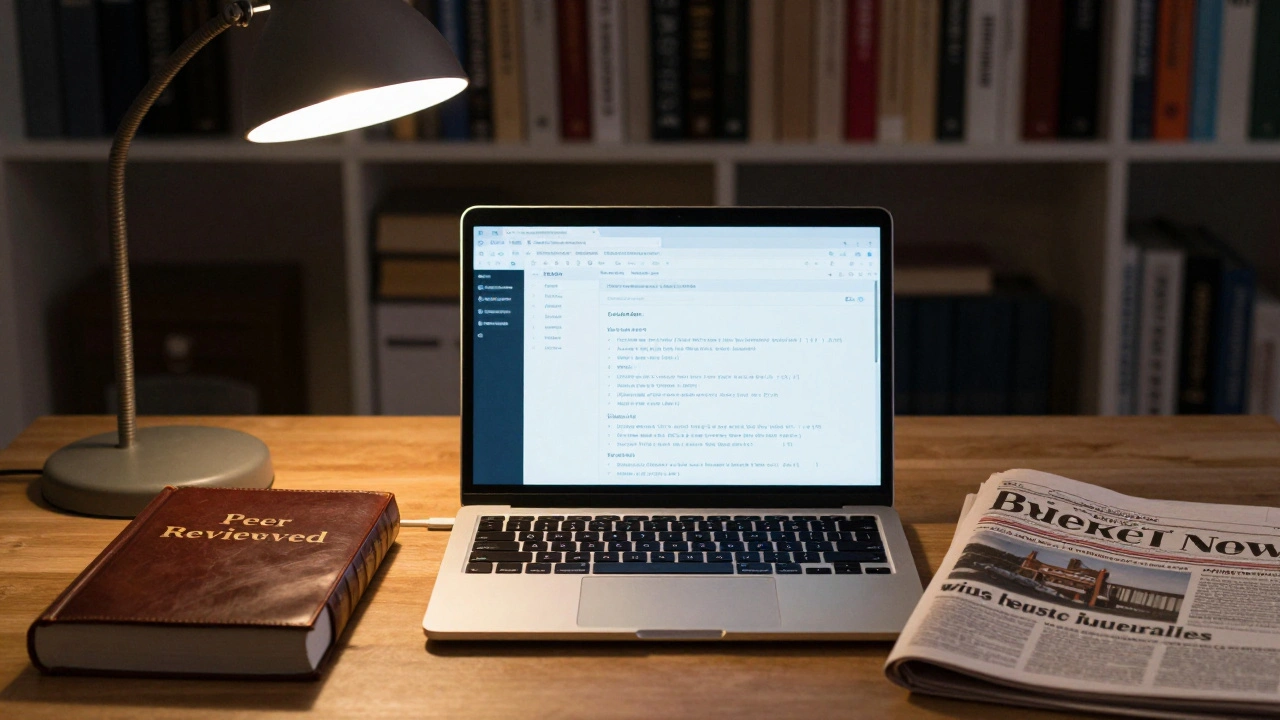
Imagine you are editing a Wikipedia article about a controversial political event. You have two sources in front of you. One is a peer-reviewed study from a university press, published three years ago after rigorous review. The other is a breaking news report from a major newspaper, written by an experienced journalist who interviewed witnesses on the day it happened. Which one do you trust? On Wikipedia, the answer isn't always straightforward.
The platform's core policy, Verifiability, which means that information must be sourced to reliable, published references, creates a constant tension between different types of authority. This tension lies at the heart of how we understand truth on the internet. Are academic sources inherently more "true" than journalistic ones? Or does the speed and immediacy of journalism give it a unique value that academia lacks?
Understanding the difference between these two pillars of sourcing is crucial for anyone who edits, reads, or relies on Wikipedia. It determines what gets included, what gets deleted, and why certain claims are contested while others stand unchallenged for decades. Let's break down exactly how Wikipedia treats these distinct worlds of knowledge production.
The Nature of Academic Authority
When Wikipedia editors talk about "academic sources," they are usually referring to materials produced within the framework of higher education and research institutions. These include peer-reviewed journal articles, books published by university presses, and conference proceedings from recognized academic societies. The defining feature of these sources is the process of peer review, where experts in the same field scrutinize the methodology, data, and conclusions before publication.
This process makes academic sources incredibly stable. A finding published in a reputable journal like Nature or The Lancet has already survived multiple layers of critique. For Wikipedia, this stability is gold. It means that once a fact is established by a high-quality academic source, it rarely needs to be revisited unless new evidence emerges. This aligns perfectly with Wikipedia's goal of creating a neutral, enduring summary of existing knowledge.
However, this strength is also its weakness. Academic publishing is slow. It can take months or even years for research to move from discovery to publication. If you are writing about a current event, such as a recent election or a natural disaster, academic sources simply won't exist yet. In these cases, relying solely on academia would leave Wikipedia silent on matters of immediate public interest. Furthermore, academic sources often assume a level of prior knowledge that general readers may not have, making them less accessible for explaining basic concepts.
The Role of Journalistic Reporting
Journalism operates on a completely different timeline and set of priorities. News organizations like The New York Times, BBC News, or Reuters prioritize timeliness and accessibility. Their goal is to inform the public about events as they happen, often under tight deadlines. This makes journalistic sources indispensable for covering contemporary history, current affairs, and cultural trends.
On Wikipedia, major news outlets are generally considered reliable for factual reporting. If a reputable newspaper states that a company filed for bankruptcy, or that a politician made a specific speech, that claim is usually accepted without question. The credibility comes from the organization's reputation and the professional standards its journalists adhere to, including fact-checking and editorial oversight.
But there is a catch. Journalism is not peer-reviewed in the academic sense. While editors check facts, they do not typically verify the underlying methodology or statistical validity of complex studies. A news article might report on a new scientific breakthrough, but if the original study was flawed, the news report will likely repeat those flaws. Wikipedia editors must be careful to distinguish between a journalist's original reporting (which is reliable for facts) and their interpretation of complex issues (which may be biased or oversimplified).
| Feature | Academic Sources | Journalistic Sources |
|---|---|---|
| Primary Strength | Depth, rigor, and long-term stability | Timeliness, breadth, and accessibility |
| Verification Process | Peer review by subject experts | Editorial fact-checking and newsroom standards |
| Best Used For | Historical analysis, scientific consensus, theoretical frameworks | Current events, biographical details, quotes, and recent developments |
| Main Weakness | Slow publication cycle; jargon-heavy | Potential for bias, sensationalism, or error correction delays |
| Wikipedia Reliability Status | Generally highly reliable for subject matter | Reliable for facts, but caution needed for analysis/opinion |

Navigating Bias and Neutrality
One of the most challenging aspects of using both academic and journalistic sources is dealing with bias. Wikipedia's core content policy is Neutral Point of View (NPOV), which requires articles to represent all significant viewpoints fairly and proportionately. Both types of sources can introduce bias, but in different ways.
Academic bias often stems from disciplinary perspectives. A historian, a sociologist, and an economist might interpret the same historical event very differently based on their training. Wikipedia editors must synthesize these differing academic viewpoints to create a balanced narrative. Ignoring a legitimate academic perspective because it conflicts with the majority view is a violation of NPOV.
Journalistic bias is often more overt and tied to political or commercial interests. Some news outlets have clear editorial stances, and their reporting may reflect those views. Wikipedia has specific guidelines for handling such sources. Generally, mainstream, widely-read newspapers are acceptable for factual claims, but their opinion pieces or heavily slanted reports should not be used to support contentious claims. Editors are encouraged to use multiple news sources from different political leanings to ensure balance.
A common mistake is assuming that because a source is "reliable," it is "neutral." This is incorrect. A reliable source is one that is well-edited and has a reputation for accuracy, not necessarily one that is unbiased. Wikipedia's job is to curate these reliable sources to construct a neutral narrative, not to adopt the bias of any single source.
Handling Conflict Between Sources
What happens when an academic source and a journalistic source contradict each other? This scenario is more common than you might think. Perhaps a news report claims a new drug is effective, but a subsequent peer-reviewed study finds no significant benefit. In these cases, Wikipedia's hierarchy of reliability comes into play.
Generally, primary sources are less preferred than secondary sources. A news report about a press release is a secondary source, but a raw dataset is primary. An academic paper analyzing the data is a secondary source with higher authority due to peer review. If a conflict arises between a reputable news outlet and a peer-reviewed journal on a matter of fact or scientific consensus, the academic source usually carries more weight. However, if the news report covers a recent development that post-dates the academic study, both may need to be cited to show the evolving nature of the topic.
Editors should avoid cherry-picking sources to support a preferred outcome. Instead, they should present the range of credible viewpoints. If the academic consensus has shifted, but some news outlets are still reporting the old view, the article should reflect the current consensus while noting the previous understanding if it remains relevant contextually.

Practical Tips for Editors
If you are adding citations to Wikipedia, keep these practical guidelines in mind:
- Use the best available source. If a peer-reviewed article exists, use it. If only a news report is available, use that, but be cautious about drawing broad conclusions.
- Check the date. Ensure your sources are up-to-date. A 10-year-old news article may be outdated, while a 10-year-old foundational academic theory may still be valid.
- Distinguish between fact and analysis. Use journalistic sources for quotes, dates, and events. Use academic sources for interpretations, theories, and long-term impacts.
- Beware of paywalls. Many academic sources are behind paywalls. While this doesn't make them unreliable, it can make verification difficult for other editors. Try to provide open-access links where possible.
- Look for consensus. Single studies or isolated news reports are less powerful than a body of work. Citing multiple sources strengthens your argument significantly.
The Evolving Landscape of Online Publishing
The line between academic and journalistic sources is blurring. Online platforms now host hybrid content that combines the depth of academic research with the accessibility of journalism. Magazines like The Atlantic or The Economist publish long-form analytical pieces that are often treated as reliable secondary sources on Wikipedia, despite not being strictly academic or traditional news.
Similarly, some academic journals now offer rapid publication channels for urgent topics, such as pandemics or climate crises, reducing the time lag between discovery and dissemination. As these boundaries shift, Wikipedia's community continues to debate and refine its policies on what constitutes a reliable source. The core principle remains unchanged: reliability is determined by the reputation of the publisher and the rigor of their editorial process, not just the format of the content.
For the everyday reader, understanding these distinctions helps in evaluating the quality of the information presented. When you see a citation on Wikipedia, consider whether it is an academic study providing deep insight or a news report offering timely facts. Both are valuable, but they serve different purposes in building a comprehensive picture of reality.
Are news websites considered reliable sources on Wikipedia?
Yes, major news websites with professional editorial standards are generally considered reliable for factual reporting. However, their opinion sections or blogs may not be suitable for supporting contentious claims. Smaller, independent blogs or sites without clear editorial oversight are often deemed unreliable.
Can I use a thesis or dissertation as a source on Wikipedia?
Generally, no. Theses and dissertations are considered self-published or unpublished works until they are formally published by a university press or journal. They have not undergone the same level of peer review as published academic articles and may contain preliminary or unverified findings.
What if an academic source contradicts a news report?
In cases of contradiction, the peer-reviewed academic source usually carries more weight for matters of scientific or historical consensus. However, if the news report covers a more recent event, both sources should be cited to reflect the evolving situation. Always aim to represent the broader consensus rather than relying on a single outlier source.
Is Wikipedia itself a reliable source?
No, Wikipedia is not considered a reliable source for citing in other academic or journalistic works. Because anyone can edit it, its content is constantly changing and lacks the formal editorial control required for external verification. It is best used as a starting point for research, not as a final reference.
How does Wikipedia handle biased news outlets?
Wikipedia allows the use of biased news outlets for straightforward factual claims, such as dates or quotes, provided the outlet is widely read and has professional standards. However, these sources should not be used to support contentious arguments or opinions. Editors are encouraged to balance such sources with others from different perspectives to maintain neutrality.