Every day, hundreds of Wikipedia drafts vanish without a trace. Not because they’re bad, but because they’ve been forgotten. These are the G13 expired drafts-pages created by new editors, left untouched for over six months, and now automatically flagged for deletion. It’s not personal. It’s policy. But if you’re trying to build something meaningful on Wikipedia, losing weeks of work to a system that doesn’t ask you to explain yourself feels unfair.
What Exactly Is a G13 Draft?
G13 is a speedy deletion criterion on Wikipedia. It applies to draft pages in the Draft: namespace that haven’t been edited in six months. These aren’t main article pages. They’re test runs, half-finished attempts, or notes that never got polished. The system doesn’t judge quality. It just checks the clock. If no one touched it in 180 days, it’s marked for deletion.
Wikipedia’s bots run this cleanup automatically. No human reviews the content. No one asks if you were waiting for sources, if you got sick, if you were learning how to cite properly. The draft just disappears. And if you didn’t get a notification-or ignored it-you’ll wake up one day and find your work gone.
Why Does This Happen So Often?
Wikipedia has over 6 million articles. But it has over 10 million drafts. That’s a backlog bigger than most small countries’ public libraries. Most drafts are created by new editors who don’t know how to navigate the system. They write a few paragraphs, hit save, and assume that’s it. They don’t realize that drafts aren’t live articles. They don’t know about the review process. They don’t know that someone has to move their draft to the main namespace before it gets published.
And here’s the kicker: Wikipedia doesn’t send reminders. Not really. The notification system is buried. You might see a tiny banner in your watchlist if you’re lucky. But most new editors never set one up. Or they check it once and forget. So when the six-month clock runs out, the draft gets deleted-and the editor walks away thinking Wikipedia doesn’t want their contribution.
How to Save Your Draft Before It’s Gone
You don’t need to be an expert. You just need to know three things.
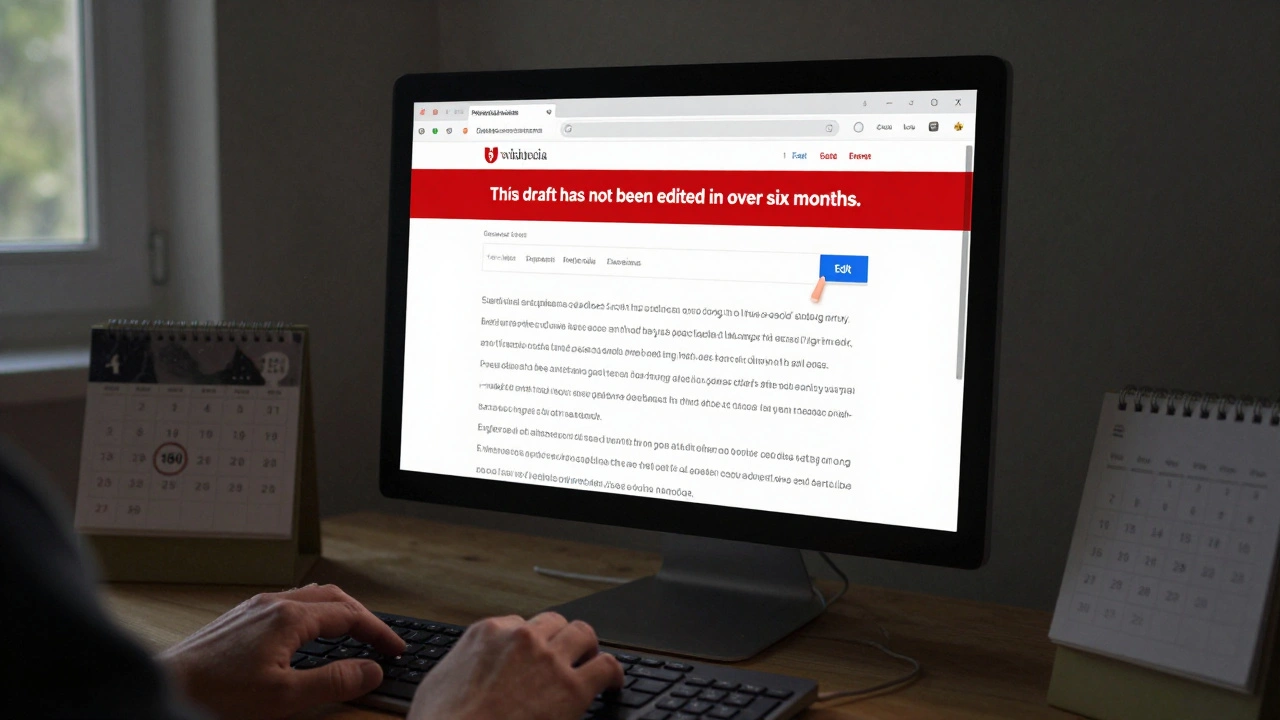
- Check your drafts regularly. Go to Special:MyPage/Drafts. That’s your personal draft dashboard. Bookmark it. Open it every two weeks. If you see a draft with a red warning that says “This draft has not been edited in over six months,” act now.
- Edit it-even if it’s small. Add a period. Fix a typo. Insert a placeholder citation. Just touch it. That resets the six-month timer. You don’t need to finish it. You just need to prove it’s alive.
- Submit it for review. Once you’ve made progress, click “Submit for review” at the top of your draft. That sends it to the Drafts for Review queue. Volunteers will look at it. They’ll give feedback. If it meets basic standards, they’ll move it to the main namespace. That’s when your work becomes a real article.
Even if your draft is only 300 words, submitting it for review is better than letting it rot. Reviewers aren’t there to reject you. They’re there to help you improve. Many of the top Wikipedia editors started with drafts that looked like messes.

What to Do If Your Draft Was Already Deleted
It’s not the end. Not even close.
If your draft was deleted under G13, you can ask for its restoration. Go to Wikipedia:Undeletion requests. Create a new section. Explain what your draft was about. Say you’re willing to fix it. Include the exact title (like Draft:YourArticleName). Be polite. Be specific.
Most requests are approved if you show you’re serious. The admins don’t care that you waited six months. They care that you care. One user restored 17 deleted drafts last year by just replying to each request with a short plan: “I’ll add two more sources, fix the structure, and submit for review by Friday.” That’s all it took.
Don’t assume it’s too late. Don’t assume you’re not welcome. Wikipedia needs more voices-not fewer.
How to Avoid Mass Deletions in the Future
Mass deletions aren’t random. They’re predictable. And you can avoid them.
- Use the Draft namespace correctly. Drafts are for work in progress. Don’t treat them like personal notes. Treat them like unfinished articles.
- Set calendar reminders. Every 60 days, block 15 minutes to check your drafts. Add it to your phone. You wouldn’t let a bank account go silent for six months. Don’t let your Wikipedia draft do that either.
- Find a mentor. Go to Wikipedia:Teahouse. Ask for help. Say, “I’m new. I have a draft. Can someone look at it?” People there are friendly. They want you to succeed.
- Don’t wait for perfection. A draft with two sources and a clear structure is better than a perfect draft that never gets submitted. Wikipedia rewards progress, not polish.
What Happens After a Draft Is Approved?
Once your draft is moved to the main namespace, it’s no longer protected from deletion. But now it’s under different rules. It can be tagged for improvement, nominated for deletion under other criteria (like notability or sourcing), or left alone if it’s solid.
But here’s the good part: once it’s live, it gets visibility. Other editors will find it. They’ll fix grammar. They’ll add citations. They’ll link it to related articles. Your work becomes part of a living system.
Many of the most-read Wikipedia articles started as G13 drafts. The article on climate change adaptation in rural communities was once a 200-word draft with one broken link. A reviewer fixed it. Another editor added data from the World Bank. Now it gets over 50,000 views a month.
Why This Matters Beyond Wikipedia
Wikipedia isn’t just a website. It’s one of the most used sources of knowledge on the planet. When a draft gets deleted, it’s not just a page lost. It’s a perspective lost. A local history. A niche expertise. A non-English speaker’s voice. A student’s first attempt at academic writing.
Mass deletions don’t just clean up clutter. They silence people who don’t know how to play the game. That’s not neutrality. That’s exclusion.
But you can change that. By saving your draft. By helping others save theirs. By submitting your work-even if it’s rough-you’re making Wikipedia more complete. More honest. More human.
You don’t need to be an expert. You just need to care enough to click “edit.”
What happens if I don’t edit my Wikipedia draft for six months?
If your draft in the Draft: namespace isn’t edited for six months, it will be automatically flagged for deletion under the G13 policy. A bot will remove it without human review. The page will no longer exist unless you request its restoration.
Can I recover a deleted draft?
Yes. Go to Wikipedia:Undeletion requests and submit a request with the exact draft title and a brief explanation that you intend to improve it. Most requests are granted if you show willingness to fix the draft and submit it for review.
Do I need to finish my draft before submitting it for review?
No. You don’t need to finish it. You just need to make it readable and show progress-like adding at least two reliable sources, organizing the structure, and removing personal opinions. Reviewers help you improve it. They don’t expect perfection.
How do I find all my drafts on Wikipedia?
Go to Special:MyPage/Drafts. This page shows every draft you’ve created. You can sort them by date edited and see which ones are at risk of deletion.
Why doesn’t Wikipedia warn me before deleting my draft?
Wikipedia does send a notification via your user talk page and watchlist, but these are easy to miss. Many new editors don’t set up watchlists or check their talk pages regularly. The system assumes that if you haven’t edited in six months, you’re no longer active. It’s automated, not personal.