When you first start editing Wikipedia, it feels exciting. You find a typo, fix it, and hit save. Then you get a message: "Your edit was reverted." Suddenly, you’re not a helper-you’re a rule-breaker. Why? Because Wikipedia isn’t just a website. It’s a living system built on policies that have evolved over two decades. And if you don’t understand them, even well-meaning edits can trigger backlash.
Why Policies Matter More Than You Think
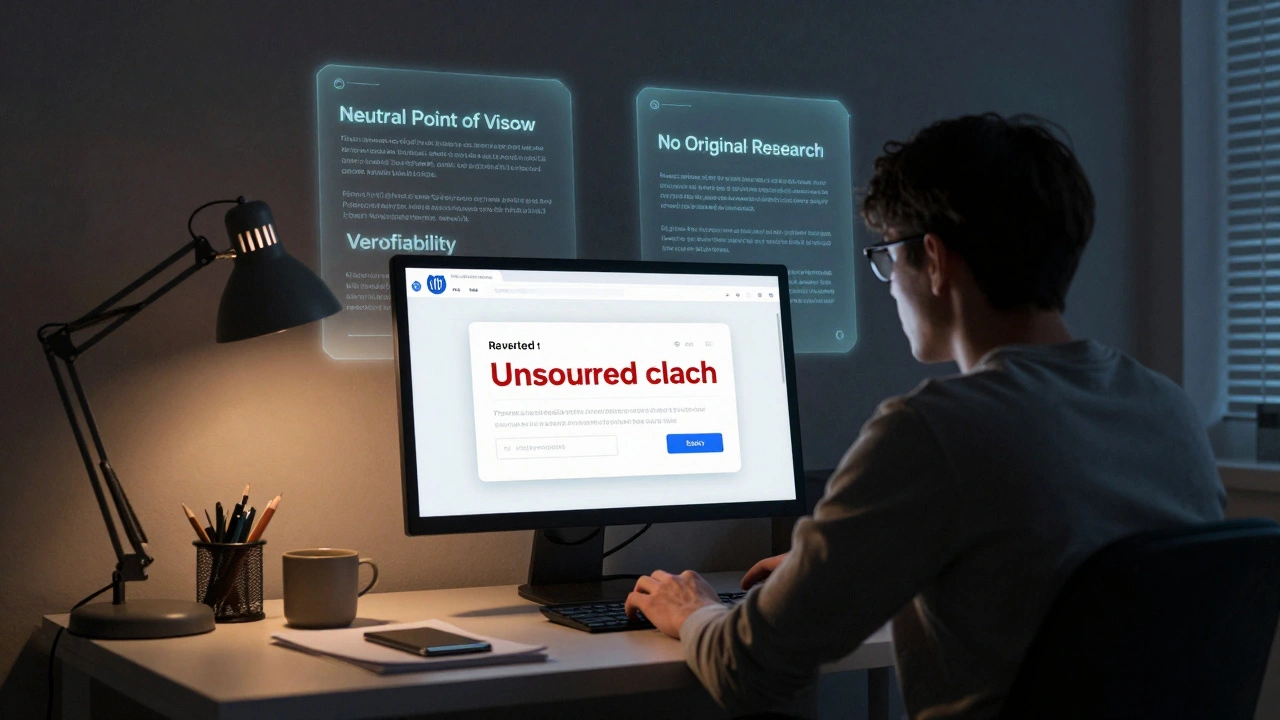
Wikipedia doesn’t have a central editor-in-chief. Instead, it runs on consensus. That means every edit must follow rules that thousands of volunteers agreed on over time. These aren’t suggestions. They’re enforced. And new editors often break them without realizing it.Take Neutral Point of View (NPOV). It’s not about being boring. It’s about not pushing a side. If you rewrite a paragraph about climate change to say "global warming is a hoax," even if you believe it, you’re violating policy. The same goes for adding unverified claims, promotional language, or personal opinions. Wikipedia isn’t your blog. It’s a reference tool.
Another common misunderstanding: "I found this on Google, so it must be true." But Wikipedia requires reliable sources. That means peer-reviewed journals, major newspapers, university publications-not personal blogs, forums, or social media posts. A 2023 study by the Wikimedia Foundation found that 68% of reverts on new editors’ first edits were due to unsourced claims.
The Top 5 Mistakes New Editors Make
- Deleting content without discussion - If you see what looks like "junk," don’t just erase it. Talk about it on the article’s talk page first. Someone might have added it for a reason.
- Using biased language - Words like "foolish," "disastrous," or "amazing" trigger automatic flags. Replace them with facts. Instead of "The law was a disaster," write "The law led to a 22% drop in public funding, according to the 2022 Government Accountability Office report."
- Editing too fast - Rushing through edits leads to mistakes. Take 10 minutes to read the article’s history and talk page. You’ll see patterns: what’s been debated, what’s been reverted, what’s considered stable.
- Ignoring edit summaries - When you save, you get a box to explain your change. Skipping it is like sending an email with no subject line. Other editors can’t tell if you fixed a typo, added a source, or started an edit war.
- Assuming all policies are the same - Policies vary by topic. A biography has stricter sourcing rules than a video game article. The Biographies of Living Persons policy alone has caused over 12,000 reverts in the last year.
How to Learn Policies Without Getting Overwhelmed
You don’t need to memorize all 500+ policies. Start with the big five:- Neutral Point of View (NPOV) - Present facts without favoring one side.
- Verifiability - Every claim must be backed by a reliable source.
- No Original Research - Don’t add new theories, analysis, or unpublished data.
- Notability - Only cover topics that have received significant coverage in reliable sources.
- Conflict of Interest - Don’t edit articles about yourself, your company, or your family.
Use the Help:Introduction page. It’s designed for new editors. Then, when you get a warning message, click the link. Most policy notices include a short explanation and a link to the full rule. Bookmark those pages.
Also, join the New Editors’ Help Desk. It’s a quiet corner of Wikipedia where experienced editors answer questions without judgment. Ask things like: "Is this source reliable?" or "Why was my edit reverted?" Most replies come within 24 hours.
What Happens When You Break a Rule
Getting reverted isn’t punishment. It’s feedback. But if you keep repeating the same mistake, things escalate.First offense: A polite edit summary like "Reverted: unsourced claim. See [[WP:VER]]"
Second offense: A message on your talk page: "Hi, I noticed your edits to [article] keep adding claims without sources. Can we talk about how to find reliable references?"
Third offense: A warning template, like {{uw-unsourced}}, which appears on your user page.
Fourth offense: A temporary block. Not forever. Usually 24 to 72 hours. It’s meant to make you pause, read, and learn.
Blocks aren’t about banning you. They’re about protecting the encyclopedia. If you’ve been blocked, don’t rage-quit. Go back. Read the policy. Ask for help. Most editors who get blocked once come back and become some of the most careful contributors.
Real Examples of Policy Violations (and Fixes)
Let’s look at three real cases from 2025:
- Case 1: A user added, "This CEO is the best leader in the industry" to a corporate article. Fix: Replaced with, "The CEO led a 40% increase in annual revenue from 2021 to 2024, according to the company’s SEC filings."
- Case 2: Someone edited a history article to say, "The treaty failed because the people were lazy." Fix: Changed to, "The treaty was rejected by 62% of voters in the 2023 national referendum, citing concerns over economic impact (Source: National Archives, 2023)."
- Case 3: A new editor created a 200-word article about their local bakery, citing the bakery’s Instagram. Fix: The article was deleted. Later, the same editor submitted a revised version citing a 2024 feature in the city’s newspaper and a 2023 interview in a regional food magazine. It was approved.
Notice the pattern? Facts over opinions. Sources over assumptions. Context over emotion.

How to Build Policy Literacy Over Time
Think of policy literacy like learning a language. You don’t master grammar on day one. You start with phrases, then sentences, then full conversations.Here’s how:
- Start small. Fix one typo per day. Read the talk page of the article afterward.
- Read one policy a week. Pick one from the big five. Read it slowly. Highlight what it says and what it doesn’t say.
- Watch experienced editors. Go to the "Recent Changes" page and filter by "Patrolled edits." See how seasoned editors explain their changes.
- Use the sandbox. Test edits in a sandbox page. No one will revert you there. Try adding a sourced claim. Then remove it. See how the system reacts.
- Ask for feedback. When you’re unsure, use the "Request Feedback" button on any article. It sends your edit to a volunteer reviewer.
There’s no rush. The average new editor who sticks around for six months becomes a reliable contributor. The ones who quit after one bad experience? They’re the ones who didn’t realize Wikipedia’s rules exist to protect its integrity-not to annoy them.
What Happens When You Get It Right
When you learn the policies, something changes. You stop feeling like an outsider. You start seeing the system as a tool-not a barrier.You’ll notice that the same editors who reverted you now thank you. You’ll get your first "thank you" message on your talk page. You’ll start to recognize patterns: what gets kept, what gets deleted, what gets improved.
And eventually, you’ll realize: Wikipedia doesn’t need perfect editors. It needs careful ones. Ones who listen. Ones who check sources. Ones who pause before they hit "save."
What if I accidentally break a policy?
Most policy violations are unintentional. If you get reverted or receive a warning, don’t panic. Read the message carefully. Visit the linked policy page. Then, edit again-this time with the rule in mind. Most editors who make one mistake and correct it are welcomed back.
Can I edit articles about myself or my business?
Technically, yes-but it’s strongly discouraged. Wikipedia’s conflict of interest policy says you shouldn’t edit articles where you have a personal stake. Even if your info is accurate, it can look promotional. Instead, suggest edits on the article’s talk page. Let neutral editors make the changes.
Are Wikipedia policies the same in every language?
No. While core policies like NPOV and verifiability are similar across languages, each Wikipedia community adapts them. For example, the German Wikipedia has stricter sourcing rules for biographies than the English version. Always check the local policy page for the language you’re editing in.
How do I know if a source is reliable?
Reliable sources are typically published by reputable organizations with editorial oversight: academic journals, major newspapers, books from established publishers, government reports, and trusted news outlets. Avoid self-published content, blogs, forums, and social media unless they’re from a recognized expert with a verifiable track record.
Do I need to cite every single fact?
Yes-if it’s not common knowledge. Common knowledge means facts most educated people know without looking it up (e.g., "The Earth orbits the Sun"). Anything specific-dates, numbers, quotes, events-needs a source. When in doubt, cite it. Better to over-cite than under-cite.
Final Thought: Policies Are the Foundation, Not the Fence
Wikipedia’s policies aren’t there to stop you. They’re there to make sure your edits last. They protect the encyclopedia from bias, misinformation, and chaos. Every great editor started as a beginner. The difference? They learned the rules before they tried to change them.Read. Listen. Ask. Edit. Repeat. That’s how you become part of the system-not just another person who got blocked.