
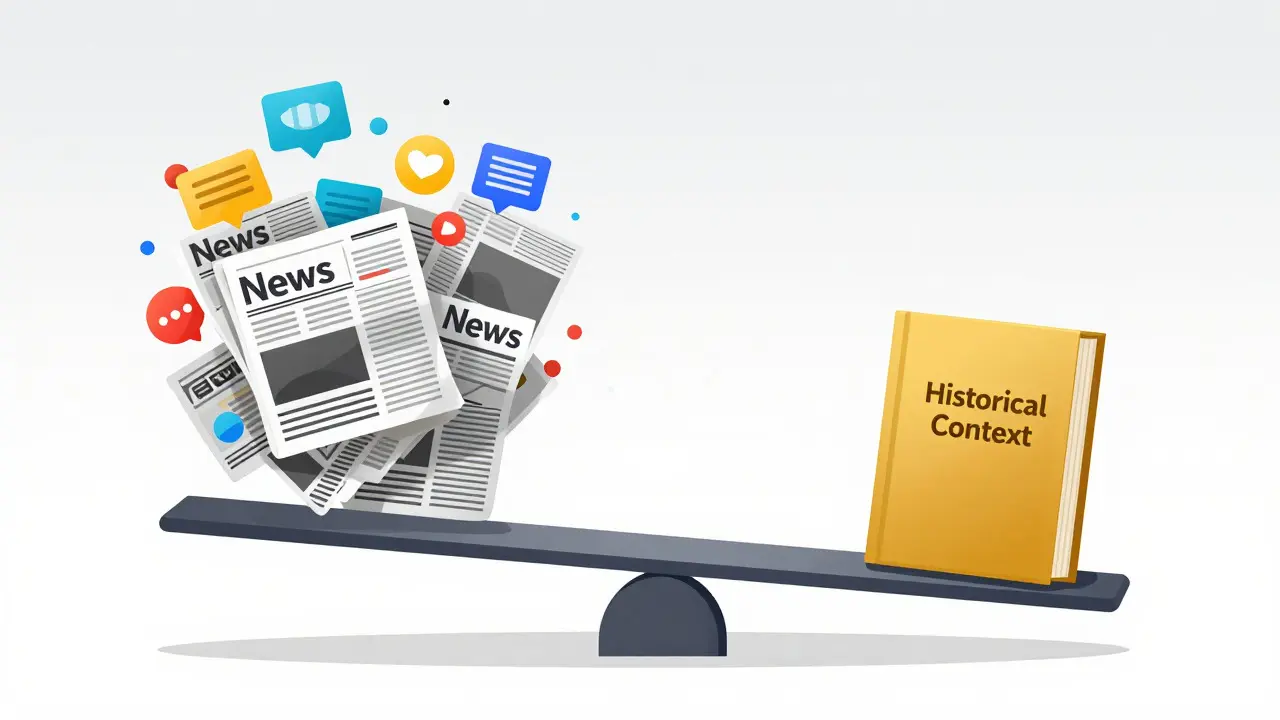
Imagine opening a Wikipedia article about a major political figure and finding the first paragraph dominated by their latest scandal, while their decades of legislative work are buried in the third section. This is Recentism a common editorial bias where recent events are given disproportionate weight compared to historical context or long-term significance. It turns reference entries into news reports, confusing readers who expect a balanced overview rather than a breaking story update.
The problem isn't that news doesn't matter. It does. But when editors treat every new headline as the most important fact, they distort the narrative. A company's quarterly earnings report shouldn't overshadow its founding mission if the article is meant to be an encyclopedia entry. Similarly, a celebrity's latest tabloid gossip shouldn't define their career legacy. The goal of Wikipedia a free online encyclopedia that aims to provide neutral, verifiable information is stability and accuracy over time, not real-time updates.
Why Recentism Happens
Human nature plays a big role here. We are wired to pay attention to what is new. In journalism, this is called the "recency effect." Editors often bring this instinct from their day jobs or personal interests. If you just read a shocking article in a mainstream newspaper, you might feel compelled to add it to Wikipedia immediately, assuming everyone else needs to know too.
There is also a technical aspect. Wikipedia articles are live documents. Unlike a printed book, there is no final deadline. This creates a constant pressure to keep things current. However, "current" does not always mean "most significant." For example, the death of a historical figure is a significant event, but for a living person, a minor legal dispute might be more prominent in the news cycle than their actual professional achievements. Distinguishing between *notable* and *new* is the core challenge for editors trying to maintain a Neutral Point of View an editorial standard requiring articles to present significant viewpoints fairly without bias.
Identifying the Bias in Articles
How do you spot recentism? Look at the structure. If the lead section (the summary at the top) focuses heavily on events from the last six months, that’s a red flag. Check the table of contents. Are there multiple sections dedicated to a single week of events? If so, the article is likely suffering from distortion.
Consider the case of a technology startup. If the company launched a new product last month, the article might spend 40% of its word count describing the launch. But if the company has been operating for ten years, that launch is just one data point in a much larger history. A balanced article would place the launch in context, perhaps under a "Products" or "History" section, rather than letting it dominate the entire page.
- Lead Section Imbalance: Does the intro mention the latest news before defining who or what the subject is?
- Section Weighting: Do recent events have their own headings while older, more foundational events are grouped together?
- Tone Shift: Does the language become more sensational or urgent for recent facts compared to historical ones?
Strategies for Balancing New Information
Avoiding recentism requires a shift in mindset. Instead of asking "What happened recently?", ask "What is the most significant aspect of this subject's existence?" Here are practical steps editors can take:
- Use the "So What?" Test: If you remove the recent news item, does the article lose its core meaning? If not, it might belong in a smaller subsection or even be omitted if it lacks long-term relevance.
- Contextualize, Don't Center: Place new information within existing frameworks. If a politician passes a bill, add it to the "Legislative Career" section, not necessarily the lead, unless it fundamentally changes their status.
- Check for Notability Decay: Some events are huge news today but forgotten tomorrow. Wait a few weeks or months before adding highly volatile news to ensure it remains relevant.
- Rely on Secondary Sources: Use established encyclopedias or academic journals for background, and use reputable news sources only for specific, verified facts. Don't let a single news cycle dictate the article's structure.
This approach helps maintain the integrity of the Free Content License a licensing model allowing users to share and adapt content freely, such as Creative Commons which relies on stable, high-quality text for reuse in other projects.
The Role of Talk Pages and Community Consensus
Wikipedia is a collaborative effort. When you notice recentism, don't just revert the change silently. Discuss it on the article's talk page. Explain why the balance feels off. Often, other editors agree that the focus has drifted too far toward the news cycle.
Community consensus is key. If multiple editors agree that a section is too heavy on recent events, they can merge it with older content or move it to a separate "Controversies" or "Recent Developments" section. This keeps the main body focused on enduring facts.
It’s also helpful to look at how similar topics are handled. If you're editing an article about a sports team, compare it to articles about other teams in the same league. If your team's article spends half its length on last season's playoffs while others focus on franchise history, you’ve identified a disparity that needs correction.
Tools and Templates That Help
You don’t have to rely solely on intuition. Wikipedia offers several tools to manage this issue.
| Approach | Best For | Risk |
|---|---|---|
| Immediate Integration | Major, permanent changes (e.g., death, merger) | High risk of recentism if event fades quickly |
| Delayed Addition | Volatile news, short-term controversies | Might miss important context if added too late |
| Separate Section | Ongoing series of events | Can clutter the article if not well-managed |
Templates like {{Main}} or {{See also}} can help direct readers to more detailed pages for complex recent events, keeping the main article concise. Additionally, using the "Edit Summary" field wisely can alert other editors to your intent. Writing "Adding context to recent event to maintain balance" signals that you are mindful of recentism.

Common Pitfalls to Avoid
Even experienced editors make mistakes. One common pitfall is "News Snobbery," where editors assume that if it's in a major outlet like The New York Times a major American daily newspaper known for its investigative reporting and global coverage, it must be central to the Wikipedia article. While these sources are reliable for verification, they aren't always authoritative on long-term significance.
Another trap is "Emotional Investment." If you follow a topic closely, you might overestimate the importance of recent developments. Step back and ask yourself: "Would a stranger care about this detail five years from now?" If the answer is no, consider trimming it down.
Finally, avoid "Whiplash Editing." This happens when one editor adds a lot of recent news, and another reverts it entirely, leaving a gap. Instead of deleting, try summarizing. Condense the news into a single, neutral sentence that acknowledges the event without letting it drive the narrative.
Frequently Asked Questions
Is it ever okay to put recent news in the lead section?
Yes, but only if the event fundamentally changes the subject's identity or status. For example, if a company goes bankrupt, that is a defining moment. However, for routine updates like quarterly earnings or minor policy changes, it is better to keep the lead focused on broader definitions and history.
How long should I wait before adding news to Wikipedia?
There is no fixed rule, but waiting 2-4 weeks allows the dust to settle. This helps determine if the event was a one-off blip or part of a significant trend. For very volatile topics like politics or entertainment, waiting longer can prevent unnecessary edit wars.
What is the difference between a news article and a Wikipedia article?
A news article focuses on the "what, who, when, where, and why

recent posts



© 2026. All rights reserved.