Research Pitfalls: Avoid Common Mistakes When Using Wikipedia for Academic Work
When you use research pitfalls, common errors that undermine the validity of academic work, especially when relying on Wikipedia as a source. Also known as Wikipedia research traps, these mistakes happen when users treat Wikipedia like a final authority instead of a starting point. It’s not that Wikipedia is wrong—it’s that people skip the step of checking where the info came from. A 2020 study from the University of Oxford found that over 60% of students who cited Wikipedia in papers never looked at the original sources listed in its references. That’s like building a house on a blueprint you didn’t verify.
One major Wikipedia bias, the uneven representation of topics based on where editors live and what they care about skews what you find. Geographic bias means your topic might be covered in depth if it’s popular in the U.S. or Europe, but barely mentioned if it’s from the Global South. That’s not a flaw in the platform—it’s a flaw in how people use it. Then there’s sourcing errors, relying on weak or outdated citations, like news articles without peer review or personal blogs passed off as reliable. Wikipedia’s rules demand solid sources, but if you copy-paste a sentence without checking the link, you’re copying a mistake. And don’t assume that a well-written article means it’s accurate. Some of the most polished pages are the ones with the oldest, least-checked citations.
Wikipedia reliability, how trustworthy Wikipedia content is when used correctly in academic contexts isn’t about whether it’s perfect—it’s about whether you treat it like a map, not the territory. The best researchers don’t cite Wikipedia. They use it to find the real sources: books, journals, official reports. They check edit histories to see if a claim was added during a heated debate. They look at talk pages to spot where editors disagreed. And they know that a Stub article isn’t useless—it’s a signal to dig deeper.
If you’re doing academic work, your goal isn’t to prove Wikipedia is good or bad. It’s to avoid the traps that make it dangerous. That means learning how to read a Wikipedia article critically—not just skimming the lead section. It means understanding how Wikipedia article classes, ratings like Stub, B-Class, and A-Class that indicate how complete and well-sourced an article is reflect the depth of research behind it. And it means knowing that a 10-year-old citation might be just as valid as a new one—if it’s from a trusted source.
Below, you’ll find real examples from Wikipedia editors and researchers who’ve seen these pitfalls up close. From how edit-a-thons fix content gaps, to how bots catch misinformation, to how librarians teach students to verify sources—these aren’t theory pieces. They’re field reports from people who’ve been there. You don’t need to be an expert to avoid these mistakes. You just need to know what to look for.
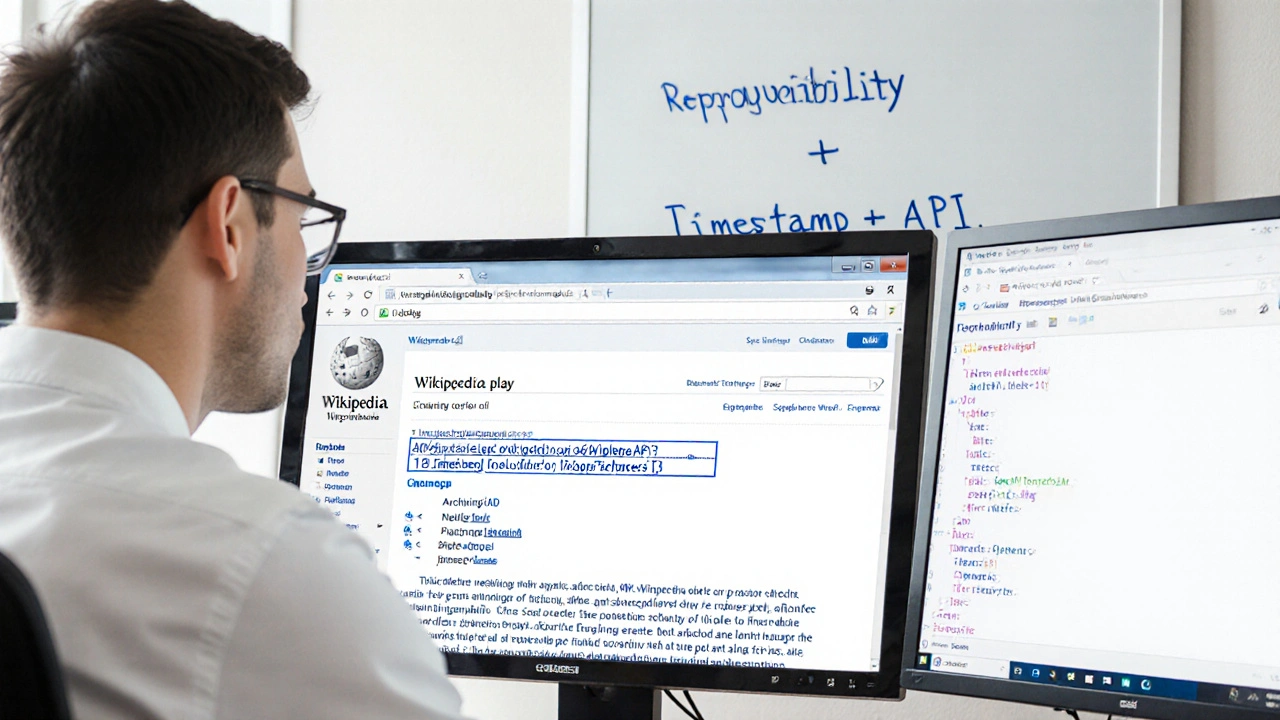
Reproducibility in Wikipedia Research: How to Avoid Common Mistakes and Follow Best Practices
Learn how to make Wikipedia-based research reproducible by saving page versions, using revision IDs, and avoiding common pitfalls that invalidate academic studies. Essential for students and researchers.