
The truth is that government publications aren't a monolith. A census data sheet is fundamentally different from a political press release. When we talk about using these documents on Wikipedia, we aren't asking if the government can write; we're asking if the specific document is an objective record of fact or a tool for persuasion. If you want your edits to stick, you have to learn how to separate the bureaucratic data from the political narrative.
Quick Takeaways: Sourcing the State
- Data vs. Opinion: Statistical reports are usually gold; policy justifications are often biased.
- The Independence Gap: Government sources are rarely "independent" because they represent the entity being described.
- Verification: Always cross-reference official claims with peer-reviewed academic journals.
- Context Matters: Use official docs for "what happened" (facts), not "why it was good" (interpretation).
The Hierarchy of Government Sources
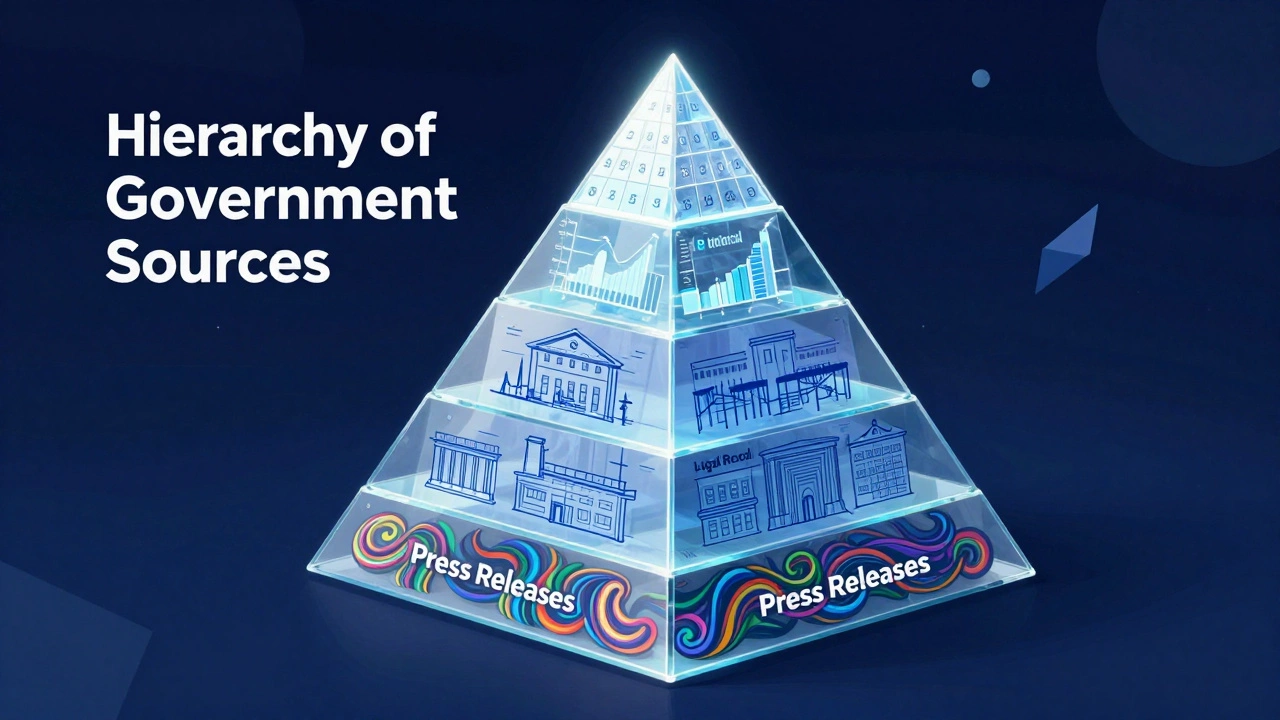
Not all PDFs from a .gov domain are created equal. To navigate this, you need to understand where a document sits in the bureaucratic hierarchy. At the bottom, you have press releases and speeches. These are essentially marketing materials for the state. If a Department of Justice press release says a prosecution was "a victory for justice," that's an opinion, not a fact. You can cite it to prove the DOJ said those words, but not to prove that justice was actually served.
Moving up, you find administrative records and legal transcripts. These are much more reliable because they are primary records. If you're citing a court transcript from the U.S. District Court, you're citing a factual record of what was said in a room. Then you have the high-tier sources: statistical agencies. The U.S. Census Bureau or the Bureau of Labor Statistics provide raw data that is generally accepted as neutral. These agencies have strict mandates to provide objective numbers regardless of who is in the White House.
| Document Type | Reliability | Best Use Case | Red Flag |
|---|---|---|---|
| Statistical Reports | High | Demographics, Economics | Outdated methodology |
| Legal Statutes/Acts | High | Law, Policy definitions | Repealed sections |
| White Papers | Medium | Proposed strategies | Lack of counter-evidence |
| Press Releases | Low | Official statements | Adjectives like "historic" or "unprecedented" |
The Bias Trap: When "Official" Isn't "Neutral"
Bias in government publications is rarely as obvious as a political campaign ad. Instead, it shows up as "framing." For example, a report on the success of a new urban development project written by the agency that managed the project will naturally highlight the wins and bury the failures. This is a conflict of interest. On Wikipedia, this triggers the Neutral Point of View (NPOV) policy. If you only cite the government's own report to describe the project, you're presenting a one-sided story.
Consider the difference between a report on climate change from the Intergovernmental Panel on Climate Change (IPCC) and a policy brief from a specific national ministry. The IPCC is a consensus-based body involving thousands of scientists worldwide. It’s designed to strip away national bias. A national ministry's report, however, might be tailored to fit the current administration's economic goals. When you see a document that spends more time justifying a decision than presenting data, you're looking at a biased source.
Practical Steps for Citing Government Docs
If you've found a government document you want to use, don't just hit "save changes." Follow these steps to ensure the citation survives the scrutiny of the community:
- Identify the Author: Is this a career civil servant (like a lead scientist at NASA) or a political appointee? Technical reports from career experts are generally more trusted than memos from political offices.
- Check the Purpose: Ask yourself: "Was this written to inform the public or to convince the public?" If the goal is persuasion, the document is a primary source for what the government believes, not a secondary source for what the truth is.
- Look for External Validation: Can you find a peer-reviewed paper in a journal like Nature or The Lancet that confirms the government's findings? If the data is robust, independent researchers will have used it too.
- Attribute the Claim: Instead of writing "The project was a success," write "According to the Department of Transportation, the project met its primary goals." This shift in phrasing moves the claim from an objective fact to a reported statement, which is much harder for other editors to challenge.
Dealing with "Official" Contradictions
What happens when two government agencies disagree? It happens more often than you'd think. You might find the Environmental Protection Agency (EPA) reporting one set of emissions data while a state-level agency reports another. This is where the reliable sources guideline gets tricky. You shouldn't just pick the one that supports your argument.
The best way to handle this on Wikipedia is to describe the contradiction. For instance, "While the EPA estimated X, the State of California's Air Resources Board reported Y." This provides a complete picture for the reader and adheres to the principle of presenting all significant viewpoints. It also protects you from accusations of "cherry-picking" sources to push a specific agenda.

Common Pitfalls to Avoid
One of the biggest mistakes new editors make is treating a government website's "About" page as a reliable source for historical achievements. These pages are promotional. If you want to cite the history of an agency, look for the National Archives or official legislative histories. These are archived records, not live marketing pages that can be changed by a web admin on a whim.
Another trap is relying on "working papers" or "pre-print" government reports. These are documents that haven't gone through a full internal or external review process. They are useful for seeing where a conversation is heading, but they aren't final. If you cite a draft report as a finished fact and the final version changes the numbers, your entire section becomes misinformation.
Are .gov websites always reliable sources?
Not automatically. While the domain indicates the source is an official government entity, the content can vary. Statistical data and legal texts are generally highly reliable, but press releases, political speeches, and promotional materials can be heavily biased and may not meet Wikipedia's standards for neutral, independent sourcing.
Can I use a government report as a secondary source?
It depends on the report. A comprehensive review of existing literature (like a systematic review by a health agency) can act as a secondary source. However, a report that simply describes a government program is a primary source. Wikipedia prefers independent secondary sources that analyze the information rather than just providing it.
What should I do if a government source is blatantly wrong?
Don't just delete the citation. Instead, find a more reliable, independent source (like a peer-reviewed study or a reputable news organization) that corrects the error. Present both pieces of information: the government's claim and the evidence that contradicts it. This maintains the encyclopedic nature of the project.
How do I cite a government document that is only available in print?
Use the standard citation templates for books or reports. Include the agency name as the author, the title of the document, the publication date, and the government printing office (GPO) number if available. If there is a digitized version in a government archive, always prefer that link for accessibility.
Is the Wikipedia 'Reliable Sources' policy the same as 'Verifiability'?
No. Verifiability means the information can be checked against a source. Reliability refers to the quality and neutrality of that source. A government press release makes a claim "verifiable," but it doesn't necessarily make the claim "reliable" according to Wikipedia's standards for neutral point of view.
Next Steps for Editors
If you are unsure about a source, the best move is to head to the article's "Talk" page. Post the source and ask, "Is this considered an independent secondary source for this specific claim?" Getting a consensus before you edit saves you the frustration of a revert war. For those moving into advanced editing, start looking into the Wikipedia Manual of Style to see how to properly format complex government citations, especially those involving multi-level agency hierarchies.
For those specializing in legal or political topics, keep a close eye on the Federal Register. It is the official journal of the government and provides the most accurate record of rule-making and executive orders, far outweighing any summary you'll find on a government agency's landing page.