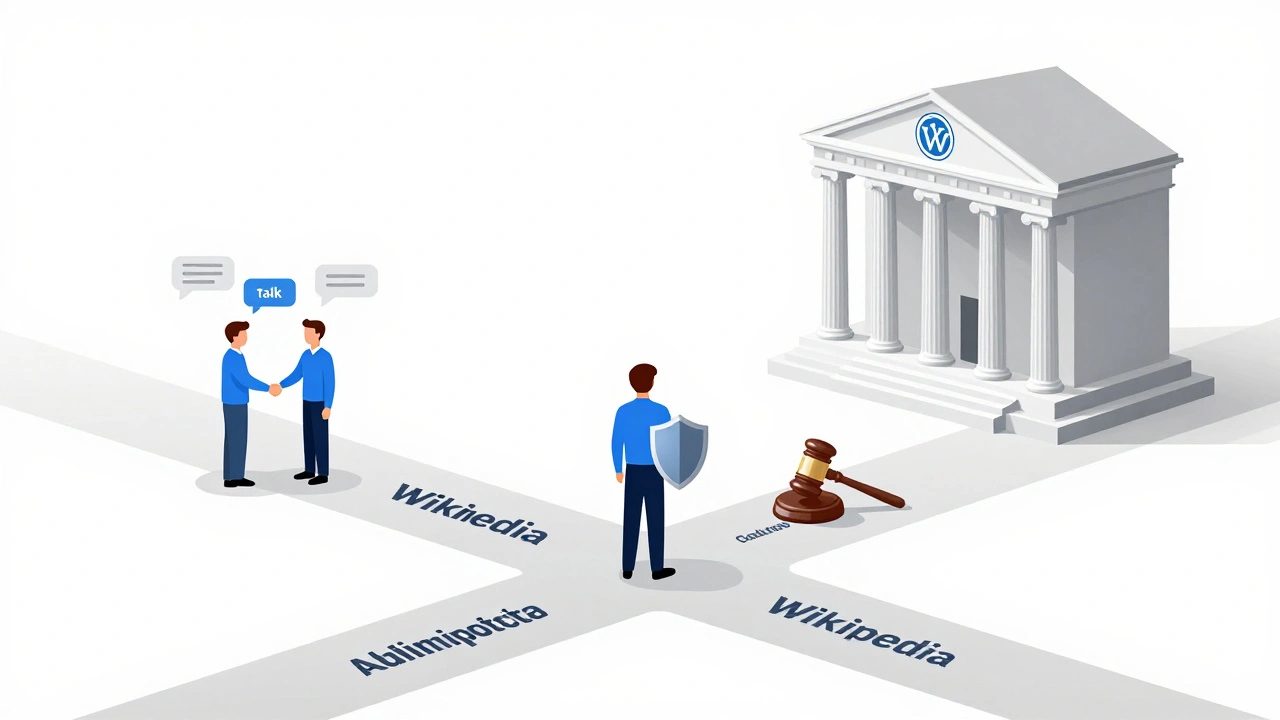
Imagine you are editing an article about a controversial political figure. You add a sourced claim. Another editor removes it, calling it "biased." You add it back. They remove it again. This cycle repeats for weeks. You report the user to an administrator. The admin does nothing, or worse, they block you because they dislike your tone. Who do you turn to now? On Wikipedia, this is where the system gets complicated. It is not a customer service desk. There is no human employee to call. Instead, there is a complex web of community processes designed to handle disputes that normal editing cannot solve.
Understanding how these mechanisms work is crucial for any serious contributor. If you get blocked unfairly, or if you see systemic abuse by powerful users, knowing the difference between an admin review and an arbitration case can save your account-and your sanity. Let’s look at how these high-level governance tools actually function behind the scenes.
The First Line of Defense: Administrators
Before we talk about committees, we have to understand the role of the Administrator. In common parlance, people think of admins as bosses. They are not. An administrator is simply an editor with technical tools. They can delete pages, protect articles from vandalism, and block users who break rules. But they do not have authority over content decisions. They enforce policies, not opinions.
When a dispute arises, the standard process is to discuss it on the article’s talk page. If that fails, you might take it to a noticeboard or ask for mediation. Sometimes, an admin will step in to enforce a policy like "No original research" or "Neutral point of view." However, admins are volunteers. They have lives. They make mistakes. And sometimes, they act arbitrarily. This is where the concept of accountability comes in.
Admin Oversight and Requests for Comment
If you believe an administrator has abused their powers-perhaps by blocking you without explanation or deleting a well-sourced article-you don’t go straight to the top court. You start with Requests for Comment (RFC). An RFC is a public discussion thread where you lay out your case and invite other experienced editors to weigh in. It is a way to build consensus before escalating.
If the RFC doesn’t resolve the issue, you might file a Request for Adminship Review or seek help from the Administrators' Noticeboard. These processes rely on peer pressure and community consensus. Other admins or senior editors will look at the logs, read the arguments, and decide if the action was justified. If the community agrees the admin acted poorly, they may be warned. In extreme cases, they can be stripped of their tools through a Request for CheckUser or a broader review process. But this is slow, messy, and often inconclusive.
The Nuclear Option: The Arbitration Committee
When informal discussions and admin interventions fail, you reach the end of the line: the Arbitration Committee, commonly known as ArbCom. Think of ArbCom as Wikipedia’s supreme court. It is a group of ten elected arbitrators who have the power to impose binding sanctions on users. Unlike admins, ArbCom members can ban users indefinitely, restrict them to specific topics, or even close entire edit wars permanently.
ArbCom handles cases that involve systemic disruption, harassment, or repeated policy violations that lower-level processes cannot stop. Filing a case with ArbCom is not something you do lightly. The committee explicitly states that it does not handle minor disputes, content disagreements, or first-time offenses. If you file a case about a petty argument over comma placement, it will be declined immediately. ArbCom is reserved for the most toxic and persistent conflicts on the site.

How the Arbitration Process Works
The process begins with a Case Submission. Any editor can submit a case, but it must meet strict criteria. The submission should detail the history of the conflict, the policies violated, and why previous remedies failed. Once submitted, the case goes into a queue. ArbCom clerks review it to ensure it meets the threshold for acceptance.
If accepted, the case moves to the Trial Phase. This is not a courtroom drama with lawyers. It is a structured discussion on a dedicated page. The involved parties present their evidence-edit histories, talk page logs, screenshots. Other editors can join as witnesses or advocates. The arbitrators read everything, ask questions, and deliberate privately. Finally, they issue a Decision. This decision is binding. Ignoring it results in an immediate global ban.
Decisions can include bans, topic bans, or warnings. A topic ban means a user can edit Wikipedia but not touch certain subjects, like politics or biography. This is often used when a user is knowledgeable but too emotionally invested in a particular area to remain neutral.
Elections and Accountability
Who chooses the arbitrators? The community does. Every year, there is an ArbCom Election. Editors nominate themselves or others. Candidates write essays explaining their philosophy on dispute resolution. Then, all active voters cast ballots. Questions are asked, answers are given, and the ten candidates with the most support win. This democratic process ensures that ArbCom remains accountable to the editors who use the site daily.
However, elections can be contentious. Some years see low turnout. Others see intense campaigning. Critics argue that ArbCom becomes too insular, dominated by a small group of long-term users who share similar views. Supporters counter that expertise matters. Resolving complex disputes requires experience with Wikipedia’s nuanced policies. Balancing democracy with efficiency is an ongoing challenge.
| Mechanism | Authority Level | Typical Use Case | Outcome | |
|---|---|---|---|---|
| Talk Page Discussion | None | Minor content disagreements | Consensus or stalemate | |
| Administrator Action | Enforcement | Vandalism, clear policy violations | Block, deletion, protection | Binding within scope |
| Requests for Comment | Community Consensus | Disputed admin actions | Guidance, warning | Non-binding advice |
| Arbitration Committee | Supreme Court | Systemic disruption, harassment | Bans, topic restrictions | Strictly binding |
Pitfalls and Common Mistakes
New editors often misunderstand these processes. One common mistake is assuming that ArbCom is a place to appeal content decisions. It is not. If you lose an argument about whether a celebrity is notable, ArbCom will not intervene. Notability is a content guideline, not a conduct rule. Another mistake is filing multiple overlapping cases. This clogs the system and annoys the arbitrators. Stick to one clear narrative.
Also, remember that tone matters. Even if you are right, being aggressive or personal will hurt your case. Wikipedia values civility. Aggressive behavior can lead to sanctions regardless of the merit of your underlying argument. Always assume good faith until proven otherwise. Document everything. Screenshots are vital because talk pages can be deleted or edited.
The Future of Governance
As Wikipedia grows, so do its governance challenges. The current system relies heavily on volunteer time. Burnout is real. Many experienced arbitrators step down after a term, exhausted by the emotional toll of handling toxic disputes. There are ongoing discussions about creating intermediate bodies to handle mid-level disputes, reducing the burden on ArbCom. Some propose expanding the role of stewards, who handle cross-wiki issues, to assist with local enforcement.
Yet, the core principle remains: community self-governance. No external corporation controls Wikipedia. The Wikimedia Foundation provides infrastructure and legal support, but it does not dictate editorial policy. This independence is both Wikipedia’s strength and its weakness. It allows for rapid innovation and diverse viewpoints, but it also means that justice depends entirely on the willingness of volunteers to show up and do the hard work.
Key Takeaways
- Administrators enforce policies but do not control content; they are peers with technical tools.
- Requests for Comment (RFC) are the first step for challenging admin actions, relying on community consensus.
- The Arbitration Committee (ArbCom) is the final resort for systemic disruption and harassment, not content disputes.
- ArbCom decisions are binding and can result in indefinite bans or topic restrictions.
- Elections determine ArbCom membership annually, ensuring community accountability.
Can I appeal an ArbCom decision?
Generally, no. ArbCom decisions are final and binding. However, you can request a reconsideration if new evidence emerges that was not available during the trial. This is rare and must be substantiated with concrete facts, not just a different opinion.
What is the difference between a ban and a topic ban?
A full ban prevents a user from editing any part of Wikipedia. A topic ban restricts editing only to specific subjects, such as "Politics" or "Biographies." Topic bans are often used when a user is knowledgeable but unable to remain neutral on certain issues.
How do I become an arbitrator?
You must nominate yourself during the annual ArbCom election. You need a strong track record of resolving disputes, deep knowledge of Wikipedia policies, and the ability to remain impartial. Community voting determines the winners.
Does the Wikimedia Foundation interfere in arbitration?
No. The Wikimedia Foundation respects the autonomy of the community. It does not intervene in editorial disputes or arbitration cases unless there are legal issues involving copyright infringement or defamation that require external legal action.
Why are some cases declined by ArbCom?
Cases are declined if they do not meet the threshold for arbitration, such as minor disputes, content disagreements, or lack of prior attempts at resolution. ArbCom reserves its resources for the most severe and persistent disruptions.
