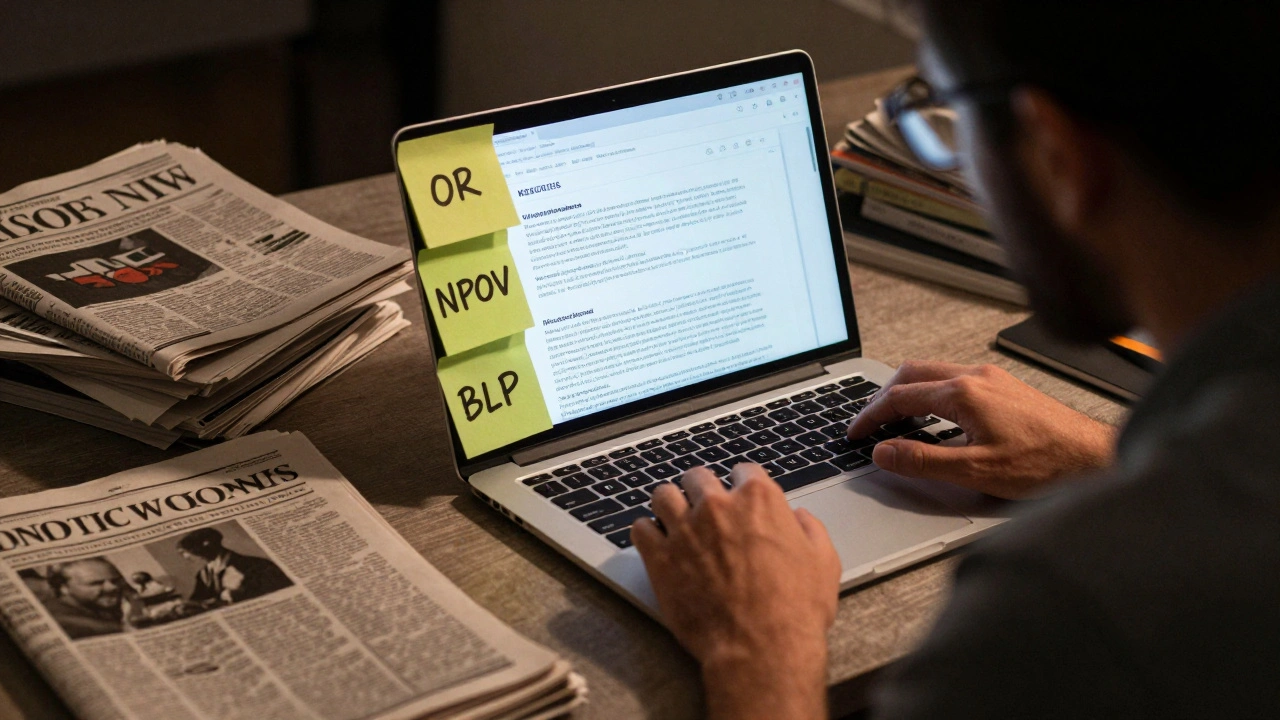
When journalists start using Wikipedia as a research tool, they quickly run into terms like OR, NPOV, and BLP. These aren’t just random acronyms-they’re the backbone of how Wikipedia works. And if you’re writing a story that cites Wikipedia, ignoring them can lead to errors, bias, or worse-public corrections that damage your credibility.
What OR Means (Original Research)
OR stands for Original Research. On Wikipedia, this rule says: don’t publish new findings, unpublished theories, or your own analysis. If you read a Wikipedia article and think, "This sounds like something I came up with after reading three sources," it’s probably a violation.
For journalists, this matters because Wikipedia won’t let you cite a claim unless it’s already been published elsewhere. That means if you find a bold statement on Wikipedia-say, "This politician was secretly involved in a 2018 bribery scheme"-and it’s not backed by a reliable published source, it’s not valid. You can’t use Wikipedia to break news. You can’t use it to connect dots no one else has connected.
Wikipedia’s OR policy forces users to rely on what’s already out there: newspapers, academic journals, books, official reports. That’s actually useful for journalists. If you’re verifying a claim, check if it appears in at least two credible outlets. If it’s only on Wikipedia, it’s a red flag. The site doesn’t allow you to invent narratives. It only reflects what’s already documented.
NPOV: Neutral Point of View
NPOV stands for Neutral Point of View. This is Wikipedia’s most important and most misunderstood rule. It doesn’t mean every side of an issue gets equal space. It means you present all significant viewpoints fairly, without giving undue weight to fringe ideas.
Here’s how it plays out in practice. If you’re writing about climate change, Wikipedia won’t give 50% of the article to climate denialists just because they exist. It’ll give space based on what major scientific institutions, peer-reviewed studies, and reputable media have established. That’s why you’ll see a clear consensus on topics like evolution, vaccines, or human-caused global warming.
Journalists need to understand this because it’s easy to misread Wikipedia as balanced when it’s actually evidence-based. If you see a Wikipedia article that says "Some scientists believe climate change isn’t real," but the rest of the article cites the IPCC and 97% consensus studies, that’s not bias-it’s NPOV in action. You can trust that structure. But if you copy that phrasing without context into your own article, you risk creating false equivalence.
Use NPOV as a guide for how to report fairly. Don’t give equal airtime to disproven theories. Don’t say "some say" unless those "some" represent a meaningful portion of experts or public opinion. Wikipedia doesn’t do that. Neither should you.
BLP: Biographies of Living Persons
BLP means Biographies of Living Persons. This is Wikipedia’s strictest policy. It exists because people’s reputations are at stake. If you’re writing about someone still alive, every negative claim must be backed by a reliable, published source. No rumors. No anonymous tips. No unverified social media posts.
For journalists, this is a goldmine. Wikipedia’s BLP policy is stricter than most newsrooms’ standards. If a claim about a public figure isn’t in a major newspaper, magazine, or official report, it won’t appear on Wikipedia. That means if you find a BLP article that says, "John Smith was convicted of fraud in 2021," you can be confident it’s been vetted.
But here’s the catch: Wikipedia often omits things. If a person was investigated but never charged, or if a scandal was reported in a small blog but never picked up by major outlets, it won’t be there. That’s not censorship-it’s protection. And it’s why journalists should treat Wikipedia as a starting point, not a finish line.
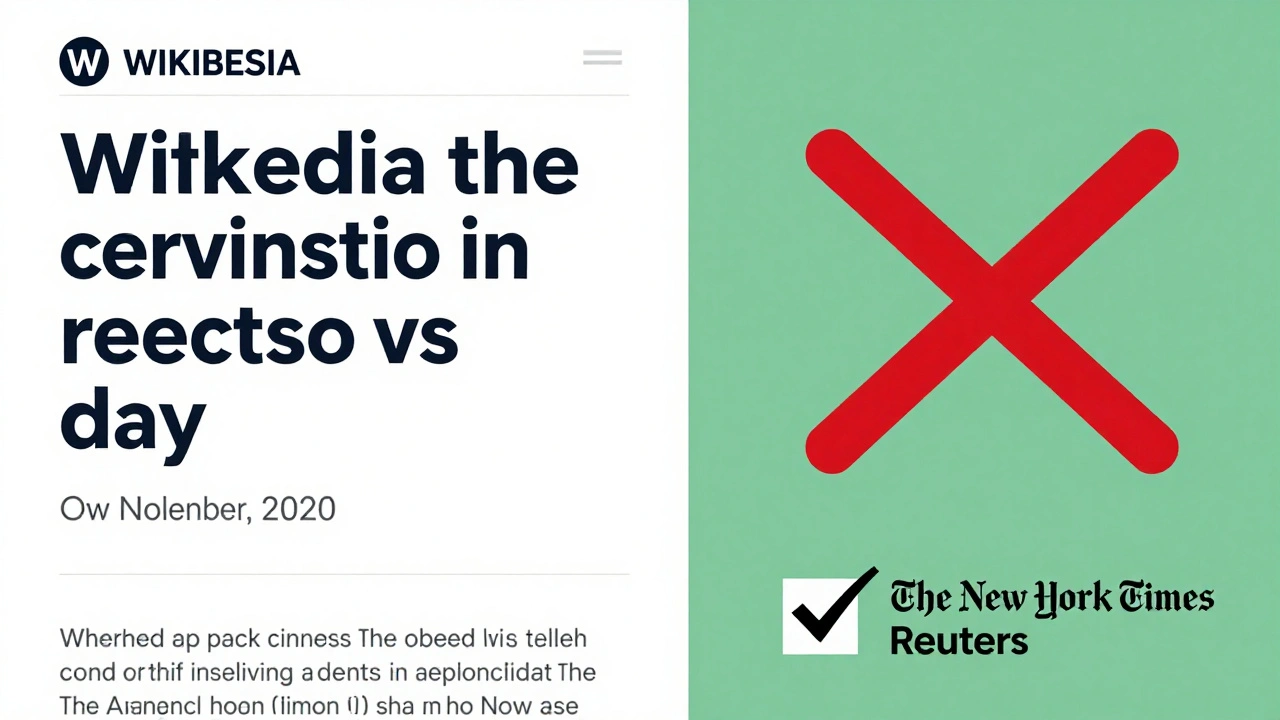
Use BLP as a checklist. Before publishing a damaging claim about someone, ask: Is this in at least two reputable sources? Has it been reported by a major outlet? If the answer is no, and it’s only on Wikipedia as a vague reference, don’t use it. If it’s on Wikipedia with a citation to The New York Times or Reuters, you’re safe to follow the trail.
Why Journalists Should Still Use Wikipedia-Carefully
Wikipedia isn’t a primary source. It’s a gateway. Think of it like a library catalog. You don’t cite the catalog. You cite the book it points to.
Journalists use Wikipedia every day. A 2023 survey by the Pew Research Center found that 62% of U.S. journalists use Wikipedia at least weekly for background research. Why? Because it’s fast, free, and surprisingly reliable for established facts. The average Wikipedia article has 20-30 citations. Most of them are from credible sources.
Here’s how to use it right:
- Start with the article to get context: Who’s involved? When did it happen? What are the key terms?
- Check the references at the bottom. Click them. Read the original source.
- Don’t copy phrases. Rewrite in your own words.
- If a claim has no citation, ignore it.
- If a claim has a citation to a blog or forum, dig deeper.
Wikipedia’s policies make it one of the most reliable places to find verified context. But only if you respect the rules behind it.
What Happens When Journalists Ignore These Rules
In 2018, a major news outlet ran a story claiming a politician had "secretly funded a protest group." The article cited Wikipedia. The Wikipedia entry had been edited by an anonymous user who added the claim without a source. The story was retracted. The outlet issued an apology. The politician sued.
That’s not rare. In 2020, a UK newspaper used a Wikipedia edit from a user with a history of vandalism to support a claim about a public health official. The claim was false. The paper lost a libel case.
These aren’t edge cases. They’re warnings. When journalists treat Wikipedia like a source instead of a signpost, they put their reputation-and their organization-at risk.

How to Spot a Wikipedia Article That’s Safe to Use
Not all Wikipedia articles are created equal. Here’s how to tell which ones you can trust:
- Look for the "Good Article" or "Featured Article" badge. These are reviewed by volunteers and meet high standards.
- Check the talk page. If there’s a long discussion about disputed claims, be cautious.
- Look at the edit history. If the article was edited 10 times in one day by new users, it might be under attack.
- Check the citations. Are they from newspapers, academic journals, or government sites? Or are they from personal blogs or forums?
- See if it’s protected. Articles on controversial living people are often semi-protected, meaning only experienced editors can change them. That’s a good sign.
If all those boxes are checked, you’re looking at a solid reference. If not, keep digging.
Wikipedia vs. Traditional Sources: What’s the Difference?
Wikipedia isn’t trying to replace The New York Times or The Guardian. It’s trying to summarize them.
Traditional journalism reports events as they happen. Wikipedia waits until the dust settles. It doesn’t break news. It compiles it. That’s why it’s perfect for background, context, and verifying facts after the fact.
Journalists who use Wikipedia as a real-time tool get burned. Those who use it as a reference library stay accurate.
Think of it this way: If you’re writing about the 2024 U.S. election, you wouldn’t cite a live tweet. You’d cite the certified results from the state board of elections. Wikipedia is like that board of elections for information-it’s the final, verified version.
Can I cite Wikipedia directly in my journalism?
No, you should never cite Wikipedia as a primary source. It’s a secondary summary. Always go to the original sources listed in its references. Citing Wikipedia directly undermines your credibility and can lead to errors if the article is later edited.
Why does Wikipedia ban original research?
Wikipedia bans original research to prevent misinformation. Without this rule, anyone could add unverified claims, conspiracy theories, or personal opinions as fact. The site relies on published, reliable sources to ensure accuracy and neutrality. This protects readers and maintains trust.
Is Wikipedia biased against certain viewpoints?
Wikipedia doesn’t exclude viewpoints-it excludes unsupported ones. If a viewpoint is held by a significant number of experts and has been published in reliable sources, it’s included. If it’s fringe or lacks evidence, it’s excluded. This isn’t bias-it’s adherence to evidence.
How do I know if a Wikipedia article about a living person is trustworthy?
Check for the BLP tag, look at the citation quality, review the edit history, and see if major outlets have reported on the subject. If the article has few citations, lots of recent edits, or vague language like "some say," treat it with caution. Always verify with independent sources.
Can I trust Wikipedia for breaking news?
No. Wikipedia is too slow to be useful for breaking news. It takes time for edits to be reviewed and sources to be added. During fast-moving events, Wikipedia often contains rumors or unverified claims. Always rely on established news organizations for breaking stories.
Final Takeaway: Use Wikipedia Wisely
Wikipedia isn’t the enemy of journalism. It’s a tool. A powerful one. But like any tool, it’s dangerous in untrained hands.
OR, NPOV, and BLP aren’t just Wikipedia rules-they’re journalism principles in disguise. Verify your sources. Avoid bias. Protect people’s reputations. Those aren’t Wikipedia values. They’re yours.
When you use Wikipedia correctly, you save time, reduce errors, and build stronger stories. When you ignore its rules, you risk everything.