Every journalist has been there. You’re racing against deadline, your editor is breathing down your neck, and you need a quick fact. So you type it into Google. Wikipedia pops up. It’s clean, it’s detailed, it’s got citations. It feels like a shortcut. But here’s the truth: Wikipedia is not a source. It’s a starting point - and sometimes, it’s a trap.
Wikipedia Isn’t Peer-Reviewed
Think of Wikipedia like a giant public bulletin board. Anyone can edit it. A high school student. A retired engineer. A bot that adds the same phrase to every page about cats. And yes - sometimes, a PR rep trying to polish a company’s image.
Unlike academic journals or official government reports, Wikipedia doesn’t require credentials. There’s no editor checking if the data is accurate, up to date, or balanced. A 2023 study by the University of Michigan found that 17% of Wikipedia entries on U.S. political figures contained at least one factual error that persisted for over six months. That’s not a glitch. That’s the system.
Journalists who treat Wikipedia as a primary source aren’t lazy - they’re trusting a system designed for broad accessibility, not journalistic rigor.
It’s Often Out of Date
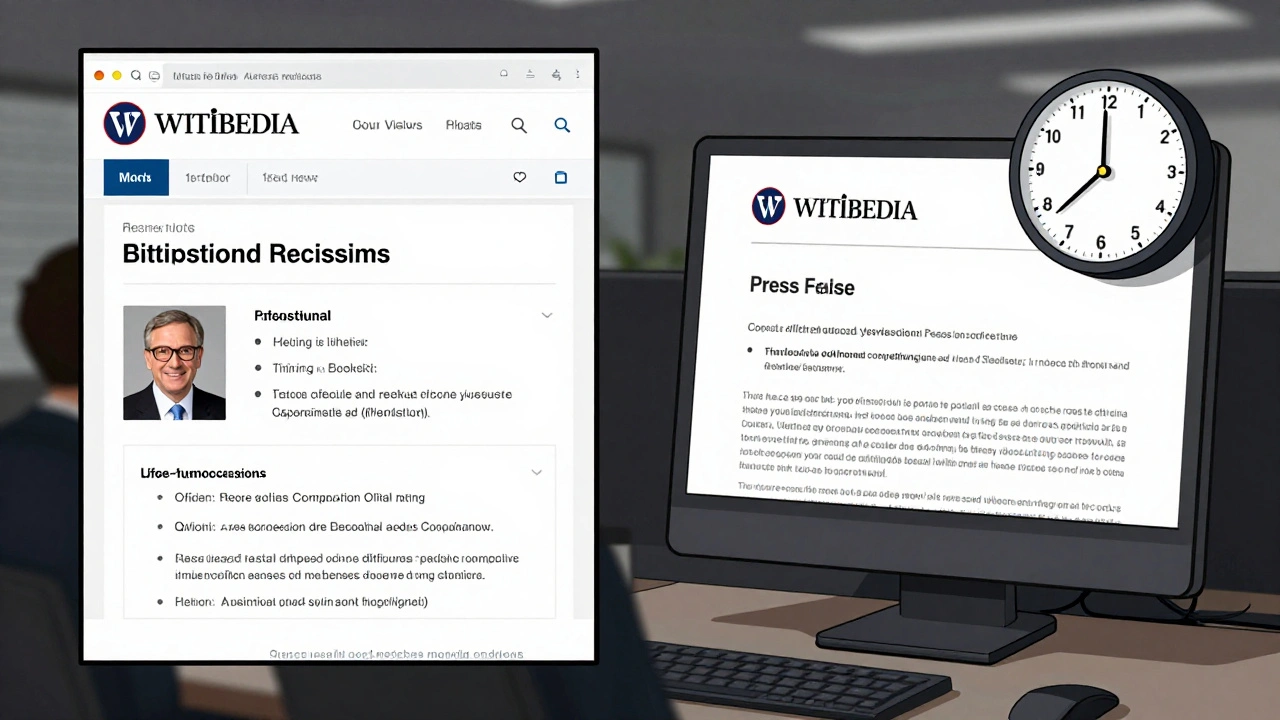
Wikipedia updates fast - but not always fast enough. In 2024, a major news outlet reported that a company’s CEO had stepped down. They cited Wikipedia. Two hours later, the company’s official press release confirmed the news. But Wikipedia? It still listed the old CEO - because no one had edited the page yet.
That’s not rare. In fast-moving fields like tech, finance, or politics, Wikipedia can lag behind real-time developments by days - or even weeks. A startup might go public. A law might be passed. A scandal might explode. But Wikipedia won’t know until someone with time and access edits it.
When you’re reporting on breaking news, relying on Wikipedia is like using a paper map to navigate a city that just rebuilt its entire subway system.
It’s Not Always Neutral
Wikipedia’s policy is neutrality. But neutrality doesn’t mean accuracy. It means balance - even when the balance is wrong.
Take climate change. Wikipedia’s page on the topic includes a section called “Skepticism,” which lists fringe viewpoints alongside peer-reviewed science. The section is long. It’s cited. It looks balanced. But it’s misleading. The overwhelming scientific consensus - 97% of climate scientists - is buried under noise.
Same with health topics. A Wikipedia entry on vaccines might include a paragraph about debunked autism links - not because it’s true, but because someone added it, and someone else argued against it. The result? A reader walks away thinking there’s legitimate debate.
For reporters, this is dangerous. You can’t quote Wikipedia as evidence of consensus if the consensus itself is distorted.
It’s a Secondary Source - Not a Primary One
Wikipedia doesn’t create original reporting. It summarizes. And when it summarizes, it often copies from other secondary sources - like news articles, books, or websites that may themselves be flawed.
Imagine this: You find a Wikipedia entry saying “The 2023 Energy Report states that solar capacity grew by 42%.” You cite Wikipedia. But what if the original report said 38%? What if the report was later retracted? What if it was a press release from a solar company with a vested interest?
Wikipedia doesn’t trace the source back to its origin. It just rewrites it. So when you cite Wikipedia, you’re citing a citation of a citation - and you have no idea if the chain is broken.
Journalists are trained to go to primary sources: official documents, interviews, data sets, court records. Wikipedia does the opposite. It removes you from the source.
It’s Prone to Vandalism and Bias
Wikipedia has a system to catch vandalism - but it’s not perfect. In 2025, a major U.S. political candidate’s Wikipedia page was edited to falsely claim he had been arrested for fraud. The edit stayed live for 14 hours. During that time, three news sites quoted Wikipedia as the source.
It’s not just sabotage. Bias is quieter - and more common. Pages about corporations, politicians, or celebrities often get edited by people with agendas. A nonprofit might quietly add glowing quotes about its founder. A rival firm might remove positive stats about a competitor.
There’s no way to know who made the edit, why, or if it’s been challenged. You can check the edit history - but that’s time-consuming. And if you’re on deadline? You won’t.
When Wikipedia Is Actually Useful
Let’s be clear: Wikipedia isn’t useless. It’s just not a source. It’s a tool.
Use it to:
- Find keywords - like technical terms, names, or dates you didn’t know.
- See what’s commonly believed - so you can challenge it.
- Track down citations - the references at the bottom of a Wikipedia page often lead to real reports, studies, or books.
But always follow the trail. If Wikipedia cites a study from the Journal of Public Health, go to the journal. If it cites a news article from 2021, find the original article. Don’t stop at Wikipedia. Use it as a map - not the destination.
Red Flags That Mean Don’t Trust Wikipedia
Here’s what to look for before even considering using a Wikipedia entry:
- No citations - If the claim has no references, walk away.
- “Citation needed” tags - These appear right on the page. They’re Wikipedia’s way of saying, “We’re not sure.”
- Recent edits - Check the edit history. If the page was changed yesterday by a user with no history, be skeptical.
- One-sided tone - If the language is overly positive or negative, it’s likely edited by someone with a bias.
- Outdated infoboxes - Those summary boxes at the top? If they show a CEO from 2020 for a company that hired someone in 2024, it’s outdated.
If you see any of these, don’t use Wikipedia. Use it to find a better source - then go there.
What Should Reporters Use Instead?
There are better tools. Here are a few:
- Official government databases - Census data, SEC filings, court records.
- Academic journals - Google Scholar, JSTOR, PubMed. These are peer-reviewed and traceable.
- News archives - LexisNexis, ProQuest, or even your own newsroom’s digital library.
- Primary interviews - Talk to the people involved. No substitute.
- Fact-checking sites - PolitiFact, Snopes, AP NewsVerify. These are built for journalists.
These aren’t perfect. But they’re accountable. They have authors. They have dates. They have corrections.
Wikipedia has none of that.
Final Rule: Always Trace Back
There’s one rule every reporter should live by: If you didn’t see the original source, you didn’t verify the fact.
Wikipedia is a mirror. It reflects what others have written. But it doesn’t show you the truth - only the echo of it.
Journalism isn’t about speed. It’s about trust. And trust is built by going back to the source - not stopping at the summary.
Can I use Wikipedia for background research?
Yes - but only as a starting point. Use it to learn terminology, find names, or spot potential sources. Then leave it behind. Always trace every claim back to its original source - a report, an interview, a government document, or a peer-reviewed study.
Why do news outlets still cite Wikipedia?
Sometimes, it’s a mistake. Other times, it’s laziness under deadline pressure. But in many cases, editors don’t realize Wikipedia isn’t a source - they think it’s a reliable summary. That’s dangerous. Even major outlets have been caught quoting Wikipedia as fact. It’s a recurring error, not a one-off.
Is Wikipedia ever accurate?
Often, yes - especially for well-covered topics like science, history, or pop culture. But “often” isn’t good enough for journalism. One error in a high-profile story can destroy credibility. Accuracy isn’t about averages - it’s about certainty. And Wikipedia doesn’t provide that.
Can I cite Wikipedia in a footnote?
Never. Footnotes are for primary or authoritative secondary sources. Wikipedia is neither. If you’re using a Wikipedia citation in your notes, you’re not doing your job. You’re outsourcing your research. Find the real source. Cite that.
What’s the fastest way to verify a fact from Wikipedia?
Look at the references at the bottom of the Wikipedia page. Pick one. Go to it. Read the original document. Check the date. Confirm the author. If it’s a news article, find the original publication. If it’s a study, get the full text. If you can’t access it, contact the author or institution. Never accept Wikipedia’s summary as final.