Ever opened a Wikipedia article and wondered why some look polished and professional while others feel rough, incomplete, or even suspicious? That’s not random. Every article on Wikipedia is officially rated for quality - and if you’re editing, you need to know what those ratings mean and how to move an article up the ladder.
What Are Wikipedia’s Article Quality Classes?
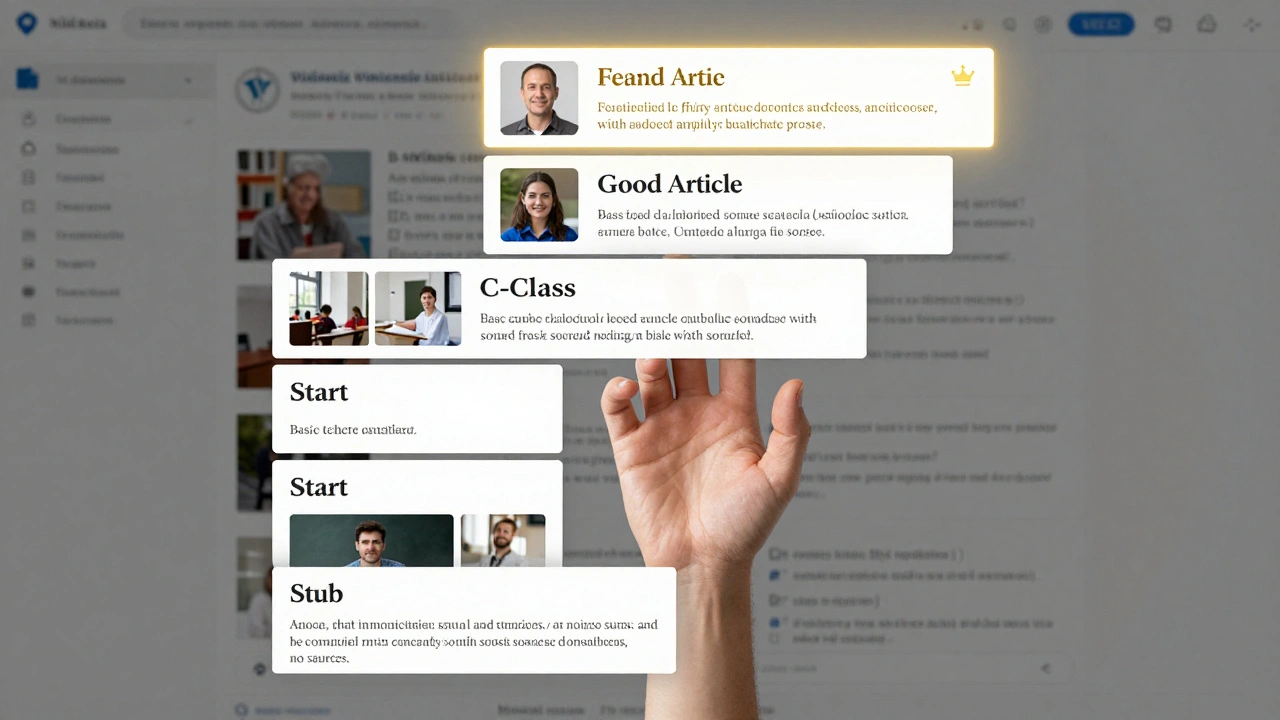
Wikipedia doesn’t just let anyone publish anything and call it done. There’s a formal system to rate articles based on completeness, accuracy, sourcing, and writing quality. These ratings aren’t just for show - they help editors prioritize work, guide new contributors, and signal to readers how much trust they can place in the content. There are six main quality classes, ranked from lowest to highest:- Stub
- Start
- C-Class
- B-Class
- Good Article (GA)
- Featured Article (FA)
Stub: The Bare Minimum
A Stub is the starting point. It’s a single paragraph, maybe two, with no references. You’ll see these on obscure towns, minor characters, or niche scientific terms. For example, an article on "The 1987 Maple Grove Fire Department" might be a Stub if it just says, "The Maple Grove Fire Department was established in 1987. It has 12 volunteers." Stubs aren’t bad - they’re just incomplete. The goal isn’t to delete them, but to expand them. Add context: Why was the department created? What equipment do they use? Who were the founding members? A Stub becomes a Start when it has a basic structure and at least one reliable source.Start: Getting Organized
A Start-class article has more than a paragraph. It usually has a clear lead section, a few subsections, and maybe a timeline or list. It still lacks depth, but it’s structured. For example, an article on "Lithium-ion batteries" might explain what they are, list common uses, and mention a few manufacturers - but without citations for each claim. The key difference between Stub and Start is organization. Start articles have a logical flow. They’re not just a pile of facts. You’ll often see these on topics that have been created recently but haven’t been worked on yet. To improve a Start, focus on adding references. Every factual claim needs a source. Wikipedia doesn’t accept personal knowledge or blog posts.C-Class: Solid, But Not Polished
C-Class is where most active articles live. It’s the "good enough" tier. A C-Class article has:- Comprehensive coverage of the main topic
- Multiple reliable sources for all key claims
- Clear structure with headings and subheadings
- No obvious factual errors
B-Class: Close to Professional
B-Class articles are what you’d expect from a decent encyclopedia entry. They’re well-researched, well-written, and balanced. They include:- Thorough coverage of all major aspects
- Multiple high-quality sources per section
- Clear, neutral tone
- Relevant images or media
- Proper citations using Wikipedia’s citation templates
Good Article: The Gold Standard Before Featured
Good Article (GA) status is a big deal. It’s awarded only after a formal review process. To qualify, an article must:- Meet all B-Class criteria
- Be stable (no edit wars or frequent major changes)
- Have no copyright violations
- Be written in clear, engaging prose
- Include a well-written lead section that summarizes the entire article
Featured Article: The Pinnacle
Featured Article (FA) is the highest honor on Wikipedia. Less than 0.1% of articles ever reach this level. To become Featured, an article must:- Be a Good Article first
- Be exceptionally comprehensive and well-written
- Have outstanding prose - clear, engaging, and free of jargon
- Include high-quality images with proper licensing
- Have no outstanding issues - no stubs, no unsourced claims, no formatting inconsistencies
- Pass a rigorous peer review with zero objections
How to Improve an Article’s Class
If you want to raise an article’s quality class, here’s how:- Check its current class on the article’s talk page. Look for the {{Stub}}, {{Start}}, or {{C-Class}} template.
- Read the assessment criteria for the next level. Each class has a detailed checklist on Wikipedia’s help pages.
- Find gaps. Look for claims without sources. Look for sections that are too short. Look for outdated information.
- Add reliable sources. Use Google Scholar, JSTOR, books from libraries, or trusted news sites like BBC, Reuters, or The New York Times.
- Improve structure. Use clear headings. Break long paragraphs. Add lists where helpful.
- Write in neutral tone. Avoid phrases like "in my opinion" or "everyone knows." Stick to facts.
- Ask for feedback. Post a note on the article’s talk page asking experienced editors to review your changes.
Why Quality Matters
You might think, "Who cares if an article is C-Class or B-Class? It’s just Wikipedia." But quality affects real people. Students use Wikipedia for research. Doctors check it for medical info. Policymakers read it for background on complex topics. A poorly sourced article on vaccine side effects can spread misinformation. A well-written, fully sourced article can save lives. Wikipedia’s quality system exists because the stakes are real. When you improve an article, you’re not just editing text - you’re helping build a trusted public resource. That’s why editors who focus on quality are among the most respected on Wikipedia.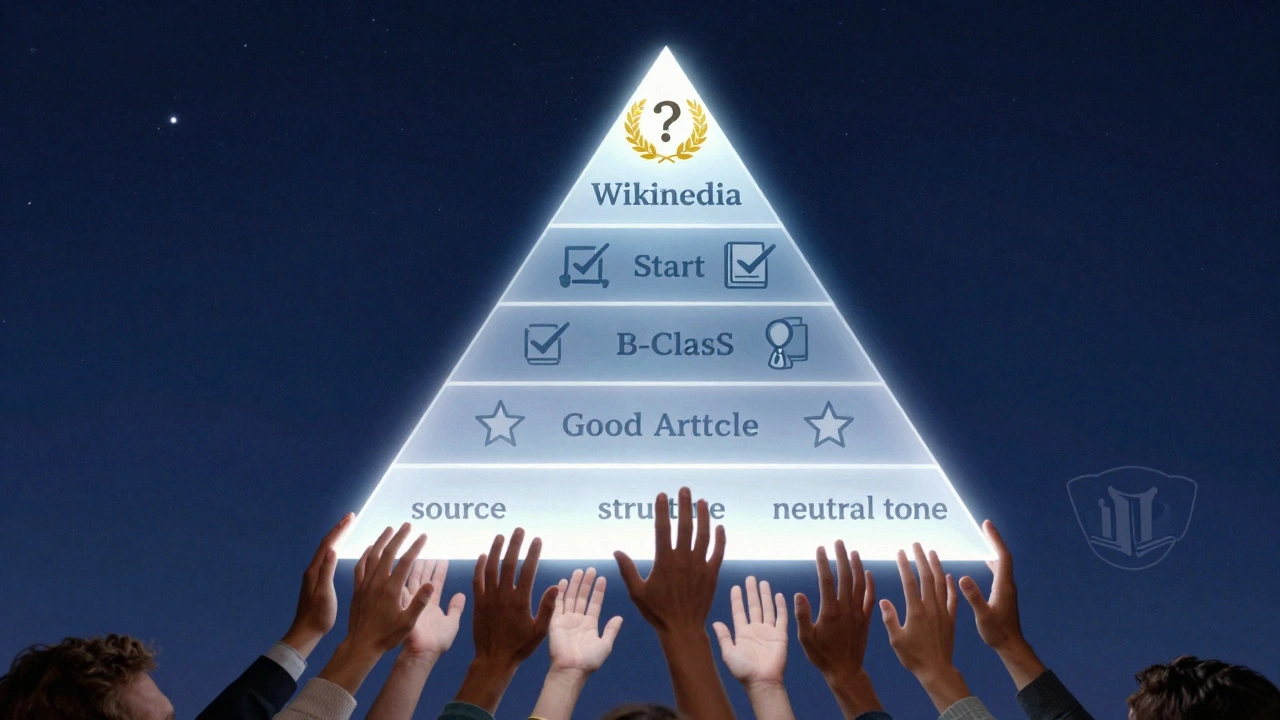
Common Mistakes Editors Make
Even experienced editors stumble. Here are the top errors that block articles from rising in quality:- Using blogs, forums, or personal websites as sources - these aren’t reliable.
- Adding original research - Wikipedia doesn’t publish new findings, only summaries of published work.
- Writing in a promotional tone - "This is the best smartphone ever" is not allowed.
- Ignoring citations for common knowledge - even "The Earth orbits the Sun" needs a source if it’s part of a larger claim.
- Not updating outdated information - an article on "2020 election results" that doesn’t mention the 2024 certification is incomplete.
Tools to Help You
Wikipedia has tools built right into the interface to help you assess and improve articles:- The Article Assessment tool on talk pages lets you see current ratings and suggested improvements.
- The ClueBot NG bot flags unsourced claims and potential copyright issues.
- WikiProject pages (like WikiProject Medicine or WikiProject History) offer checklists, templates, and mentorship.
- The Pageviews Analysis tool shows how many people are reading the article - helping you prioritize high-traffic topics.
What Happens After Featured?
Once an article becomes Featured, it doesn’t stop evolving. New research comes out. Events change context. A Featured article on "Climate Change" in 2020 might need updates in 2026 based on new IPCC reports. Featured status isn’t permanent. Articles can be demoted if they fall out of date or lose quality. That’s why ongoing maintenance matters. The best editors don’t just create Featured Articles - they keep them that way.Next Steps for New Editors
If you’re just starting out:- Find a Stub or Start article in a topic you care about - maybe your hometown, a hobby, or a favorite book.
- Add one reliable source and expand the lead paragraph.
- Save your edit and check the talk page for feedback.
- Repeat. One edit at a time.
How do I find out what quality class an article is currently rated?
Look at the top of the article’s talk page. You’ll see a template like {{C-Class}} or {{GA}}. Click on it to see the full assessment and any feedback from reviewers. If no template is there, the article hasn’t been formally assessed yet.
Can I rate my own article?
No. Only experienced editors can assign quality ratings. You can suggest a rating on the talk page, but a peer review is required for official classification. This prevents bias and ensures consistency.
Do I need to be a registered user to improve article quality?
No, you can edit anonymously. But registered users have more tools available - like watchlists, talk page notifications, and the ability to participate in formal reviews. Creating an account is free and takes less than a minute.
What sources count as reliable on Wikipedia?
Reliable sources include peer-reviewed journals, university publications, major newspapers (like The Guardian or The Washington Post), books from established publishers, and official reports from government or international organizations. Avoid blogs, social media, personal websites, and self-published content.
How long does it take to get an article to Featured status?
It varies. Some articles reach Featured status in a few months with active editing. Others take years. It depends on the topic’s complexity, how much existing material is available, and how many editors contribute. The key is consistency - not speed.