
Most people think of Wikipedia as a finished product, a static repository of facts. But behind the scenes, it is a living ecosystem driven by human effort. The biggest threat to this ecosystem isn't bad data or server crashes; it's the silent exit of the people who build it. Understanding editor churn is critical because if you lose your core contributors, the quality of the encyclopedia drops, and eventually, the project stalls. This article breaks down how researchers model the lifecycle of a Wikipedia editor, from their first click to their final edit, and why predicting retention is harder than it looks.
The Anatomy of an Editor's Journey
To understand churn, we first need to define what an "editor" actually is in the context of Open Source Collaboration. In academic research, an editor is typically defined as any user who has made at least one substantive edit to an article. However, not all editors are created equal. Researchers often segment users into distinct phases based on their activity levels over time.
The standard lifecycle model follows three main stages:
- Onboarding: The period immediately following registration or the first edit. This is where friction is highest. Newcomers face complex editing interfaces, strict community norms, and potential conflict with experienced users.
- Active Contribution: The middle phase where an editor regularly edits articles, participates in discussions, and builds social capital within the community. This stage varies wildly in duration; some last months, others years.
- Dormancy or Churn: The point at which an editor stops contributing. In most models, churn is defined as a lack of activity for a specific threshold, often 90 days or six months, depending on the study's scope.
What makes this tricky is that "churn" isn't always permanent. Many editors return after a break, a phenomenon known as reactivation. Therefore, modern models treat churn as a probabilistic state rather than a binary switch. An editor might be dormant for two years but still have a high probability of returning if they see a notification about an article they previously edited.
Why Do Editors Leave? The Drivers of Attrition
If you ask a former Wikipedia editor why they quit, you’ll get a dozen different answers. But when you aggregate this data across thousands of users, patterns emerge. Research consistently points to three primary drivers of attrition: social friction, task complexity, and perceived impact.
Social Friction is often cited as the number one killer of new editors. Wikipedia has a unique culture that can feel unwelcoming to outsiders. A new user might make a minor improvement to an article, only to find it reverted by a veteran editor with a curt comment like "Citation needed" or "Notable?". Without context, this feels hostile. Studies show that negative interactions in the first week significantly increase the likelihood of permanent churn.
Task Complexity refers to the cognitive load required to maintain an article. Editing text is easy; maintaining accuracy, neutrality, and formatting according to style guides is hard. As editors gain experience, they realize that keeping up with changes across multiple articles is exhausting. When the effort-to-reward ratio tips, they leave.
Perceived Impact is the psychological belief that their work matters. If an editor feels their contributions are invisible or unappreciated, motivation drops. Conversely, recognition through badges, thank-you messages, or seeing their name in the article history can boost retention.
Modeling Churn: From Simple Statistics to Machine Learning
How do we predict who will leave? Early research relied on simple statistical methods, like survival analysis. These models look at time-to-event data (time until an editor stops editing) and calculate hazard rates. While useful for getting a general sense of stability, these models struggle to capture the complex, non-linear behaviors of individual users.
Modern approaches use machine learning algorithms to classify editors as "likely to churn" or "likely to stay." These models ingest features derived from an editor's history, such as:
- Edit Frequency: How often they log in and make changes.
- Article Diversity: Whether they focus on one topic or many.
- Interaction History: Number of talk page comments, reverts received, and thanks given.
- Account Age: How long since they registered.
Algorithms like Random Forests and Gradient Boosted Trees have shown strong performance in this area. They can identify subtle patterns, such as an editor who usually edits every Tuesday but missed the last three Tuesdays, flagging them as at-risk. The key advantage here is granularity. Instead of saying "40% of new editors churn," the model says "Editor X has a 75% probability of churning within 30 days due to recent reverts and declining edit frequency."

Retention Strategies Based on Data
Predicting churn is useless if you don't act on it. The goal of lifecycle modeling is to inform intervention strategies. Based on the drivers identified earlier, successful retention programs target specific pain points.
For new editors, the focus is on reducing social friction. Initiatives like "WikiProject Newcomer Care" assign mentors to help guide first-time editors. Data shows that editors who receive positive feedback within their first 48 hours are twice as likely to remain active after one year. The strategy here is speed: catch the negative sentiment before it calcifies into resentment.
For veteran editors, the focus shifts to workload management and recognition. Tools that track contribution metrics and provide automated acknowledgments help maintain morale. Additionally, identifying "at-risk" veterans allows the community to reach out personally, asking for their input on major policy decisions. This reinforces their sense of ownership and impact.
| Method | Complexity | Accuracy | Best Use Case |
|---|---|---|---|
| Survival Analysis | Low | Moderate | General trend monitoring |
| Logistic Regression | Medium | Good | Identifying key risk factors |
| Random Forest | High | Very Good | Individual user prediction |
| Deep Learning | Very High | Excellent | Large-scale behavioral sequencing |
The Role of Community Structure
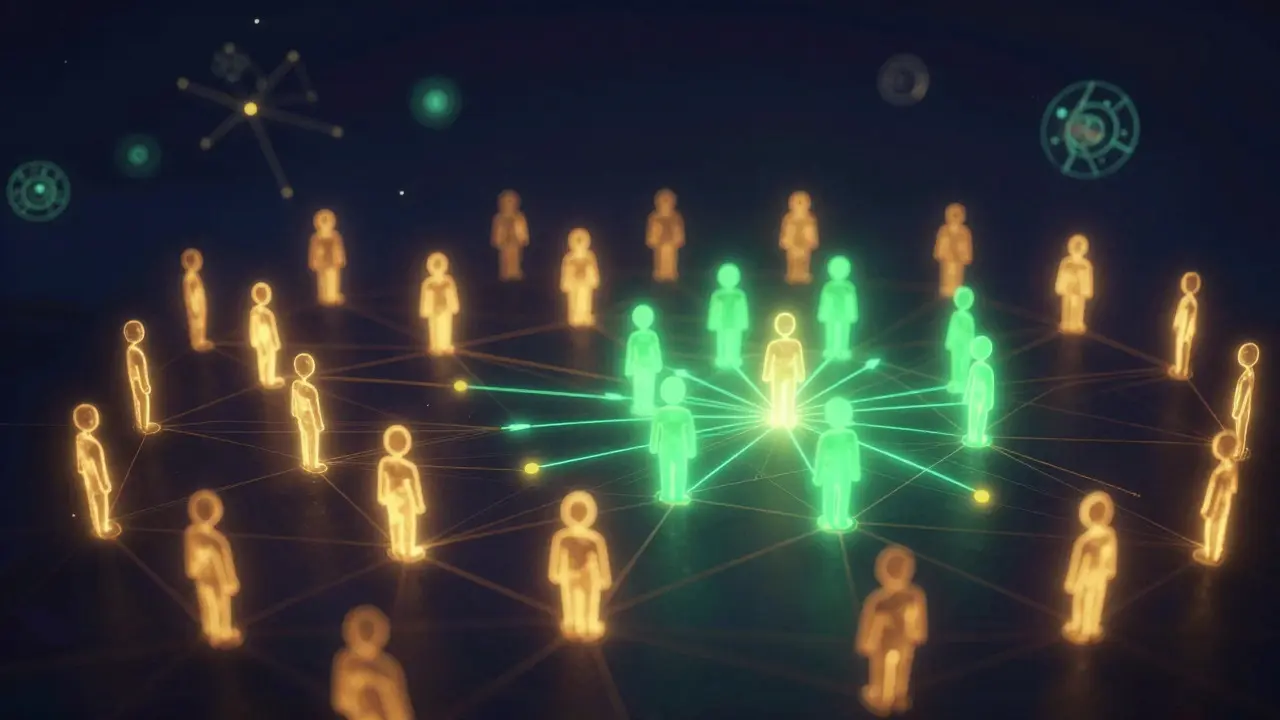
You can't model editor behavior in isolation. Wikipedia is a network. An editor's retention is heavily influenced by their position within the community graph. Isolated editors are far more likely to churn than those embedded in clusters of active collaborators.
Researchers use network analysis to map these relationships. If an editor frequently interacts with the same group of five people, they form a "community of practice." When one member of this tight-knit group leaves, the others are statistically more likely to follow. This cascading effect means that retaining key "hub" editors-those with many connections-is disproportionately important for overall platform health.
This insight changes how we view retention. It’s not just about fixing the individual user's experience; it’s about strengthening the social fabric. Interventions that encourage cross-project collaboration can reduce silos and create redundant support networks, making the community more resilient to individual departures.
Challenges in Current Research
Despite advances, significant gaps remain in our understanding. One major issue is the definition of "success." Most models focus on edit count, but does editing 100 times mean more success than editing 10 times with high-quality, lasting impact? We lack robust metrics for qualitative contribution.
Another challenge is data bias. Most studies rely on historical logs, which reflect past behaviors. If the Wikipedia interface changes drastically, or if a new mobile app launches, old models may fail to predict future behavior accurately. The dynamic nature of the platform means models require constant retraining.
Finally, there is the question of intent. Does an editor who stops editing because they found their niche elsewhere represent a failure of retention? Or is it a natural graduation? Distinguishing between healthy attrition (users moving on after achieving their goals) and unhealthy churn (users leaving due to frustration) requires nuanced interpretation of behavioral signals.
Future Directions in Lifecycle Modeling
Where does this go next? The frontier lies in real-time predictive analytics. Instead of waiting for monthly reports, tools could integrate directly into the editing interface, providing gentle nudges to at-risk users. Imagine a system that detects a drop in edit frequency and suggests a low-effort task, like updating a reference, to re-engage the user without overwhelming them.
We also expect to see more integration with external data sources. By linking Wikipedia activity with broader trends in digital participation, researchers might uncover macro-level factors influencing volunteerism. Are economic downturns affecting editor retention? Do global events spike interest in specific topics, temporarily boosting engagement?
Ultimately, the goal isn't just to keep people on Wikipedia. It's to foster a sustainable environment where contribution feels rewarding, manageable, and socially connected. By refining our models of churn and retention, we move closer to ensuring that the world's largest encyclopedia remains a vibrant, collaborative space for decades to come.
What is the average lifespan of a Wikipedia editor?
There is no single average, as it varies by language version and era. However, studies suggest that the median time to churn for new editors is often less than six months. Long-term active editors typically remain for several years, forming a stable core of contributors.
How is churn defined in Wikipedia research?
Churn is generally defined as a period of inactivity exceeding a set threshold, commonly 90 days or 6 months. Some models use dynamic thresholds based on an editor's previous activity patterns to account for varying commitment levels.
Which machine learning algorithm is best for predicting editor churn?
Gradient Boosted Trees and Random Forests are currently considered the gold standard for tabular data like edit histories. They offer a good balance between accuracy and interpretability, allowing researchers to understand which features drive predictions.
Does social interaction really affect retention?
Yes, significantly. Positive social interactions, such as thanks and mentorship, correlate strongly with longer retention periods. Negative interactions, like unexplained reverts, are among the strongest predictors of early churn.
Can dormant editors be reactivated?
Yes, reactivation is possible. Targeted notifications about changes to articles they previously edited or invitations to specific projects can successfully bring back dormant users, though success rates vary widely.