You’ve spent hours refining a topic on Wikipedia, polishing citations, and balancing perspectives. But how do you know if your work actually meets the platform’s rigorous benchmarks? It’s not just about writing well; it’s about hitting specific, measurable targets that separate average entries from the encyclopedia’s elite tier.
Most editors never cross the threshold from "acceptable" to "exemplary." The difference lies in understanding the distinct criteria for Good Articles (GA) and Featured Articles (FA). These aren’t subjective awards based on popularity or length. They are codified standards maintained by the community to ensure reliability, neutrality, and completeness. If you’re aiming to elevate your contributions, you need to know exactly what the reviewers look for-and where most drafts fail.
The Hierarchy of Wikipedia Content Quality
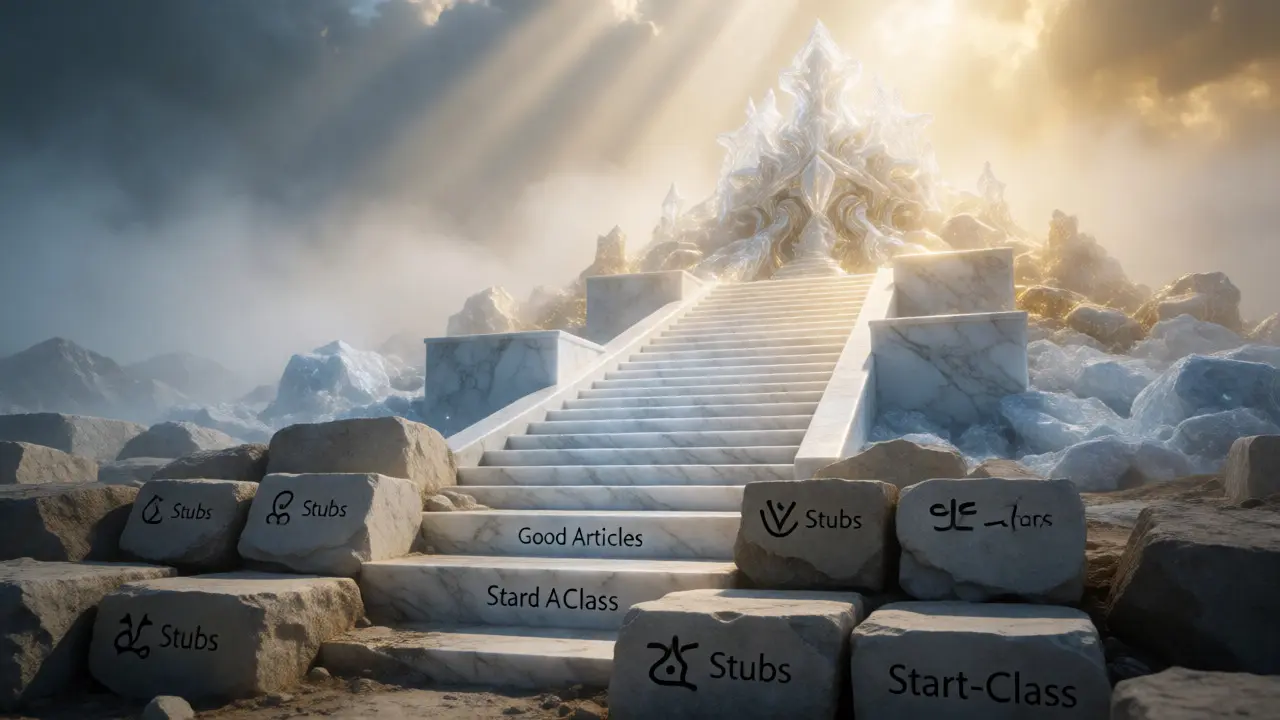
Think of Wikipedia’s quality assessment as a ladder. At the bottom, you have stubs and start-class articles-entries that exist but lack depth. As you climb, you reach B-Class, then Good Article status, which signifies a reliable, well-sourced, and neutral resource suitable for general readers. Above that sits the Featured Article, the gold standard representing the best work the project has to offer.
Why does this hierarchy matter? Because it dictates visibility and trust. Featured Articles appear on the main page rotation, signaling to millions of daily visitors that this is vetted, high-quality information. Good Articles serve as templates for other editors, showing what a solid entry looks like without necessarily being perfect. Understanding these tiers helps you set realistic goals. You don’t need to aim for FA immediately. Securing GA status is a massive achievement and often sufficient for establishing credibility in niche topics.
The process isn’t automated. Unlike some platforms where algorithms judge content, Wikipedia relies on human review. For Good Articles, you submit a nomination to the Good Article Candidates page. Reviewers check against six strict criteria. For Featured Articles, the bar is higher, involving a more thorough peer review process known as Featured Article Candidate (FAC) reviews.
Decoding the Six Criteria for Good Articles
To earn the Good Article badge, an entry must satisfy six specific requirements. Missing even one disqualifies the article. Let’s break down what each actually means in practice, stripping away the jargon.
- Prose: The writing must be engaging, clear, and concise. No filler words, no academic pretension, and absolutely no copyright violations. If a sentence requires three re-reads to understand, it fails.
- Comprehensiveness: Does the article cover all major aspects of the topic? A biography missing key career milestones fails here. A historical event lacking context on causes or consequences also fails.
- Neutrality: This is the hardest hurdle. The tone must be impartial. Avoid loaded language like "notorious," "visionary," or "controversial" unless citing a source that uses those terms. Present significant viewpoints fairly, giving weight proportional to their prominence in reliable sources.
- Factuality: Every claim needs verification. Not just any source, but reliable sources-peer-reviewed journals, reputable news outlets, or published books. Blogs and self-published works rarely cut it.
- Stability: The article shouldn’t be in the middle of an edit war. If two editors are constantly reverting each other’s changes, it’s unstable. Wait until consensus forms before nominating.
- Illustrations: Images should be relevant, properly licensed, and captioned. Too many images clutter the page; too few make it dry. Ensure files comply with copyright laws.
Notice what’s missing? There’s no requirement for "originality" in the sense of new research. Wikipedia summarizes existing knowledge. Your job is synthesis, not discovery. Many editors get rejected because they try to inject personal analysis rather than reporting what reliable sources say.

What Elevates a Good Article to Featured Status?
If Good Articles are excellent, Featured Articles are exceptional. The jump from GA to FA involves stricter scrutiny on style, structure, and sourcing depth. While GA allows for minor flaws, FA demands near-perfection.
The primary differentiator is prose quality. Featured Articles read like professional journalism or encyclopedic prose. Sentences vary in length and structure. Transitions between paragraphs are seamless. Passive voice is minimized. Editors often rewrite entire sections during FAC reviews to achieve this flow.
Sourcing becomes more critical at the FA level. It’s not enough to cite a newspaper article. Reviewers expect multiple independent sources backing up major claims. If a controversial statement appears, it needs robust support from diverse, high-quality references. Over-reliance on a single source-even a good one-is a common rejection reason.
Structure also plays a bigger role. Featured Articles often include comprehensive lead sections that summarize the entire article in accessible language. They use subheadings effectively to guide the reader. Tables, infoboxes, and diagrams are integrated smoothly, not tacked on as afterthoughts. The visual presentation matters as much as the text.
| Criterion | Good Article (GA) | Featured Article (FA) |
|---|---|---|
| Prose Style | Clear and correct; minor stylistic issues allowed | Professional, engaging, polished; zero tolerance for awkward phrasing |
| Sourcing Depth | Adequate coverage of major points; reliable sources required | Extensive, multi-source verification; preference for scholarly or primary sources |
| Completeness | Covers all major aspects; minor gaps acceptable | Exhaustive coverage; addresses edge cases and nuances |
| Review Process | Single reviewer check against checklist | Multiple reviewers; detailed critique and revision cycles |
| Time Investment | Weeks to months of editing | Months to years of collaborative refinement |
The Review Process: What Actually Happens When You Nominate
Nominating an article feels like submitting homework to a strict teacher. For Good Article Candidates, you post a template on the candidate page. Other editors then review it. They might leave comments asking for clarification, pointing out uncited claims, or suggesting structural changes.
Don’t take criticism personally. Reviewers are volunteers aiming to uphold standards. If someone says your neutrality is off, they usually provide examples. Fixing these issues quickly increases your chances of promotion. Ignoring feedback leads to stale nominations, which are often closed without action.
For Featured Article Candidates, the process is longer. It can last weeks. During this time, the community debates whether the article meets the high bar. Consensus determines the outcome. Sometimes, an article gets promoted despite minor objections if the overall quality is undeniable. Other times, it’s demoted back to GA or lower if fundamental flaws emerge late in the game.
One pitfall to avoid: gaming the system. Don’t nominate an article just to see if it passes. Only nominate when you genuinely believe it meets the criteria. Wasting reviewers’ time annoys the community and can hurt your reputation as an editor. Read recent successful nominations to gauge the current climate. Standards evolve slightly over time, so staying updated is crucial.

Common Pitfalls That Kill Nominations
Even experienced editors face rejection. Why? Usually, it’s due to recurring mistakes that violate core policies. Here are the big ones.
Copyright Violations: This is fatal. Copying text from another website, even with attribution, breaks Wikipedia’s licensing rules. You must paraphrase everything. If you’re unsure, run a plagiarism checker. Better yet, write from scratch using notes from your sources.
POV (Point of View) Bias: Subtle bias slips in easily. Using phrases like "unfortunately" or "thankfully" implies judgment. Stick to facts. Instead of saying "The policy was disastrous," say "Critics argued the policy led to economic downturns." Let the sources carry the opinion.
Inadequate Sourcing: Citing a blog post for a medical claim won’t fly. Use PubMed, JSTOR, or major newspapers. Check if your sources are outdated. Information from 2010 might be obsolete for tech topics today.
Poor Lead Section: The first paragraph sets the tone. If it’s vague or overly technical, readers bounce. Write the lead last, once the rest of the article is solid. Summarize the who, what, when, where, and why clearly.
Over-editing: Trying to fix everything at once can introduce errors. Make incremental changes. Save often. Ask for feedback early in the drafting phase, not just at the end.
Tips for First-Time Nominees
If you’re new to this, start small. Pick a topic you know well but isn’t overly contentious. Biography articles are great starting points because the structure is predictable. Avoid hot-button political issues until you’re comfortable with neutrality guidelines.
Collaborate. Find other editors interested in your topic. Two pairs of eyes catch errors faster. Join WikiProjects related to your subject area. These groups share resources and advice specific to certain fields, like medicine, history, or science.
Use tools wisely. Extensions like Twinkle help manage nominations and track responses. Reference managers like Zotero streamline citation formatting. Automation reduces busywork, letting you focus on content quality.
Finally, be patient. Quality takes time. An article might sit in review for days or weeks. Use that time to polish further. Revisit old edits. Check links. Ensure images load correctly. The more prepared you are, the smoother the process goes.
Can I promote my own article to Good Article status?
Yes, you can nominate your own article, but it’s recommended to have others review it first. Self-nomination is common, but having a second pair of eyes ensures you haven’t missed obvious flaws. Transparency about your involvement is key to maintaining community trust.
How long does the Good Article review process take?
It varies widely. Some reviews conclude in a few days, while others stretch into weeks depending on reviewer availability and the complexity of the article. Backlogs can occur during peak editing periods, so patience is essential.
What happens if my Featured Article nomination fails?
If a nomination fails, the article typically retains its previous rating (e.g., Good Article). You receive feedback explaining why it didn’t meet the FA criteria. You can address these issues and re-nominate later, usually after a cooling-off period to allow for substantial improvements.
Are there specific topics that are harder to get featured?
Controversial topics, such as politics or religion, often face stricter scrutiny regarding neutrality. Additionally, topics with limited reliable sources may struggle to meet comprehensiveness standards. Science and history topics with abundant scholarly literature tend to have clearer paths to FA status.
Do I need to cite every single fact?
Not every trivial fact needs a citation, but any non-obvious claim, statistic, or quote must be sourced. Common knowledge (like "Paris is in France") doesn’t require a reference. However, borderline facts should be cited to avoid disputes during review.