
Wikipedia isn’t just a collection of articles. It’s a living, breathing system run by volunteers - and without clear rules, it would fall apart. That’s where WikiProject governance comes in. These are the hidden frameworks that keep hundreds of topic-specific groups organized, productive, and fair. Whether it’s improving articles on climate science or cleaning up biographies of living people, WikiProjects rely on three core pillars: consensus, defined roles, and structured decision-making.
What Is a WikiProject?
A WikiProject is a group of editors who come together to improve Wikipedia content in a specific area. Think of them as specialized teams: one might focus on military history, another on video games, and another on medical accuracy. There are over 2,000 active WikiProjects, each with its own talk page, guidelines, and list of participants. They don’t have official power - no salaries, no headquarters - but they hold real influence because they shape what gets written, how it’s written, and who gets to decide.
Unlike formal organizations, WikiProjects don’t hire staff or vote in leaders. Instead, they operate on a simple idea: if enough people agree, it becomes policy. This is the heart of Wikipedia’s consensus model.
Consensus: The Engine of Wikipedia Democracy
Consensus doesn’t mean everyone agrees. It means no one strongly objects - and enough people support the idea to move forward. On WikiProjects, this plays out in talk page discussions, edit summaries, and formal proposals.
For example, a group working on articles about African history might propose changing how sources are cited to prioritize African scholars. The proposal gets posted on the project’s talk page. Editors weigh in: some support it, others raise concerns about accessibility, and a few stay silent. After two weeks, if the majority of active participants support the change and no one presents a compelling counterargument, the change is adopted. Silence isn’t consent - but persistent silence after clear discussion often is.
Consensus is messy. It takes time. It can be frustrating. But it’s the reason Wikipedia survives without top-down control. Without it, powerful editors could push through changes that alienate others. With it, even small voices can shift direction.
Roles in WikiProjects: Who Does What?
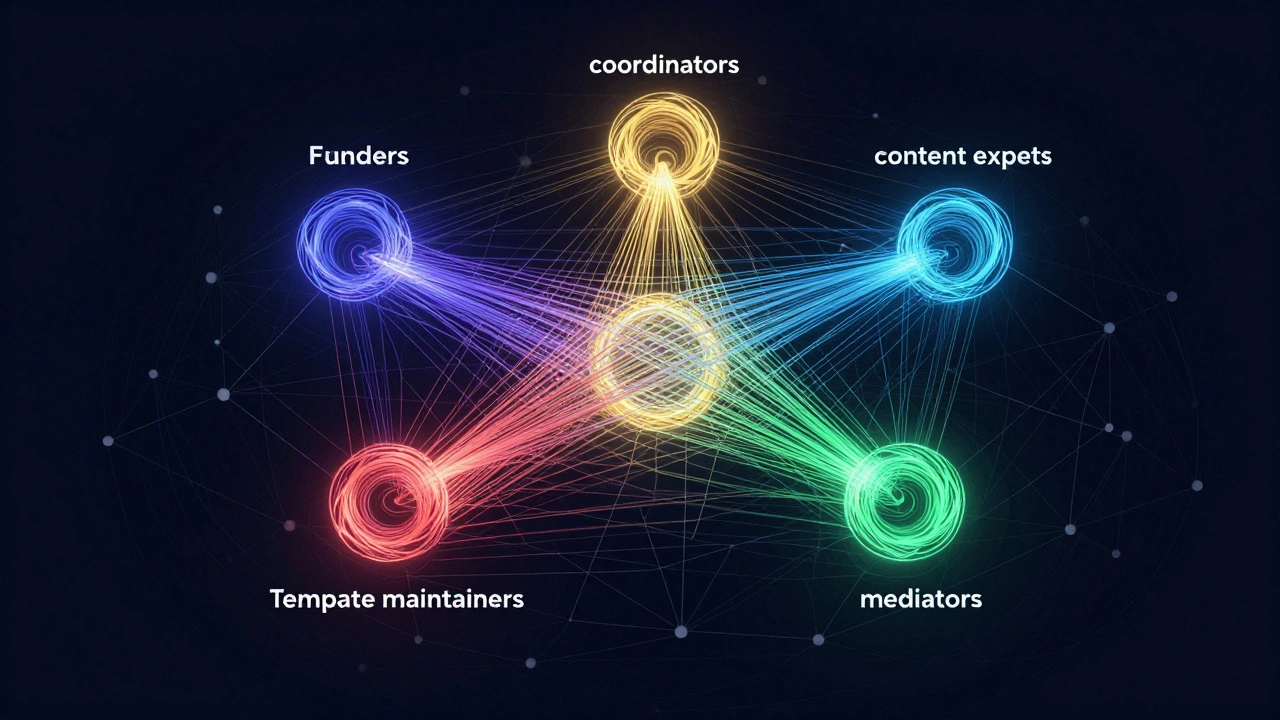
While WikiProjects don’t have official titles like CEO or manager, roles naturally emerge. These aren’t appointed - they’re earned through consistent, trusted work.
- Project founders - The first editors who started the project. They often set the initial scope and tone.
- Active coordinators - Editors who regularly organize discussions, update project pages, and moderate conflicts. They’re the glue holding things together.
- Content experts - Contributors with deep knowledge in the topic area. They review articles for accuracy, flag unreliable sources, and mentor newcomers.
- Template and bot maintainers - These editors build tools: automated tags that flag incomplete articles, standardized citation formats, or bots that notify editors about broken links.
- Mediators - Not official, but often recognized. These are editors others turn to when arguments get heated. They don’t impose solutions - they help people find common ground.
These roles aren’t permanent. If someone stops contributing, their influence fades. New people step up. It’s a meritocracy built on action, not titles.
How Decisions Are Made: From Proposal to Policy
Every major change in a WikiProject follows a pattern. It’s not random. It’s repeatable. Here’s how it usually works:
- Identify the issue - A problem is noticed: too many stub articles on European geography, or inconsistent quality in film reviews.
- Propose a solution - Someone writes a draft proposal on the project’s talk page. It includes background, reasoning, and examples.
- Discuss openly - At least 7-14 days of discussion. People comment, ask questions, offer alternatives. Editors who rarely speak up are encouraged to weigh in.
- Test it - The change is trialed on a few articles. If it works, great. If it causes confusion, it’s tweaked or dropped.
- Document and adopt - If consensus forms, the policy is added to the project’s guidelines page. It becomes a reference for future editors.
Some projects use formal voting - but only when necessary. Voting isn’t preferred because it can split communities. Consensus-building is slower, but it builds stronger buy-in.
Common Pitfalls and How Projects Avoid Them
Not every WikiProject thrives. Many fade away. Here are the top three reasons they fail - and how successful ones avoid them.
- One person dominates - If one editor makes all the decisions, others leave. Successful projects rotate coordination duties, invite new voices, and gently redirect control.
- No documentation - If decisions aren’t written down, new editors repeat old arguments. Top projects keep clear, updated guidelines with links to past discussions.
- Too much bureaucracy - Overly complex rules scare off volunteers. The best projects keep rules simple: clear goals, minimal steps, and a focus on improvement over perfection.
For example, WikiProject Medicine has over 3,000 participants. Its success comes from three things: a strict policy of using only peer-reviewed sources, a clear checklist for article quality, and a weekly “edit-a-thon” where editors collaborate in real time. It’s not perfect - but it’s structured enough to work.
How You Can Join and Make a Difference
Want to help? You don’t need to be an expert. You don’t even need to edit articles. Here’s how to get started:
- Find a project that matches your interest - search “WikiProject [topic]” on Wikipedia.
- Join the talk page. Read through recent discussions.
- Start small: fix a broken link, add a citation, tag an article for improvement.
- Ask questions. Most experienced editors are happy to help.
- After a few weeks, propose a small change - maybe a new template or a clearer guideline.
Every big project started with one person caring enough to speak up.
Why This Matters Beyond Wikipedia
WikiProject governance is more than a Wikipedia quirk. It’s a real-world model for how large, decentralized groups can make decisions without hierarchy. Businesses, open-source software teams, and community organizations all face the same challenges: how to include diverse voices, avoid burnout, and make decisions that stick.
Wikipedia’s approach shows that trust, transparency, and patience can replace top-down control. It’s not flawless - but it works. And it proves that when people are given space to collaborate, they often rise to the occasion.
Do WikiProjects have official authority on Wikipedia?
No. WikiProjects have no formal power. They can’t delete articles, block users, or override Wikipedia’s core policies. Their influence comes from consensus and reputation. Editors choose to follow their guidelines because they’re well-reasoned and widely supported - not because they’re enforced.
Can anyone start a WikiProject?
Yes. All you need is a clear topic, a few interested editors, and a talk page. You don’t need approval. Many projects begin with just two people discussing how to improve a set of articles. Over time, if others join and contribute, it grows. If not, it fades - and that’s okay.
How do WikiProjects handle conflicts between editors?
Most conflicts are resolved on the project’s talk page through discussion. If that fails, editors can request help from the Wikipedia Mediation Committee or file a formal dispute. But most projects avoid escalation by encouraging respectful dialogue and documenting decisions clearly. The goal isn’t to win - it’s to find a solution everyone can live with.
Are WikiProjects only for English Wikipedia?
No. Every language version of Wikipedia has its own WikiProjects. The German, Japanese, and Spanish Wikipedias all have thriving, self-governing project groups. Some even cross-language, like WikiProject Women in Science, which coordinates efforts across multiple language editions.
What happens if a WikiProject becomes inactive?
Inactive projects aren’t deleted. They’re archived. Their guidelines and discussions remain accessible for future editors. Sometimes, years later, someone revives an old project with new energy. Wikipedia’s history is built on layers - and even dormant projects can be valuable resources.