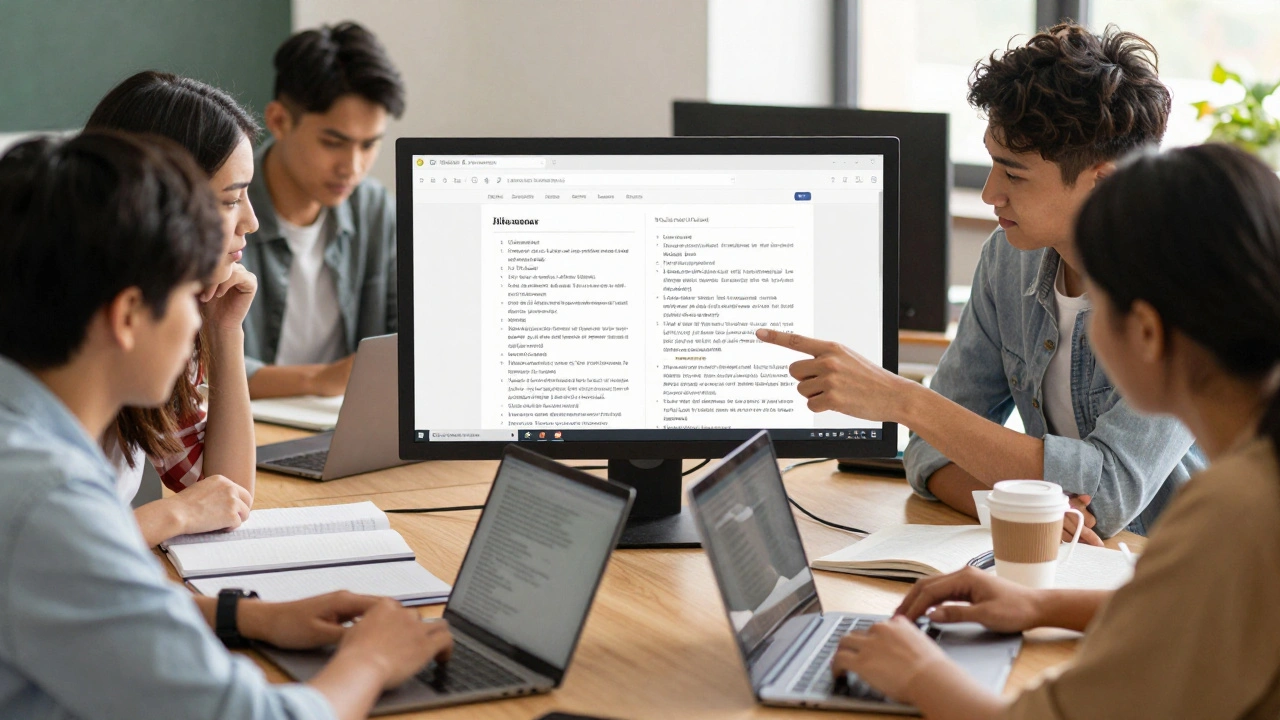
Every year, thousands of college students around the world edit Wikipedia as part of their coursework. They write articles, fix citations, and improve existing content-not for grades alone, but because they’re learning how to communicate knowledge clearly and responsibly. This isn’t just a fun side project. It’s a structured, real-world exercise in research, writing, and digital citizenship. And it’s all guided by WikiProject Students, a long-running initiative that helps educators align classroom assignments with Wikipedia’s core policies.
Why Wikipedia in the Classroom?
Most students have heard that Wikipedia isn’t a reliable source. But few have ever tried to edit it. That’s the gap WikiProject Students fills. Instead of writing a paper that only the professor reads, students publish work that millions of people can access, cite, and improve. A 2023 study by the Wikimedia Foundation found that student edits in 2022 contributed over 1.2 million new words to English Wikipedia, with nearly 70% of those edits still standing after six months. That’s not fluff. That’s lasting content.
Professors in history, biology, sociology, and even engineering have used this model. One biology class at the University of Wisconsin-Madison had students rewrite Wikipedia articles on neglected tropical diseases. Their edits didn’t just fix grammar-they added peer-reviewed sources, corrected outdated statistics, and linked to public health databases. By the end of the semester, five of those articles were rated as “C-class” quality by Wikipedia editors-meaning they met basic reliability standards.
How WikiProject Students Works
It’s not as simple as telling students to go edit Wikipedia. There are rules. And they’re strict. WikiProject Students gives instructors a roadmap to navigate them.
- Students must register for a Wikipedia Education Program account through their school’s instructor.
- They’re assigned a topic that’s underdeveloped, poorly sourced, or biased-never a topic they’re personally connected to.
- Every edit must follow Wikipedia’s five pillars: neutrality, verifiability, no original research, civility, and free content.
- Students submit drafts to their instructor first, then to Wikipedia’s “Articles for Creation” queue for review by volunteer editors.
There’s no rush. Editing happens over weeks, not days. Students learn that a single citation matters. That a biased phrase can mislead. That “everyone knows” isn’t good enough.
What Students Actually Do
Let’s say a student is assigned to improve the article on “The Role of Women in Early Computing.” They don’t just copy-paste from a textbook. They:
- Search for academic journals through their university library’s database.
- Find primary sources-letters, interviews, conference proceedings-that aren’t widely cited.
- Remove unsupported claims like “many women were ignored,” replacing them with “at least 12 women listed in the 1947 ACM conference proceedings were excluded from public recognition.”
- Add a “References” section with full APA or Chicago-style citations.
- Tag sections needing more sources with {{citation needed}} so other editors know where to look.
This isn’t just writing. It’s detective work. And it teaches critical thinking better than any multiple-choice quiz.
Common Mistakes and How to Avoid Them
Not every student edit succeeds. Some common pitfalls:
- Writing like a student paper-too much “I think” or “in my opinion.” Wikipedia doesn’t allow personal views.
- Adding original research-like summarizing a book in a new way. That’s not allowed. Only summarize published sources.
- Using unreliable sources-blogs, personal websites, YouTube videos. Only peer-reviewed journals, books from university presses, or major news outlets count.
- Conflict of interest-editing about your own school, family, or employer. That’s a red flag for Wikipedia’s community.
These mistakes get flagged quickly. But they’re also teachable moments. When a student’s edit gets reverted, they don’t just get a grade deduction-they get feedback from a real editor who says: “This claim needs a source from a 2020 study.” That’s real-world accountability.
Why This Matters Beyond the Classroom
Wikipedia is the fifth most visited website in the world. It’s often the first place people go to learn about anything-from quantum physics to local history. When students contribute, they’re not just improving an article. They’re helping shape public knowledge.
In 2024, a student-editing project at the University of Michigan improved articles on Indigenous languages. Before, many entries had no audio samples or speaker statistics. After the class, 17 new articles included recordings from native speakers and links to community language programs. That content didn’t just sit on Wikipedia-it was picked up by public libraries, school curricula, and even a Smithsonian exhibit.
These aren’t just assignments. They’re acts of public scholarship.
Getting Started as an Instructor
If you’re a professor thinking about trying this:
- Visit outreach.wikimedia.org/wiki/Education (no link in final output) to register your course.
- Use the Wikipedia Education Program Dashboard to track student progress, assign topics, and see which articles need help.
- Partner with a local Wikipedia editor-they’ll review student work and give feedback. Many volunteer editors are former professors.
- Start small: one assignment, one module. You don’t need to overhaul your syllabus.
The program is free. No technical skills required. And you don’t need to be a Wikipedia expert. The support system is built in.
What Happens After the Semester Ends?
Student edits don’t disappear. They stay on Wikipedia. And they keep getting improved.
One article on “The History of the Green River Formation,” edited by geology students in 2021, was later expanded by a professional paleontologist. That same article now has over 30 references and has been cited in three academic papers. The original student authors? They never saw it again. But their work lived on.
That’s the power of open knowledge. One person’s effort becomes part of a larger conversation. And that’s exactly what WikiProject Students is designed to teach.
Can students get in trouble for editing Wikipedia in class?
No, as long as they follow Wikipedia’s guidelines and use the official Education Program. The program gives students a protected account that shows they’re part of a verified course. This prevents their edits from being flagged as vandalism or conflict of interest. Instructors also review all work before submission, so edits are pre-vetted for policy compliance.
Do students need to cite Wikipedia in their own papers?
No. Wikipedia is not a primary source. Students are taught to use Wikipedia to find credible sources-like journal articles, books, or government reports-and then cite those instead. The goal is to use Wikipedia as a starting point, not an endpoint.
What if a student’s edit gets deleted?
It happens. Often because the edit lacked citations, was too opinionated, or duplicated existing content. But deletion isn’t failure-it’s feedback. Students learn to read the edit summary, understand why it was removed, and revise. Many successful Wikipedia editors say their first edits were rejected. That’s part of the learning curve.
Are there subject-specific guidelines for different classes?
Yes. WikiProject Students has sub-guidelines for science, history, social sciences, and humanities. For example, science classes must use peer-reviewed journals from databases like PubMed or JSTOR. History classes must use primary sources and avoid modern political interpretations. Each discipline has its own checklist, and instructors can download them from the Education Program portal.
Can high school students participate?
Yes, but with restrictions. The program is designed for college-level work, but some high schools run modified versions with teacher supervision and parental consent. The content must be age-appropriate, and students can’t edit topics involving politics, religion, or controversial current events. The focus is on neutral, factual subjects like biology, geography, or local history.