Imagine you’ve spent hours researching a topic, writing a draft, and polishing your prose. You hit “Save,” expecting it to look professional. Instead, a bot or an editor tags it as Start class, meaning it’s barely more than a stub. It’s frustrating. But what if you could aim higher? What if you knew exactly what editors look for when they upgrade an article to B-Classa level of quality that signifies a well-developed, comprehensive, and reliable entry on Wikipedia?
Achieving B-Class status isn’t about being perfect. It’s about being solid. It means your article covers the main points thoroughly, relies on high-quality sources, and follows Wikipedia’s core content policies without major violations. If you’re aiming to improve an article from C-Class or Start-Class to B-Class, you need a concrete plan. This guide breaks down the specific criteria, common pitfalls, and practical steps to get your article assessed correctly.
Understanding the B-Class Standard
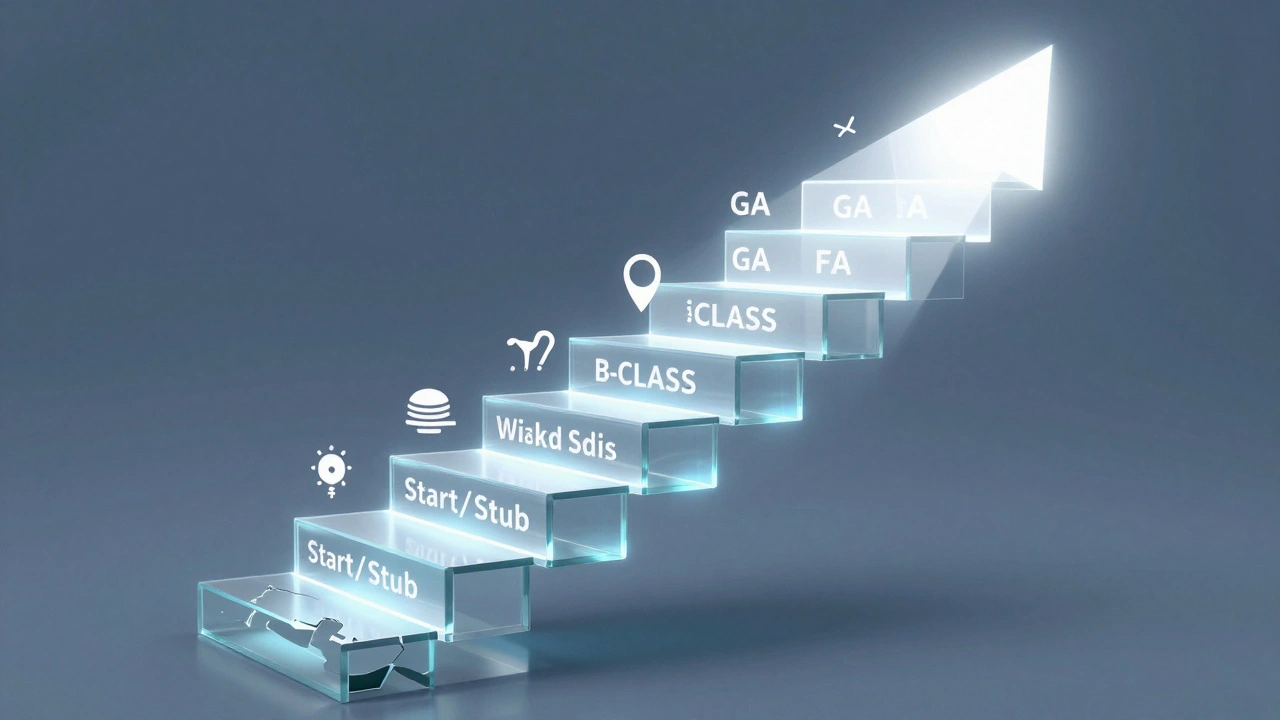
To understand B-Class, you first have to understand where it sits in Wikipedia’s hierarchy. The WikiProject Assessment Schemethe system used by Wikipedia communities to evaluate the quality and importance of articles uses a ladder. At the bottom, you have Stub and Start classes. In the middle lies B-Class. Above it are GA (Good Articles), A-Class, and FA (Featured Articles).
B-Class is often called the “workhorse” tier. It doesn’t require the exhaustive depth of a Featured Article, but it demands significantly more than a Start-Class entry. According to the general guidelines, a B-Class article must be:
- Well-written and free of obvious grammatical errors.
- Comprehensive, covering all major aspects of the topic.
- Neutral, presenting all significant viewpoints fairly.
- Verifiable, with citations supporting every factual claim.
- Stable, meaning it isn’t subject to frequent edit wars or major content disputes.
If your article meets these five pillars, you’re in the running. However, “well-written” and “comprehensive” are subjective terms. To pass inspection, you need to translate these vague goals into actionable checks.
The Core Content Requirements
The biggest gap between Start-Class and B-Class is usually coverage. A Start-Class article might cover the basics: who, what, where, and when. A B-Class article answers “why” and “how.” It explores context, significance, and impact.
First, look at your Lead Sectionthe introductory paragraph of a Wikipedia article that summarizes the entire entry. Does it stand alone? Can a reader understand the essence of the topic just by reading the first three paragraphs? The lead should summarize the most important information from the body, not introduce new details. It must include a clear definition, key dates, and the subject’s primary significance.
Next, examine the body structure. A B-Class article needs logical flow. Use Headingsstructural elements in Wikipedia articles that organize content into distinct sections effectively. Don’t just dump text. Break it down. For a biographical article, this might mean Early Life, Career, Personal Life, and Legacy. For a technical topic, it could be History, Mechanism, Applications, and Controversies. Each section should have enough depth to justify its existence. If a section has only one sentence, merge it or expand it.
Crucially, avoid “listicle” formatting. B-Class articles should read like essays, not bullet-point lists. Convert lists into narrative prose where possible. This improves readability and demonstrates synthesis of information rather than just data dumping.
Sourcing and Verifiability
You can write the most beautiful prose in the world, but if your sources are weak, your article won’t reach B-Class. Wikipedia’s core policy is Verifiabilitythe principle that readers must be able to check that material included in Wikipedia already appeared in a reliable published source. This means every factual statement needs a citation. Not just every paragraph-every claim.
What counts as a good source? For B-Class, you need secondary sources. Primary sources (like raw data sets, original interviews, or self-published blogs) are generally insufficient for establishing consensus or significance. You need books, peer-reviewed journals, reputable news outlets, and academic papers. Avoid circular references, such as citing other Wikipedia articles or fan sites.
Check your citations for reliability. Is the source independent? Did the author have a conflict of interest? If you’re writing about a controversial political figure, citing only their own speeches is a red flag. You need analysis from neutral third parties. Also, ensure your citations are formatted correctly using Citation Templatesstandardized tools in Wikipedia markup that format bibliographic references consistently like {{cite web}} or {{cite book}}. Messy inline links look unprofessional and make it hard for reviewers to verify facts quickly.
Neutrality and Tone
One of the fastest ways to fail a B-Class review is violating Neutral Point of ViewNPOV, a core Wikipedia policy requiring articles to represent all significant views fairly and proportionally (NPOV). This doesn’t mean you have to pretend everyone agrees. It means you must report disagreements accurately.
Scan your article for loaded language. Words like “brilliant,” “disastrous,” “unfortunately,” or “clearly” are editorializing. They inject opinion. Replace them with neutral descriptors. Instead of saying “The policy was a disastrous failure,” say “Critics argued the policy failed due to X, Y, and Z, while supporters claimed it achieved A and B.”
Balance is key. If there is significant controversy surrounding the topic, give it appropriate weight. A minor critique shouldn’t dominate a section about widespread acclaim, and vice versa. Use attributive phrasing: “According to Smith…” or “Jones argues that…” This keeps the tone objective.
Structure and Formatting Details
Small details matter. Reviewers look for polish. Here are the technical checks that often trip up aspiring B-Class articles:
- Infoboxes: Ensure the Infoboxa standardized summary box at the top of Wikipedia articles containing key data about the subject is complete and accurate. Missing fields or outdated images signal neglect.
- Categories: Are you categorized correctly? Too many categories clutter the page; too few make the article hard to find. Check the Category Guidelinesrules governing how Wikipedia organizes articles into hierarchical groups for your specific topic area.
- Internal Links: Link to relevant Wikipedia articles, but don’t over-link. Linking common words like “water” or “history” is unnecessary. Link proper nouns and specific concepts that help readers navigate.
- Images: Do you have a high-resolution, properly licensed image? Images should have descriptive captions that explain their relevance, not just repeat what’s visible.
Also, check for orphaned sections. Every part of the article should connect logically to the next. Transitions between paragraphs are vital. Use linking words to guide the reader through the argument.

The Peer Review Process
Before you officially request a B-Class assessment, run your article through Peer Reviewa collaborative process on Wikipedia where editors provide feedback on article quality before formal assessment. This is a low-stakes environment to catch issues early. Post your link on the relevant WikiProjecta group of Wikipedia volunteers dedicated to improving articles within a specific subject area talk page or the general Peer Review forum.
Ask specific questions. Don’t just say “Is this B-Class?” Ask, “Does the lead adequately summarize the controversies?” or “Are my sources balanced enough?” Editors appreciate specificity. It shows you’ve thought critically about your work.
When feedback comes in, act on it. If someone says a section is biased, rewrite it. If they cite missing sources, add them. Ignoring feedback is the quickest way to get rejected. Collaboration is the heart of Wikipedia.
| Class Level | Coverage Depth | Source Quality | Common Issues |
|---|---|---|---|
| Start-Class | Basic facts only | Often primary or weak secondary | Stub-like, lacks context |
| B-Class | Comprehensive major points | Reliable secondary sources | Minor gaps, slight bias |
| GA (Good Article) | Thorough and detailed | High-quality, diverse sources | Formatting inconsistencies |
| FA (Featured Article) | Exhaustive and definitive | Best available scholarship | Rare; requires perfection |
Common Pitfalls to Avoid
Even experienced editors stumble. Here are the most frequent reasons B-Class nominations fail:
- Original Research: Synthesizing sources to create a new conclusion is forbidden. You can only report what sources say. If Source A says X and Source B says Y, you can’t conclude Z unless a third source explicitly states Z.
- Biography of Living Persons (BLP): If you’re writing about a living person, strict rules apply. No unsourced negative claims. Any criticism must be backed by highly reliable sources. One mistake here can lead to immediate deletion.
- Over-reliance on One Source: Using a single biography for an entire article creates a bubble. Diversify your sources to show broader consensus.
- Poor Lead Summary: The lead is the first thing reviewers see. If it’s messy, they assume the rest is too. Polish the introduction meticulously.
Remember, B-Class is a milestone, not the finish line. It proves your article is trustworthy and useful. From there, you can aim for Good Article status, which involves even stricter scrutiny of prose and sourcing.
Final Checklist Before Submission
Before you tag your article for assessment, run through this final mental checklist:
- Is the lead section concise and comprehensive?
- Are all major aspects of the topic covered?
- Are all claims supported by reliable, secondary sources?
- Is the tone neutral and free of promotional language?
- Are headings logical and properly formatted?
- Is the infobox complete and up-to-date?
- Have I checked for copyright violations (no copy-pasted text)?
- Has the article been stable for at least a week?
If you answered yes to all of these, you’re ready. Submit your nomination on the relevant WikiProject page. Be patient. Reviews take time. And remember, every comment is a chance to learn. Writing for Wikipedia is a skill that sharpens with practice. Your goal isn’t just to get a badge; it’s to contribute knowledge that lasts.
How long does it take to get a B-Class assessment?
It varies widely depending on the WikiProject. Some active projects review articles within days, while others may take weeks or months. Patience is key. If no response occurs after two weeks, you can politely ping the project coordinators.
Can I nominate my own article for B-Class?
Yes, you can nominate your own work, but it must meet all criteria independently. Self-nomination is common, but reviewers will scrutinize it closely for bias. It’s often helpful to have another editor review it first via Peer Review.
What happens if my article fails the B-Class review?
Failure is normal. Reviewers will list specific issues. Address those problems-add sources, rewrite biased sections, or expand coverage-and resubmit later. Many articles go through multiple rounds before passing.
Do I need to be an experienced editor to achieve B-Class?
Not necessarily. New editors can produce B-Class articles if they follow the guidelines strictly. Focus on sourcing and neutrality. Experienced editors often mentor newcomers through the Peer Review process.
Is B-Class the highest quality level on Wikipedia?
No. Above B-Class are Good Articles (GA), A-Class, and Featured Articles (FA). FA represents the highest standard, requiring exhaustive coverage and flawless prose. B-Class is a solid intermediate step.
How do I find the right WikiProject for my article?
Look at the categories of similar articles. Most articles belong to multiple WikiProjects (e.g., Biography, Science, History). Choose the most relevant one for assessment. You can also check the article’s talk page for existing project banners.
Can I use blog posts as sources for B-Class?
Generally, no. Blogs are considered self-published and unreliable unless written by recognized experts in the field and cited by mainstream media. Stick to books, journals, and reputable news outlets for B-Class compliance.
What is the difference between B-Class and Good Article?
B-Class requires comprehensive coverage and reliable sources. Good Articles require everything in B-Class plus exceptional prose, stricter adherence to style guides, and a more rigorous review process involving multiple independent editors.