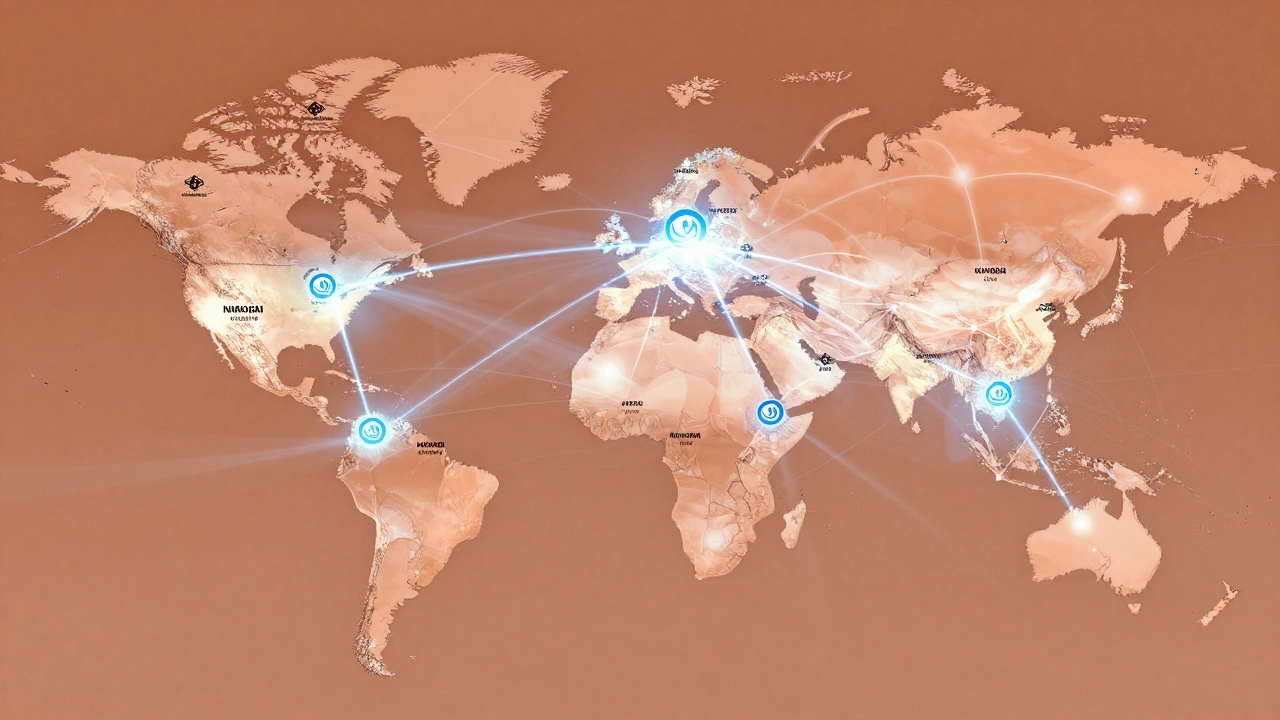
Wikipedia loads in under a second on your phone in Nairobi, your tablet in Jakarta, and your laptop in Reykjavik-even during a global news event that sends traffic soaring. How? It’s not magic. It’s CDN and edge caching working together at massive scale.
What a CDN actually does for Wikipedia
A content delivery network, or CDN, is a network of servers spread across the globe. Instead of every user in the world asking the same server in Virginia for a page, they get it from the closest one. Wikipedia uses a CDN to copy its entire encyclopedia to hundreds of locations. When you type "Albert Einstein" into your browser, you don’t pull the page from a single data center. You get it from a server in your region, often just a few miles away.
This cuts down travel time. Data moves at the speed of light, but even that’s not fast enough when it has to cross oceans. A request from Sydney to Virginia takes about 180 milliseconds just to get there. With a local edge server, that drops to 20 milliseconds. That’s the difference between a page feeling instant or frustratingly slow.
Edge caching: the real secret weapon
CDNs alone aren’t enough. What makes Wikipedia fast isn’t just having servers nearby-it’s what those servers store. That’s where edge caching comes in.
Edge caching means storing copies of frequently accessed pages right at the edge of the network, where users connect. Wikipedia’s edge servers don’t just hold static images or CSS files. They cache full HTML pages-thousands of them. When 50,000 people search for "Ukraine" after a major event, the first few requests go to the origin server. The rest? They’re served from the cache, instantly. No database query. No server processing. Just a file handed off in milliseconds.
Wikipedia caches pages for hours, even days, depending on how often they change. A biography page rarely updates, so it stays cached for a long time. A live news article might refresh every few minutes. The system adapts automatically. This reduces load on Wikipedia’s core servers by over 90% during traffic spikes.
How Wikipedia’s CDN is built differently
Most companies use commercial CDNs like Cloudflare or Akamai. Wikipedia does too-but not the way you’d expect. It doesn’t rely on one vendor. It runs its own infrastructure alongside partners.
The Wikimedia Foundation operates its own edge network called Cache Layer. It’s made up of thousands of servers in data centers around the world, many hosted by universities and research institutions. These aren’t fancy corporate facilities. They’re often modest rooms with racks of servers, maintained by volunteers and engineers who care about open knowledge.
Why build your own? Control. Wikipedia needs to handle massive, unpredictable traffic. During the 2020 U.S. election, traffic spiked 300% in a single day. During the Russia-Ukraine war, searches for "NATO" jumped 800%. Commercial CDNs can throttle or charge more during peaks. Wikipedia can’t. So it built a resilient, open, and cost-efficient system that scales without limits.
What gets cached-and what doesn’t
Not everything on Wikipedia is cached. The system is smart about what stays and what doesn’t.
- Cached: Static pages, infoboxes, images, templates, and article HTML. These make up over 95% of page views.
- Not cached: User-specific content like logged-in preferences, recent changes, edit histories, and personal notifications. These change too fast or are too personal to cache.
Even the search function isn’t cached. When you search for "quantum physics," Wikipedia doesn’t serve a pre-built result. It queries its database in real time. But once you click a result, that article gets cached immediately for the next 10,000 people.
This balance keeps the site fast without breaking personalization or accuracy.
Real-world impact: speed in low-bandwidth regions
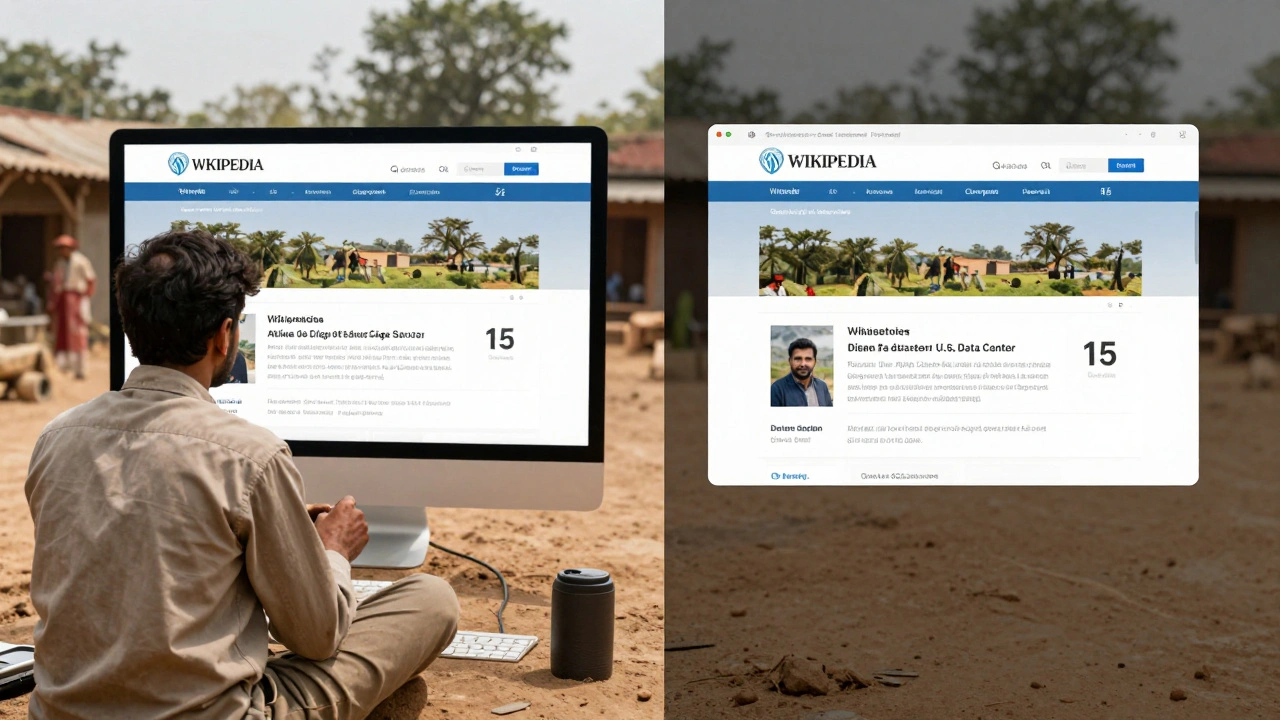
Wikipedia is used in places where internet connections are slow or expensive. In rural India, parts of Sub-Saharan Africa, and remote islands, users often have 2G or unstable Wi-Fi.
Edge caching makes a huge difference here. A 2MB article might take 15 seconds to load over 2G from the U.S. But from a local cache in Mumbai or Lagos? It loads in under 2 seconds. That’s not just convenience-it’s access to knowledge.
Wikipedia’s team tracks performance by region. They’ve found that in countries with poor connectivity, caching reduces load times by 70-85%. That’s why they prioritize placing servers in regions with high usage but low infrastructure. Today, Wikipedia has edge nodes in over 70 countries, including places like Nepal, Bolivia, and Senegal.

How Wikipedia keeps caches fresh
Caching sounds simple, but keeping it accurate is hard. What if someone edits a page while it’s cached?
Wikipedia uses a system called cache invalidation. When an article is edited, the system sends a signal to all edge servers holding that page’s cache. Those servers delete the old copy. The next person who asks for it gets the updated version from the origin server-and then it’s cached again.
It’s not perfect. Sometimes a change takes a few seconds to propagate. But for most users, the delay is invisible. And for articles that rarely change, like historical facts or biographies, the cache can last for days without issue.
Wikipedia also uses stale-while-revalidate. If a cached page is a little old, it still shows it-while quietly fetching the new version in the background. The user sees no delay. The system updates silently.
Why this matters beyond Wikipedia
Wikipedia’s approach isn’t just about being fast. It’s about being fair. Every person, no matter where they live or how much they pay for internet, should get the same speed. That’s not true for most websites. Big tech platforms often prioritize users in rich countries. Wikipedia doesn’t.
Its CDN model proves that global scale doesn’t require corporate profit. It can be built by a nonprofit, using open tools, volunteer power, and smart engineering. Other open projects-like LibreOffice, Signal, and the Internet Archive-now use similar setups.
Wikipedia’s system handles 12 billion page views a month. That’s more than Netflix and YouTube combined during peak hours. And it does it with a tiny tech team and no ads. The secret? Edge caching, done right.
What you can learn from Wikipedia’s setup
If you run a website-even a small one-you can borrow from Wikipedia’s model:
- Use a CDN, even a free one like Cloudflare, to serve static files from nearby locations.
- Cache full pages for users who aren’t logged in. It’s the easiest way to cut server load.
- Don’t cache everything. Personalized content should always be dynamic.
- Monitor performance in low-bandwidth regions. If your site is slow in Nigeria or Indonesia, you’re failing half your potential users.
- Use stale-while-revalidate to keep users happy while updating content silently.
You don’t need Wikipedia’s scale to benefit from edge caching. You just need to understand it.