Imagine asking ChatGPT for a quick fact about the French Revolution and getting a confident, well-written answer that is completely wrong.
This isn't a hypothetical scenario; it's a daily reality for millions of users. ChatGPT is a large language model developed by OpenAI that generates human-like text based on patterns learned from vast datasets. It doesn't "know" things in the way we do. Instead, it predicts the next most likely word. This fundamental difference creates a fascinating tension with Wikipedia, a free, web-based collaborative project intended to provide a neutral point of view for anyone to edit, an encyclopedic reference work.
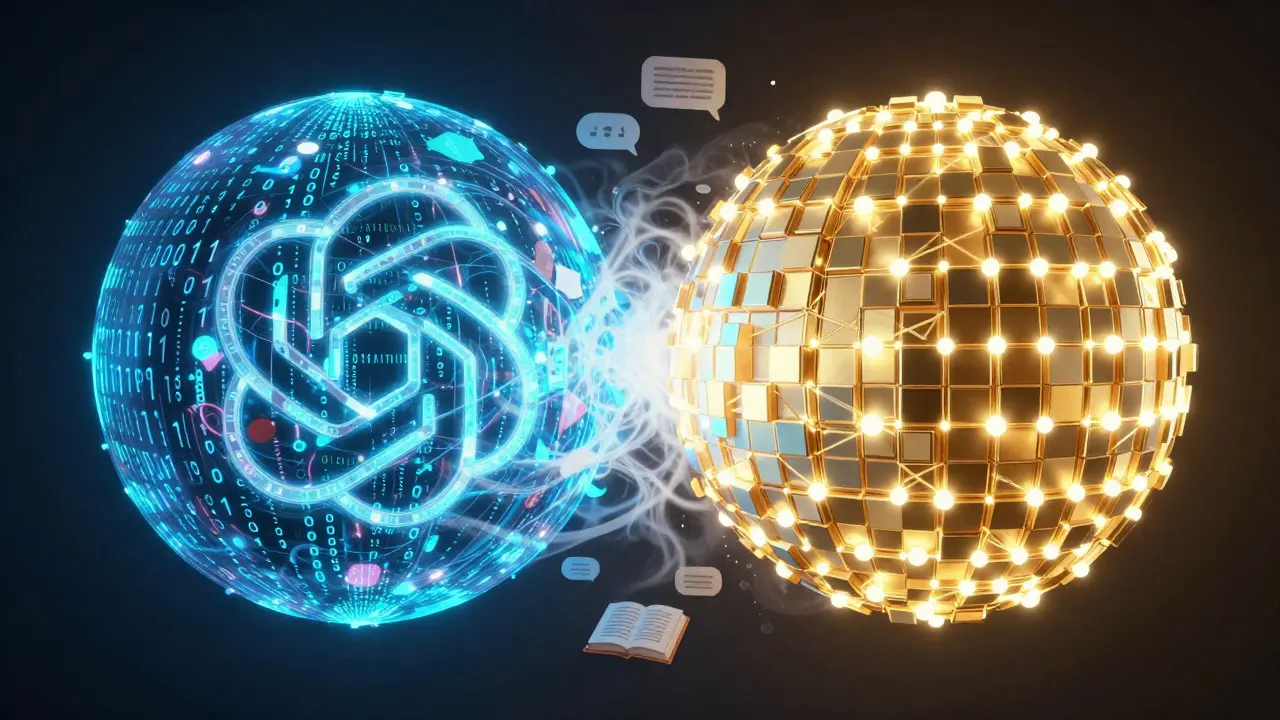
The relationship between these two giants of information is no longer just parallel; it's increasingly entangled. As generative AI becomes the default search tool for many, the role of traditional encyclopedic content is shifting from a primary source of truth to a backend verification layer. Here’s how this dynamic is reshaping how we consume and trust information.
The Core Difference: Prediction vs. Verification
To understand why ChatGPT and Wikipedia often conflict, you have to look at their underlying architectures. They solve different problems using opposite methodologies.
Wikipedia operates on consensus and citation. Every major claim should be backed by a reliable source. Editors debate, cite, and revise. If a statement lacks a reference, it gets flagged or removed. The goal is factual stability. It’s slow, bureaucratic, and sometimes outdated, but it’s anchored to evidence.
ChatGPT operates on probability and flow. Its goal is to generate coherent, fluent text that sounds correct. It draws from a snapshot of the internet (including Wikipedia, books, and news articles) captured during its training phase. However, it doesn't check sources in real-time unless specifically prompted to use a browsing tool. This leads to the phenomenon known as hallucination, the generation of plausible-sounding but factually incorrect information by an AI model.
Think of it this way: Wikipedia is like a library where every book has a librarian checking the spine for a catalog number. ChatGPT is like a very smart friend who remembers everything they’ve ever read but occasionally mixes up details because they’re trying to keep the conversation moving smoothly.
How AI Relies on Encyclopedic Content
Here’s the irony: while ChatGPT can contradict Wikipedia, it heavily depends on it. During the training process, large language models ingest massive amounts of text data. Wikipedia is one of the highest-quality, most structured, and linguistically diverse datasets available.
Because Wikipedia articles are written in clear, declarative sentences with consistent formatting, they are ideal for teaching AI what a "fact" looks like syntactically. Many developers argue that without high-quality encyclopedic data, early language models would have been far more erratic. In essence, Wikipedia provided the skeleton upon which the muscle of modern AI was built.
However, this reliance comes with a caveat: data drift. If a fact changes in the real world (e.g., a new capital city, a change in legal status), Wikipedia updates quickly. ChatGPT, however, remains frozen in time until the next model update. This means that for static historical facts, the two align closely. For dynamic current events, the gap widens significantly.
The Hallucination Problem: When AI Gets It Wrong
The most significant friction point between AI and encyclopedic content is accuracy. Studies have shown that when asked to cite sources, AI models frequently invent citations-fake book titles, non-existent journal articles, or misattributed quotes. This is dangerous because users tend to trust the confidence of the delivery over the content itself.
Consider a student writing a paper. They ask ChatGPT for a quote from a famous economist. The AI provides a perfect-looking block quote with page numbers. The student pastes it into their essay. Later, they try to find the source and realize it never existed. This is a classic hallucination.
In contrast, if that same student looked up the concept on Wikipedia, they would see a list of references at the bottom. While those references might need further verification, the structure forces a level of accountability that pure generation lacks.
Comparing the Two Approaches
To help visualize the trade-offs, let’s compare the key attributes of both platforms. This table highlights where each excels and where they fall short.
| Attribute | ChatGPT (Generative AI) | Wikipedia (Encyclopedic Database) |
|---|---|---|
| Primary Goal | Fluency and contextual relevance | Factual accuracy and neutrality |
| Update Frequency | Static (until model retraining) | Real-time (community edited) |
| Source Transparency | Low (often hidden or hallucinated) | High (explicit citations required) |
| User Interaction | Conversational and adaptive | Browsing and searching |
| Risk Profile | Hallucinations and bias | Vandalism and editorial bias |
| Best Use Case | Brainstorming, summarizing, drafting | Fact-checking, definition lookup, verification |
Notice the "Risk Profile" row. Neither system is perfect. Wikipedia suffers from vandalism and subtle editorial biases from its volunteer base. ChatGPT suffers from systemic biases present in its training data and the inherent risk of making things up. The key is knowing which risk you are willing to accept for your specific task.
The Shift in User Behavior
As of 2026, user behavior has shifted dramatically. We no longer treat search engines as directories. We treat them as assistants. This means the first step in research is often a conversational query rather than a keyword search.
However, savvy users have adopted a hybrid workflow:
- Ask AI for the Overview: Use ChatGPT to get a quick summary, identify key terms, or explain complex concepts in simple language.
- Verify with Encyclopedias: Cross-reference specific claims with Wikipedia or specialized academic databases.
- Deep Dive with Primary Sources: Follow the citations from the encyclopedia to original papers or news reports.

Challenges for Wikipedia in the AI Era
The rise of AI poses unique challenges for Wikipedia. If people stop reading full articles and only consume AI-generated summaries, does the detailed structure of Wikipedia matter less? Some editors worry that the incentive to maintain high-quality, deeply cited articles may diminish if the end-user never sees the footnotes.
Furthermore, there is a feedback loop emerging. AI models summarize Wikipedia. People read the AI summaries. People then edit Wikipedia based on those summaries, potentially introducing errors back into the source. This circular dependency could degrade the quality of the encyclopedia over time if not monitored carefully.
To combat this, the Wikimedia Foundation and other organizations are exploring ways to make their data more accessible to AI models through structured APIs and open licenses, ensuring that AI tools pull from verified, machine-readable formats rather than scraping messy HTML pages.
Practical Tips for Navigating the AI-Encyclopedia Gap
If you rely on both tools daily, here are some practical heuristics to maintain accuracy:
- Check the Date: Always ask ChatGPT, "When was this information last updated?" If it’s a fast-moving topic, assume the AI is out of date.
- Look for Citations: If ChatGPT provides a source, verify it exists. If it doesn’t, treat the fact as unverified.
- Use Wikipedia for Definitions: For standard definitions and historical dates, Wikipedia is generally more reliable than a single AI prompt.
- Compare Multiple Sources: Never rely on a single instance of either tool. Cross-reference at least two independent sources for critical decisions.
FAQs About AI and Encyclopedic Content
Is ChatGPT more accurate than Wikipedia?
Generally, no. For static facts, Wikipedia is more accurate due to its citation requirements. ChatGPT is better at synthesizing information and answering complex questions in context, but it is prone to hallucinations. Wikipedia is safer for verification; ChatGPT is safer for brainstorming.
Does ChatGPT use Wikipedia data?
Yes. Wikipedia is a significant part of the training data for most large language models. The clean, structured nature of Wikipedia articles makes them ideal for teaching AI how to form coherent factual statements.
What is an AI hallucination?
An AI hallucination occurs when a language model generates information that sounds plausible but is factually incorrect or non-existent. This happens because the model prioritizes linguistic fluency over factual truth.
Should I trust AI answers for school assignments?
Only with caution. Use AI to understand concepts or outline ideas, but always verify specific facts, quotes, and statistics against primary sources or reputable encyclopedias like Wikipedia before submitting work.
How does Wikipedia stay updated compared to AI?
Wikipedia is updated in real-time by volunteers. ChatGPT relies on a static dataset from its last training run. Unless you use a version of ChatGPT with live browsing capabilities, it cannot know about events that happened after its training cutoff date.