When you’re deep into editing Wikipedia, you don’t just care about articles-you care about what’s happening in the community. Who’s getting blocked? What’s the debate over article scope this week? Which editor just won an award for 10,000 edits? That’s where community newsletters come in. And at the top of that list is The Signpost.
What Is The Signpost?
The Signpost is Wikipedia’s independent, volunteer-run newspaper. It launched in January 2005, making it one of the oldest continuously published community newsletters on any Wikimedia project. It’s not written by the Wikimedia Foundation. It’s written by editors-just like you-who report on internal disputes, policy changes, technical updates, and even human interest stories from within the Wikipedia world.
It’s published weekly, usually on Sundays, and covers everything from arbitration cases to new bot deployments. It has sections like “In the media,” where editors call out how mainstream outlets are covering Wikipedia, and “Traffic report,” which highlights articles that suddenly got millions of views. You’ll find interviews with longtime contributors, obituaries of editors who passed away, and even humorous takes on wiki drama.
Unlike official announcements from the Wikimedia Foundation, The Signpost doesn’t shy away from controversy. It’s the place where you read about the 2013 “Pete’s Purge,” when a bot deleted thousands of stub articles overnight, or the 2020 debate over whether to ban a high-profile editor for coordinating sockpuppets. It’s raw, it’s unfiltered, and it’s essential reading for anyone who wants to understand how Wikipedia really works behind the scenes.
Other Wikimedia Newsletters: What’s Out There?
The Signpost isn’t alone. There are dozens of community newsletters across different Wikimedia projects and language editions. Some are small and local. Others are large and well-established. Here are a few key ones that stand out.
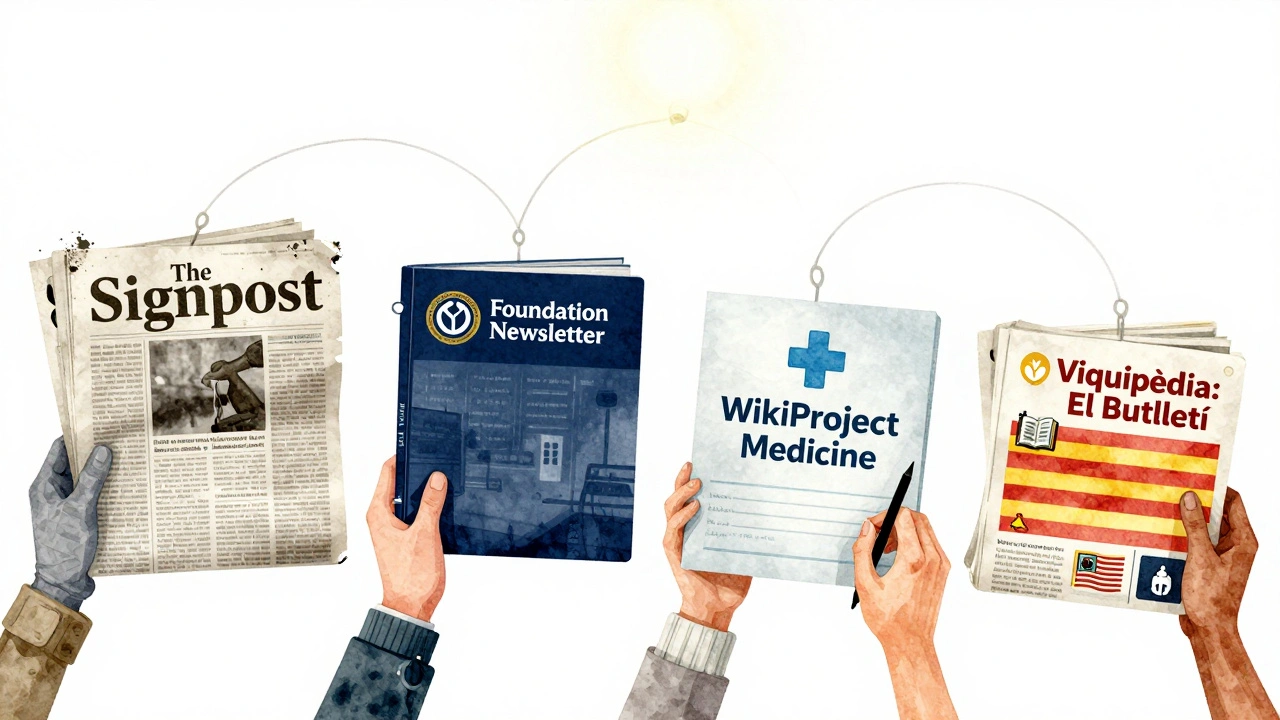
- WikiProject Newsletter (English Wikipedia) - Run by WikiProjects, these are topic-specific updates. For example, WikiProject Medicine publishes a monthly digest on medical article improvements, recent peer reviews, and new guidelines. These are hyper-focused and often ignored by casual editors-but critical for subject-matter experts.
- Wikipedia Signpost (German) - The German Wikipedia has its own version, called Die Signpost. It’s smaller, less frequent, and more formal. It focuses on policy debates and foundation announcements, but rarely dives into drama or personal stories.
- Viquipèdia: El Butlletí (Catalan) - Published monthly, this Catalan newsletter mixes community news with cultural context. It often includes interviews with editors from schools and universities, highlighting how Wikipedia is used in education across Catalonia.
- Wikimedia Foundation Newsletter - This is the official one. It’s sent out monthly via email and posted on Meta-Wiki. It covers fundraising, new tools, staff hires, and global initiatives like the 2025 Knowledge Equity Fund. It’s polished, corporate in tone, and rarely mentions internal conflicts.
- WikiProject Women in Red Newsletter - This one’s all about closing the gender gap. Each issue tracks how many new biographies of women were created, which articles need citations, and upcoming edit-a-thons. It’s grassroots, mission-driven, and has helped create over 200,000 articles since 2015.
These newsletters serve different purposes. The Signpost is the watchdog. The Foundation newsletter is the press release. The WikiProject ones are the specialist bulletins. And the language-specific ones? They’re the cultural mirrors.
How The Signpost Stands Out
What makes The Signpost different isn’t just its longevity. It’s the tone. It’s the voice. It’s the fact that it’s written by editors who’ve been there, done that, and got the T-shirt.
Compare it to the Foundation newsletter. The Foundation says: “We launched a new mobile editor in 12 languages.” The Signpost says: “The new mobile editor crashed for 400 users during the 2024 New Year’s edit-a-thon. Here’s what went wrong-and how the devs fixed it.” One tells you what happened. The other tells you what it meant.
The Signpost also has a unique structure. It’s divided into clear sections, each with a distinct voice. “The Backlog” is a sarcastic take on unresolved issues. “Community noticeboard” summarizes heated debates. “In the media” doesn’t just list articles-it critiques how reporters misunderstand Wikipedia’s reliability.
And it’s not afraid to call out the Foundation. In 2023, it published a full editorial questioning the decision to limit community input on new content moderation tools. That kind of accountability is rare in any online community-and nonexistent in official channels.
Who Reads These Newsletters?
Not everyone. But the people who do? They’re the ones who shape Wikipedia.
Active editors, especially those involved in policy, arbitration, or WikiProjects, check The Signpost every week. So do researchers studying online collaboration. And increasingly, educators teaching digital literacy use it as a case study in how open communities self-govern.
Language-specific newsletters serve their own audiences. The Catalan one helps university professors integrate Wikipedia into coursework. The Women in Red newsletter connects global volunteers who might never meet but are working toward the same goal.
The Foundation newsletter? Mostly read by board members, staff, and donors. But also by editors who want to know what’s coming down the pipeline-like the 2025 AI content labeling pilot or the new mobile app redesign.
There’s a hierarchy here. The Signpost is for insiders. The Foundation newsletter is for stakeholders. The WikiProject ones are for specialists. And the language editions? They’re for local communities trying to make Wikipedia feel like their own.
Why This Matters for Wikipedia’s Future
Wikipedia is the fifth most visited website in the world. But its power doesn’t come from servers or algorithms. It comes from its community.
Newsletters like The Signpost are the nervous system of that community. They’re where gossip turns into accountability. Where frustration turns into reform. Where a single editor’s complaint about a broken tool becomes a patch released two weeks later.
Without The Signpost, Wikipedia would lose its ability to self-correct. Without local newsletters, non-English communities would feel disconnected. Without WikiProject digests, specialized knowledge would stagnate.
And yet, these newsletters run on volunteer time. The Signpost’s entire staff-editors, designers, copy editors-are unpaid. They do this in their spare time, often after long workdays. That’s why their work is so valuable. It’s not funded by ads or grants. It’s fueled by dedication.
The rise of AI-generated content and automated moderation tools makes these newsletters more important than ever. As machines take over routine edits, human judgment becomes rarer-and more vital. The Signpost reminds us that Wikipedia is still, at its core, a human project.
How to Get Involved
Want to read The Signpost? Go to en.wikipedia.org/wiki/Wikipedia:The_Signpost. You can subscribe to its weekly email digest or just check it every Sunday.
Want to write for it? Anyone can pitch an article. You don’t need to be an admin or have 10,000 edits. All you need is a story worth telling. Past contributors have included students, retirees, librarians, and people who’ve never edited an article before-but noticed something odd and decided to investigate.
For other newsletters, visit their respective project pages. The Women in Red newsletter has a sign-up form on Meta-Wiki. The German Signpost accepts submissions via talk page. Each one has its own culture, its own rhythm.
Don’t wait to be invited. Jump in. Write a short piece about a recent edit-a-thon you attended. Summarize a heated discussion on the noticeboard. Point out a broken link in a policy page. These newsletters survive because people like you show up.
What’s Next for Wikimedia Newsletters?
The next five years will test these newsletters. With declining volunteer numbers and rising AI content, the pressure on community-driven communication is growing.
Some are experimenting with audio versions. The Signpost now has a weekly podcast summarizing key stories. The Catalan edition is testing a video newsletter. Others are moving to Discord or Matrix for real-time updates.
But the core model stays the same: human voices, human stories, human accountability. That’s what keeps Wikipedia from becoming just another algorithm-driven content farm.
The Signpost may not have millions of readers. But it has the right ones. And that’s enough.
Is The Signpost officially run by the Wikimedia Foundation?
No, The Signpost is completely independent. It’s written and edited by Wikipedia volunteers, not by Wikimedia Foundation staff. While it sometimes reports on Foundation decisions, it does so critically and without editorial oversight from the organization.
Can I contribute to The Signpost if I’m new to Wikipedia?
Yes. Many contributors started with just a few edits. All you need is a clear story-like noticing a pattern in article deletions, covering a local edit-a-thon, or summarizing a community debate. The editors welcome fresh perspectives and will help you polish your writing.
Are there newsletters for non-English Wikipedias?
Yes. Major language editions like German, French, Spanish, and Catalan each have their own community newsletters. Some are weekly, others monthly. They often cover local issues, cultural context, and language-specific policies that don’t appear in the English-language versions.
How often are these newsletters published?
The Signpost publishes weekly, every Sunday. WikiProject newsletters vary-some are monthly, others biweekly. The Wikimedia Foundation newsletter comes out monthly. Language editions range from weekly to quarterly, depending on community size and activity.
Do these newsletters have any impact on Wikipedia policies?
Absolutely. The Signpost has influenced policy changes multiple times. For example, its coverage of the 2017 bot controversy led to a revision of the bot approval process. WikiProject newsletters often trigger updates to article guidelines. Community feedback published in these newsletters is regularly cited in formal policy discussions on Meta-Wiki.