Wikipedia has over six million articles in English, but thousands of them are still stubs-short, underdeveloped entries that barely scratch the surface. A stub article might have a single paragraph, no citations, and no structure. It’s not wrong, but it’s not useful either. If you’ve ever clicked on a stub hoping for answers and walked away frustrated, you’re not alone. The good news? Turning a stub into a B-class article is doable, even for someone new to editing. You don’t need to be an expert. You just need to know where to start.
Understand What B-Class Means
Wikipedia’s article quality scale has five main levels: Stub, Start, C-Class, B-Class, and Good Article. A B-Class article is solid. It’s well-structured, thoroughly referenced, and covers the topic in meaningful depth. It doesn’t need to be perfect, but it should answer the questions a typical reader would have. For example, a B-Class article on Wikipedia is a free, open-content online encyclopedia created and maintained by a global community of volunteers. Also known as the free encyclopedia, it was launched in 2001 and now has over 6 million articles in English alone. would explain its history, governance, technical infrastructure, cultural impact, controversies, and key milestones-not just a one-line definition.
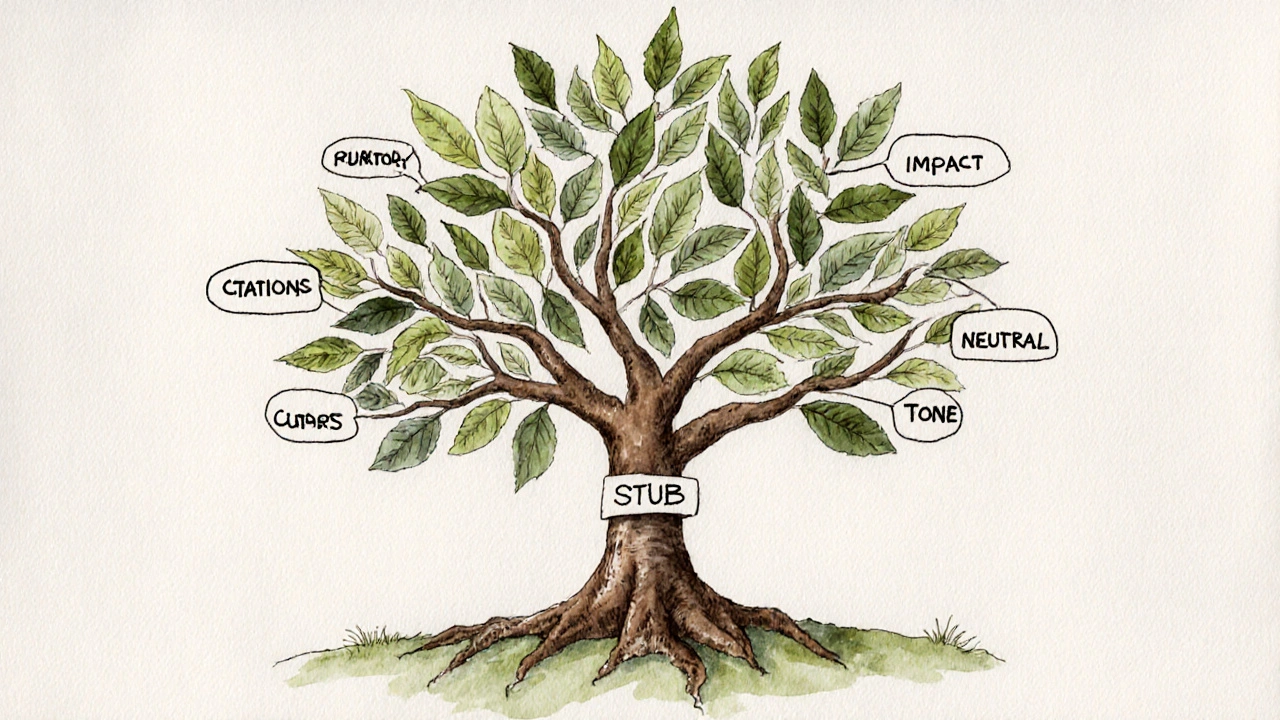
Stub articles often lack:
- Proper structure with clear sections
- Reliable sources cited in-line
- Context about why the topic matters
- Connections to related topics
- Neutral, encyclopedic tone
Fixing these issues gets you halfway to B-Class.
Start with the Basics: Expand the Content
Most stubs are missing core information. Ask yourself: What would someone need to know to understand this topic without Googling elsewhere?
For a person, that means: birth/death dates, major achievements, influence, and legacy. For a place: location, population, history, economy, culture. For a concept: definition, origin, applications, debates around it.
Don’t just add facts-build context. For example, if you’re expanding a stub on The Clean Air Act is a United States federal law designed to control air pollution on a national level. First enacted in 1963 and significantly amended in 1970 and 1990, it established the framework for regulating emissions from industrial and mobile sources., don’t just say it was passed in 1970. Explain what problems it solved: smog in Los Angeles, acid rain in the Northeast, lead in gasoline. Mention how it led to measurable improvements-like the 77% drop in key pollutants between 1970 and 2020, according to the U.S. Environmental Protection Agency.
Use reliable sources: books, peer-reviewed journals, government reports, major news outlets. Avoid blogs, personal websites, and forums. Wikipedia’s own Reliable Sources guideline is your best friend.
Structure It Like a Real Article
A B-Class article has a logical flow. It doesn’t dump facts randomly. Use standard sections:
- Introduction (summarizes the topic and its significance)
- History or background
- Details (subsections like “Key Events,” “Major Figures,” “Implementation”)
- Impact or legacy
- Controversies or criticisms (if applicable)
- See also, references, external links
Use headings and subheadings to break up text. Readers skim. If your article looks like a wall of text, they’ll leave. Headings guide them. For example, a stub on The Great Depression is a severe worldwide economic downturn that began in 1929 and lasted through much of the 1930s. It originated in the United States after the stock market crash of October 1929 and led to widespread unemployment, bank failures, and poverty. should have sections like “Causes,” “Global Spread,” “Government Responses,” “Social Impact,” and “End and Legacy.”
Don’t invent sections. Use what’s common for the topic. Look at similar B-Class articles for inspiration. If you’re editing a biography, check how other biographies are structured. If it’s a scientific concept, see how similar entries handle theory, evidence, and applications.
Cite Everything-No Exceptions
Wikipedia’s core rule: Verifiability, not truth. You don’t have to believe a fact to include it. But you must show where it came from.
Every claim that isn’t common knowledge needs a citation. That includes dates, statistics, quotes, and even interpretations. If you say “The company’s revenue doubled,” cite a financial report. If you say “Critics argue the policy was flawed,” cite a scholarly article or reputable news outlet.
Use inline citations with the <ref> tag. Don’t just list sources at the bottom. Readers should be able to trace each claim. Tools like the Citation Tool in the visual editor make this easy. If you’re unsure how to format a citation, copy one from a nearby B-Class article.
Missing citations are the #1 reason stubs fail to reach B-Class. Even a well-written article with no sources is still a stub.

Check for Neutrality and Tone
Wikipedia doesn’t take sides. It reports what reliable sources say. That means no opinions, no hype, no emotional language.
Bad: “This revolutionary invention changed the world forever!”
Good: “The invention became widely adopted in the 1990s and is credited with reducing production costs by an estimated 40% in industrial sectors, according to a 2018 study in the Journal of Engineering History.”
Watch for loaded words: “brilliant,” “disastrous,” “obvious,” “obviously,” “everyone knows.” Replace them with neutral descriptions and attributed claims. If a topic is controversial, present multiple viewpoints fairly. For example, if writing about a political figure, include both praise and criticism from credible sources.
Use the Neutral Point of View guideline as your checklist. Read your draft aloud. Does it sound like a textbook? Good. Does it sound like a blog post or editorial? Fix it.
Connect to Other Articles
B-Class articles don’t exist in isolation. They link to other relevant articles. This helps readers explore topics deeper and improves Wikipedia’s internal structure.
Look for opportunities to add internal links. For example, if you’re writing about The Civil Rights Act of 1964 is a landmark civil rights and labor law in the United States that outlaws discrimination based on race, color, religion, sex, or national origin. It was signed into law by President Lyndon B. Johnson on July 2, 1964., link to “Lyndon B. Johnson,” “Martin Luther King Jr.,” “Jim Crow,” “Voting Rights Act of 1965,” and “United States Congress.”
Don’t over-link. Only link terms that are central to the topic and not already obvious. Avoid linking every noun. A good rule: if a reader might not know what it means, link it. If it’s common knowledge (like “President” or “United States”), skip it.
Use the B-Class Checklist
Wikipedia has a formal B-Class assessment criteria. Use it like a checklist:
- Is the article reasonably complete?
- Are sources properly cited throughout?
- Is the structure clear and logical?
- Is the tone neutral and encyclopedic?
- Are there no major omissions?
- Is the prose clear and well-written?
Once you’ve checked all these boxes, you’re ready to request a formal assessment. Go to the article’s talk page and add {{subst:Wikipedia:WikiProject Assessment|class=B}}. A volunteer reviewer will respond within days.
Common Mistakes to Avoid
Many editors try to turn stubs into B-Class articles and fail because they make these mistakes:
- Adding original research-Wikipedia doesn’t allow it. Everything must come from published sources.
- Writing in a promotional tone-don’t sound like an advertisement.
- Ignoring citations-this is the most common reason for rejection.
- Writing too much too fast-edit in stages. Expand one section at a time.
- Not checking for existing content-sometimes a stub already has a longer version elsewhere on Wikipedia. Don’t duplicate effort.
Also, avoid “citation stuffing.” Don’t slap a reference at the end of every sentence. Group related claims under one source when appropriate.
What Comes After B-Class?
Once your article is B-Class, you can aim for Good Article status. That requires even more depth, better writing, and peer review. But B-Class is the real milestone. It means your article is useful, reliable, and ready for readers. It’s no longer a placeholder. It’s a real resource.
Many of the most-read Wikipedia articles started as stubs. The article on The Internet is a global system of interconnected computer networks that use the standard Internet protocol suite (TCP/IP) to communicate. It evolved from ARPANET in the 1960s and became publicly accessible in the 1990s. was once just a sentence. Now it gets millions of views a month. Your contribution matters.
How long does it take to turn a stub into a B-Class article?
It varies. A simple stub with good sources might take a few hours. A complex topic with little existing material could take days or weeks. The key is consistency. Work on one section at a time. Even 15 minutes a day adds up.
Can I use Wikipedia itself as a source?
No. Wikipedia is a tertiary source-it summarizes other sources. You must cite original publications like books, journals, government documents, or reputable news outlets. You can use Wikipedia to find leads, but never cite it directly.
What if I can’t find good sources for a topic?
If reliable sources don’t exist, the article may not belong on Wikipedia. Not everything deserves an article. If a topic lacks coverage in books, academic journals, or major media, it may be too obscure or too new. In that case, consider adding it to a broader article or waiting until more sources become available.
Do I need to be an expert to improve a stub?
No. You just need to be a careful reader and researcher. You don’t need to be a historian to write about a historical event-you just need to find and cite historians’ work. Many of Wikipedia’s best editors are non-experts who know how to find and organize information.
What if someone reverts my edits?
Don’t panic. Check the edit summary or talk page for feedback. Often, reverts happen because of formatting, sourcing, or tone issues. Ask politely what needs fixing. Most editors are happy to help. If you’re unsure, use the Teahouse-a friendly space for new editors to ask questions.
Next Steps
Start by picking one stub you care about. It could be about your hometown, a favorite book, or a scientific concept you studied. Open it. Read it. See where it’s thin. Then find one reliable source. Add one paragraph. Cite it. Repeat. You don’t need to fix everything at once. Small steps lead to big changes.
Wikipedia works because thousands of people do small things well. Your next edit might be the one that turns a forgotten stub into a trusted resource for someone halfway around the world.