Wikipedia’s Featured Articles are the gold standard. They’re the 0.1% of articles that meet the highest standards for accuracy, depth, and writing quality. If you’ve ever tried to get your article featured, you know it’s not just about writing well-it’s about proving your article deserves to stand next to the likes of World War II, Quantum mechanics, or Climate change. The key? Sources. Not just any sources. The right ones.
Understand What Makes a Featured Article
A Featured Article on Wikipedia isn’t just long or well-written. It must be comprehensive, neutral, stable, and thoroughly sourced. The official criteria list four main areas: content, structure, style, and sourcing. But if you look at every Featured Article ever approved, one thing never changes: every claim that isn’t common knowledge is backed by a reliable, published source.Common knowledge? Things like “The Earth orbits the Sun” or “Water boils at 100°C at sea level.” You don’t need a source for that. But if you say “The 2020 U.S. presidential election had the highest voter turnout in 120 years,” you need a source. And not just any source. It has to be something that other editors can check, verify, and trust.
Use Only Reliable Sources
Wikipedia doesn’t accept blogs, personal websites, social media posts, or self-published material as reliable sources. That includes YouTube videos, Medium articles, or even your own blog-even if you’re an expert. The platform trusts sources that have editorial oversight: peer-reviewed journals, books from academic presses, major newspapers, and established magazines.For example, if you’re writing about the history of the Internet, you’d cite:
- Networks of Innovation by David C. Mowery (Cambridge University Press)
- Articles from The New York Times or The Guardian published between 1990-2000
- Technical reports from the Internet Engineering Task Force (IETF)
- Peer-reviewed papers from IEEE Xplore or ACM Digital Library
These aren’t just “good sources.” They’re sources that have been vetted by editors, fact-checkers, or subject-matter experts. That’s what makes them acceptable.
Don’t Just Cite-Anchor Every Claim
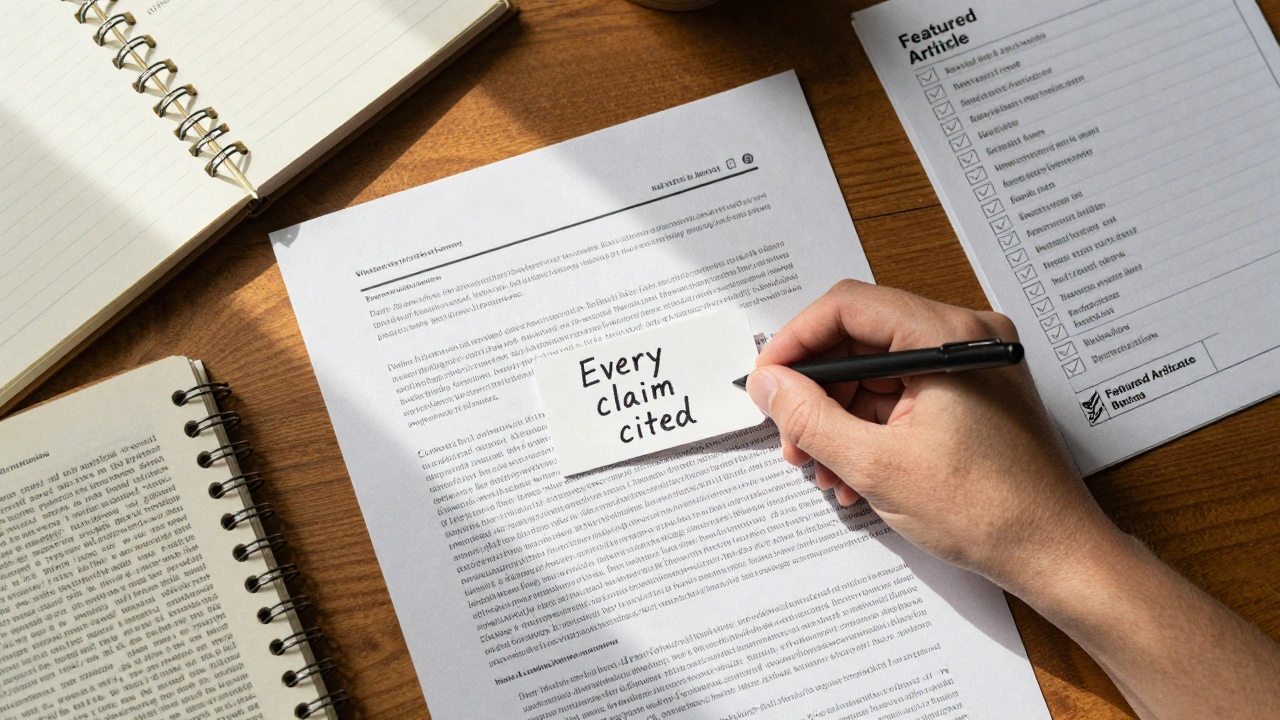
One of the biggest mistakes new editors make is citing a source at the end of a paragraph and assuming it covers everything. That’s not enough. Each factual claim needs its own citation.Let’s say you write:
“The iPhone was introduced in 2007 and revolutionized mobile computing. By 2010, it held 25% of the global smartphone market.”
You need two citations here-one for the launch date, one for the market share. If you cite only one source that mentions both, fine. But if you pull the launch date from Apple’s press release and the market share from Statista, you need two separate footnotes.
Use inline citations with <ref> tags. Don’t use footnotes at the bottom of the page unless you’re following the exact format used in existing Featured Articles. Most use the {{cite web}}, {{cite book}}, or {{cite journal}} templates for consistency.
Avoid Primary Sources Unless Necessary
Primary sources-like original research, interviews, patents, or raw data-are tricky. Wikipedia prefers secondary sources because they analyze, interpret, or summarize primary material. A newspaper article quoting a scientist is better than the scientist’s unpublished lab notes.There are exceptions. If you’re writing about a historical event and the only surviving records are letters or diaries, then yes, use them. But you must still interpret them through a secondary source. For example, if you’re using a 19th-century letter to describe a battle, cite it alongside a modern historian’s analysis of that letter.
Never use primary sources to make claims that go beyond what the source directly says. Don’t say “This letter proves the inventor was a genius.” Say “The letter describes the inventor’s frustration with early prototypes, as noted by historian Susan Lee in Technology and Innovation in the Gilded Age.”
Balance Your Sources
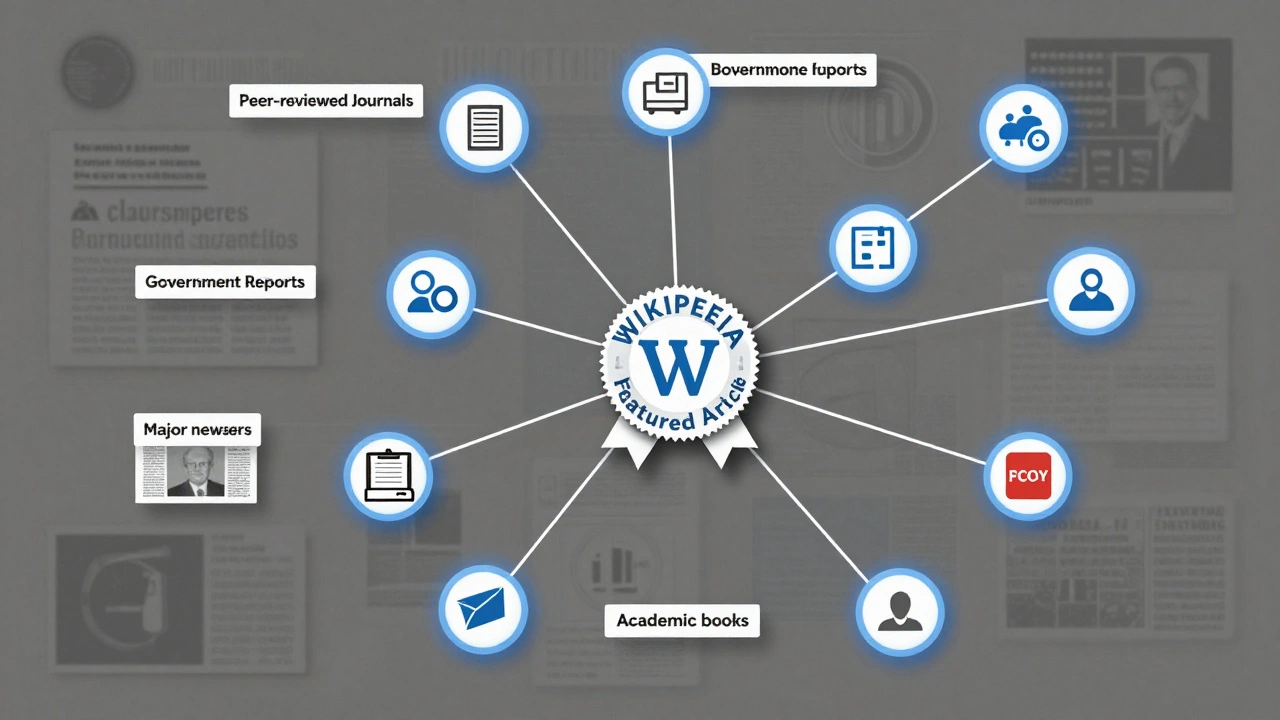
A Featured Article doesn’t rely on one or two sources. It draws from multiple, independent sources to build a complete picture. If every fact in your article comes from a single book or website, reviewers will reject it.For a well-rounded article on Renewable energy, you might use:
- A 2023 report from the International Energy Agency for global capacity stats
- A peer-reviewed study from Nature Energy on solar efficiency trends
- A 2022 article from Bloomberg on policy changes in Germany
- A 2021 book from MIT Press on economic impacts
- A government energy department publication on subsidies
Each source brings a different angle. That’s what makes the article authoritative.
Check for Source Reliability Before You Write
Before you start writing, spend time vetting your sources. Ask yourself:- Is this published by a known organization or publisher?
- Does it have editors or peer reviewers?
- Is it cited by other reputable sources?
- Is it free from obvious bias or conflict of interest?
Use Wikipedia’s own Reliable Sources Noticeboard if you’re unsure. Editors there can help you judge whether a source is acceptable. Don’t guess. Ask.
Update Sources Regularly
Featured Articles aren’t static. They’re living documents. If your article was accepted in 2022, but new data came out in 2025, you need to update it. Outdated sources are a red flag.For example, if your article on COVID-19 vaccines still cites 2021 efficacy rates without mentioning 2024 booster data or long-term side effect studies, it won’t stay featured. Always use the most recent reliable sources available. If there’s a gap-say, no peer-reviewed studies on a new topic-say so. Transparency matters more than pretending you have data you don’t.
Follow the Manual of Style
Sources aren’t the only requirement. The article must also follow Wikipedia’s Manual of Style. That means:- Using neutral language-no “amazing,” “disastrous,” or “obviously”
- Writing in third person
- Formatting dates consistently (e.g., 15 March 2023, not March 15, 2023)
- Using proper capitalization for titles and proper nouns
- Avoiding jargon unless it’s defined
These aren’t minor details. They’re part of what makes a Featured Article feel professional and trustworthy. An article with perfect sources but sloppy formatting will still be rejected.
Submit for Review-Then Be Ready to Revise
Once you think your article is ready, submit it to Featured Article Candidates. You’ll get feedback from experienced editors. Expect criticism. Expect requests for more sources. Expect to rewrite entire sections.Don’t take it personally. The goal isn’t to prove you’re right. It’s to prove your article is reliable enough for millions of readers to trust.
Most successful Featured Articles go through 3-5 rounds of review. Some take months. If you’re serious about this, treat it like a research project. Keep track of every edit, every source, every comment. Respond to feedback with evidence, not opinion.
What Happens If You Fail?
Not every article becomes Featured. That’s normal. Even experienced editors rarely get one on their first try. If your article is rejected, the feedback will tell you why. Common reasons:- Too few sources
- Sources aren’t reliable
- Claims aren’t properly cited
- Over-reliance on one source
- Unbalanced coverage
- Writing style is too promotional
Fix the issues. Resubmit. Many Featured Articles were rejected once or twice before passing.
Final Checklist Before Submission
Before you hit “submit,” run through this quick checklist:- Every factual claim (except common knowledge) has a citation
- All sources are published, reputable, and independent
- No primary sources are used to make interpretations
- Sources are balanced across time, perspective, and type
- Article follows Wikipedia’s Manual of Style
- Language is neutral, clear, and free of bias
- References use proper citation templates
- Article is at least 5,000 words long
- No original research is included
If you can say yes to all of these, you’re ready. Not guaranteed to pass-but you’ve done everything right.
Can I use Wikipedia itself as a source?
No. Wikipedia is not a reliable source for its own content. It’s an encyclopedia, not a primary or secondary source. You must cite the original publications that Wikipedia references. If you see a claim on Wikipedia, trace it back to the book, journal, or news article it cites-and cite that instead.
Do I need peer-reviewed sources for every article?
Not always. For history, politics, or culture topics, major newspapers, books from academic publishers, and official reports are acceptable. Peer-reviewed journals are required for scientific, medical, or technical claims. The key is matching the source type to the subject matter.
What if a source is behind a paywall?
Paywalls don’t disqualify a source. What matters is whether the source is reputable and verifiable. If you can’t access it, ask for help on Wikipedia’s Reliable Sources Noticeboard. Other editors may have access and can verify the content for you.
Can I cite a source that’s in another language?
Yes, if it’s a reputable publication in its own country. For example, a study from Le Monde or Der Spiegel is acceptable. But you must provide an English translation of the key passage in your citation, and make sure the source is widely recognized in its field.
How long does the review process take?
Typically 2-8 weeks. Some articles are reviewed faster if they’re well-written and thoroughly sourced. Others take longer if they’re controversial or require expert input. Be patient. Respond to feedback promptly. Don’t rush the process.
What if I can’t find enough sources on my topic?
If reliable sources are scarce, your topic may not be suitable for a Featured Article. Wikipedia requires depth and breadth. If you can’t find at least five independent, reputable sources covering different aspects of the topic, consider writing a Good Article instead-or expanding your research to include related areas.