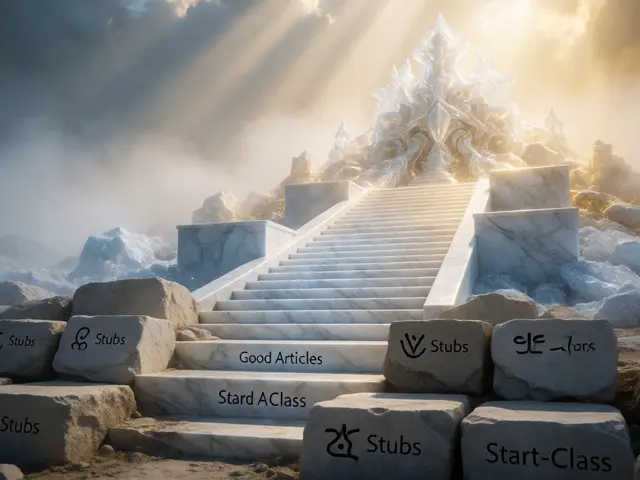
Most Wikipedia editors hit a wall. You’ve written the content, added citations, and formatted the text, but the article still feels flat or incomplete. The difference between a decent entry and a top-tier one often isn’t about writing skill-it’s about process. That’s where WikiProjects come in. These are collaborative groups of volunteers who focus on specific topics, like history, science, or geography, to standardize quality and push articles toward higher classifications.
If you’re aiming for a "Good Article" (GA) or "Featured Article" (FA) status, working alone is slow and error-prone. WikiProjects provide the structure, feedback, and community expertise you need to close gaps quickly. Here’s how to leverage them effectively to raise your article’s class without burning out.
Understanding the Role of WikiProjects in Quality Assurance
WikiProjects are community-driven initiatives on Wikipedia that organize editors by subject matter to improve consistency, accuracy, and depth across related articles. They act as hubs for best practices, template usage, and peer review. Unlike general talk pages, which can be chaotic, WikiProject talk pages are curated spaces where experienced editors discuss specific issues like sourcing standards or structural clarity.
The primary value here is accountability. When an article is adopted by a project, it enters a queue for review. Editors within the project know exactly what criteria apply to their domain. For example, a medical article needs different citation types than a historical biography. By joining the right project, you align your work with the specific expectations of that field, reducing the chance of rejection during formal nomination processes.
Identifying the Right Project for Your Topic
Your first step is finding the correct home for your article. This isn’t always obvious. A single article might touch on multiple disciplines. For instance, an article on the "Treaty of Versailles" relates to both World War I history and international law.
- Check the article’s header: Look at the top of the page. If it’s already part of a project, there will be a banner. If not, search the main Wikipedia namespace for "Wikipedia:WikiProject [Topic]."
- Review scope definitions: Each project has a "Scope" section explaining what they cover. Read this carefully. Some projects are broad (e.g., History), while others are niche (e.g., Aviation History).
- Join via the Talk Page: Post a brief note on the project’s talk page introducing your article. Ask if it fits their scope. This simple action signals intent and invites early feedback.
Don’t hesitate to join multiple projects if applicable. Cross-project collaboration often leads to richer insights, especially for interdisciplinary topics.
The Peer Review Process: Getting Feedback Before Nomination
Nominating an article for GA or FA status without prior feedback is risky. Rejections can be harsh and demoralizing. Instead, use the internal peer review mechanisms within WikiProjects.
Most active projects maintain a "Peer Review" subpage. You submit your article link, and other editors comment on specific weaknesses. Common feedback includes:
- Sourcing gaps: Missing references for key claims or reliance on secondary sources when primary ones exist.
- Neutral Point of View (NPOV): Biased language or uneven coverage of perspectives.
- Structure issues: Poor flow, redundant sections, or lack of clear headings.
- Image quality: Low-resolution media or missing captions.
Treat this feedback as a checklist. Address each point systematically. It’s normal to have multiple rounds of review. The goal isn’t perfection in one go, but iterative improvement. Experienced editors in these projects often become mentors, offering detailed explanations of why a change is needed rather than just pointing out errors.
Meeting the Criteria for Good and Featured Articles
To understand what you’re working toward, you need to know the benchmarks. Wikipedia uses a classification system based on quality and importance. Here’s how the two highest tiers differ:
| Criteria | Good Article (GA) | Featured Article (FA) |
|---|---|---|
| Length & Depth | Cover all significant aspects; no major omissions. | Comprehensive; covers all notable details with deep analysis. |
| Sourcing | Reliable sources cited; minor gaps acceptable. | Extensive, high-quality sources; every claim supported. |
| Style & Structure | Clear, readable, well-organized. | Polished, engaging, and structurally elegant. |
| Images | Relevant images with proper licensing. | High-quality, diverse, and well-captioned visuals. |
| Stability | No major edit wars; stable version. | Long-term stability; consensus on content. |
Notice that FA requires more than just completeness-it demands excellence in presentation and sourcing. This is why WikiProject involvement is crucial. They help you bridge the gap between "complete" and "excellent."
Practical Tips for Effective Collaboration
Collaboration on Wikipedia can be tricky. Edits happen fast, and opinions vary. To keep the process smooth, follow these guidelines:
- Be responsive: If someone leaves a comment, reply promptly. Silence can be interpreted as disagreement or disinterest.
- Use templates: Many projects have standardized templates for reviews. Using them makes it easier for others to track progress.
- Document changes: When making significant edits based on feedback, mention it in the edit summary. This builds trust and transparency.
- Stay focused: Avoid tangential debates. If a discussion goes off-track, suggest moving it to the talk page.
Remember, the goal is the article, not winning an argument. Most experienced editors are willing to compromise if you show good faith and effort.
Common Pitfalls and How to Avoid Them
Even well-intentioned editors make mistakes that delay progress. Watch out for these common traps:
Ignoring scope boundaries: Adding content that doesn’t fit the article’s topic dilutes its focus. Keep additions relevant. If something belongs in a separate article, create a stub there instead.
Over-reliance on web sources: While online sources are convenient, they’re often less reliable than books or academic journals. Prioritize print-based or peer-reviewed digital sources where possible.
Skipping the self-review: Before submitting for peer review, read your article critically. Check for typos, broken links, and inconsistent formatting. This shows respect for reviewers’ time and increases the likelihood of constructive feedback.
Burnout: Improving an article to FA level can take months. Break the work into small tasks. Focus on one section at a time. Celebrate small wins, like fixing a citation or improving an image caption.
Next Steps After Classification
Earning GA or FA status isn’t the end. It’s a milestone. Once classified, your article becomes a model for others. Consider:
- Maintaining stability: Monitor the article for vandalism or poor edits. Set up watchlists to stay informed.
- Expanding related articles: Use your expertise to improve linked articles. This strengthens the entire topic cluster.
- Mentoring new editors: Share your experience with newcomers. Helping others improves the overall quality of the encyclopedia.
By staying engaged with your WikiProject, you contribute to a sustainable ecosystem of high-quality content. The knowledge you gain through collaboration doesn’t just benefit one article-it elevates the entire community’s standards.
Do I need to be an expert in the topic to join a WikiProject?
No. Expertise helps, but willingness to learn and follow guidelines is more important. Many successful contributors started as beginners. The project members will guide you on specific standards.
How long does it typically take to reach Good Article status?
It varies widely. Simple topics might take a few weeks, while complex subjects can take several months. Consistency matters more than speed. Aim for steady, incremental improvements.
What happens if my article is rejected for GA or FA?
Rejection is common and not final. Reviewers usually list specific reasons. Address those points, make improvements, and resubmit after a reasonable period. Many FAs were rejected once or twice before succeeding.
Can I work on multiple articles simultaneously?
Yes, but prioritize. Focusing on one article at a time allows for deeper engagement with reviewers and faster progress. Juggling too many can lead to stalled projects and frustration.
Are WikiProjects mandatory for improving article quality?
Not mandatory, but highly recommended. Working independently is possible, but you miss out on specialized feedback and community support. Projects provide a structured path to quality that solo efforts often lack.