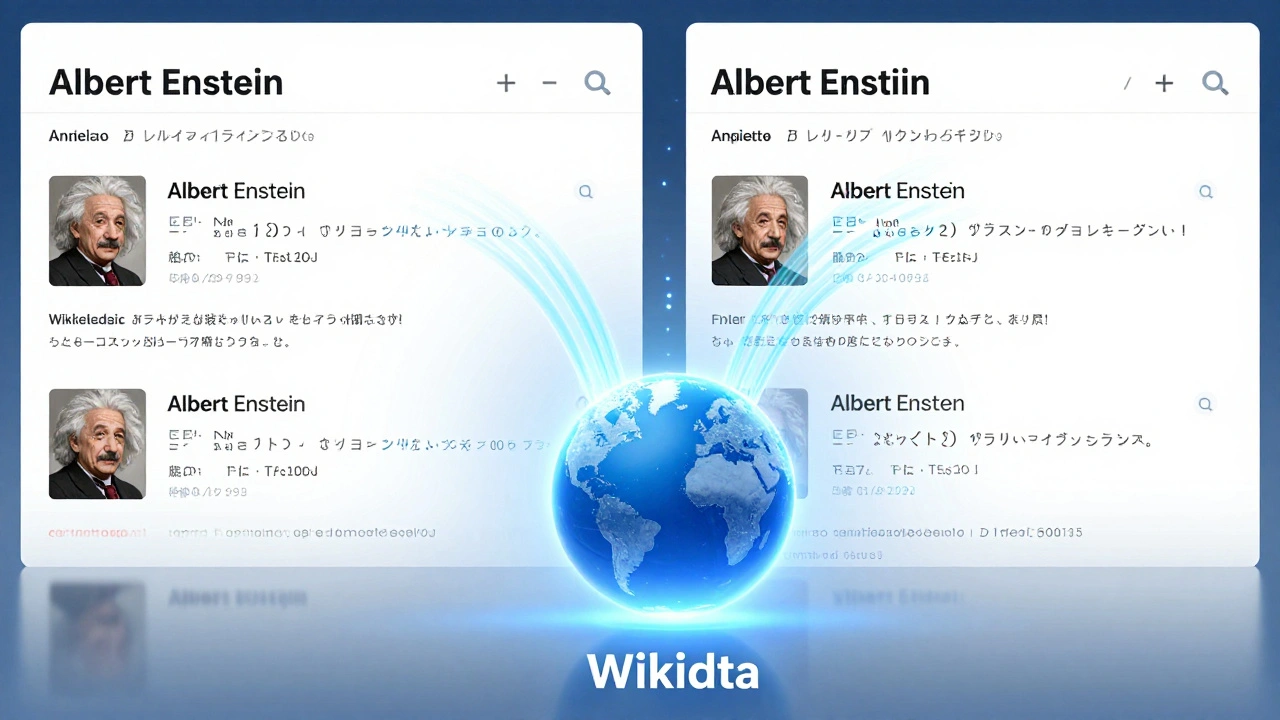
Ever opened a Wikipedia page in Spanish, then switched to Japanese, and noticed the exact same facts in the box on the right? That’s not a coincidence. It’s Wikidata doing the heavy lifting behind the scenes. Wikidata-powered infoboxes are what make Wikipedia’s multilingual coordination possible - turning a collection of separate language editions into one globally synchronized knowledge base.
What Wikidata-Powered Infoboxes Actually Do
Before Wikidata, every Wikipedia language edition had its own infoboxes. A person’s birth date in English Wikipedia might be correct, but in French or Russian, it could be wrong, missing, or formatted differently. Editors had to update each version manually. That meant errors piled up, and consistency was impossible.
Wikidata changed that. Instead of storing data inside each Wikipedia article, the data lives in a central, machine-readable database. When you see an infobox on a Wikipedia page - whether it’s about Albert Einstein, the Eiffel Tower, or the 2024 Summer Olympics - the information isn’t written there. It’s pulled from Wikidata. And because Wikidata is multilingual, the same data can appear in any language, translated automatically.
Think of it like a single source of truth. If someone fixes the population of Tokyo in Wikidata, that update shows up on every Wikipedia language version that uses that infobox - in English, Arabic, Hindi, Swahili, you name it. No more copying and pasting. No more outdated stats.
How It Works Behind the Scenes
Wikidata uses something called items and statements. Each real-world thing - a person, a city, a movie - gets its own item. For example, the item for the Statue of Liberty is Q1123. That item holds all the facts: when it was built, who designed it, where it’s located, its height, and more.
Each fact is a statement: “Statue of Liberty - height - 93 meters.” These statements can have qualifiers, like “as of 2023,” or sources, like “from the National Park Service.”
Wikipedia infoboxes don’t store this data. They just ask Wikidata: “Give me the height of Q1123, in the language I’m using.” Wikidata responds with the right number and the right translation. If the article is in Chinese, the number stays the same, but the label “height” becomes “高度.”
This system works because Wikipedia editors don’t write data - they link to it. Instead of typing “Born: February 12, 1809” into an article, they just insert a single line of code that says, “Use the birth date from item Q1123.” That’s it.
Why This Matters for Multilingual Coordination
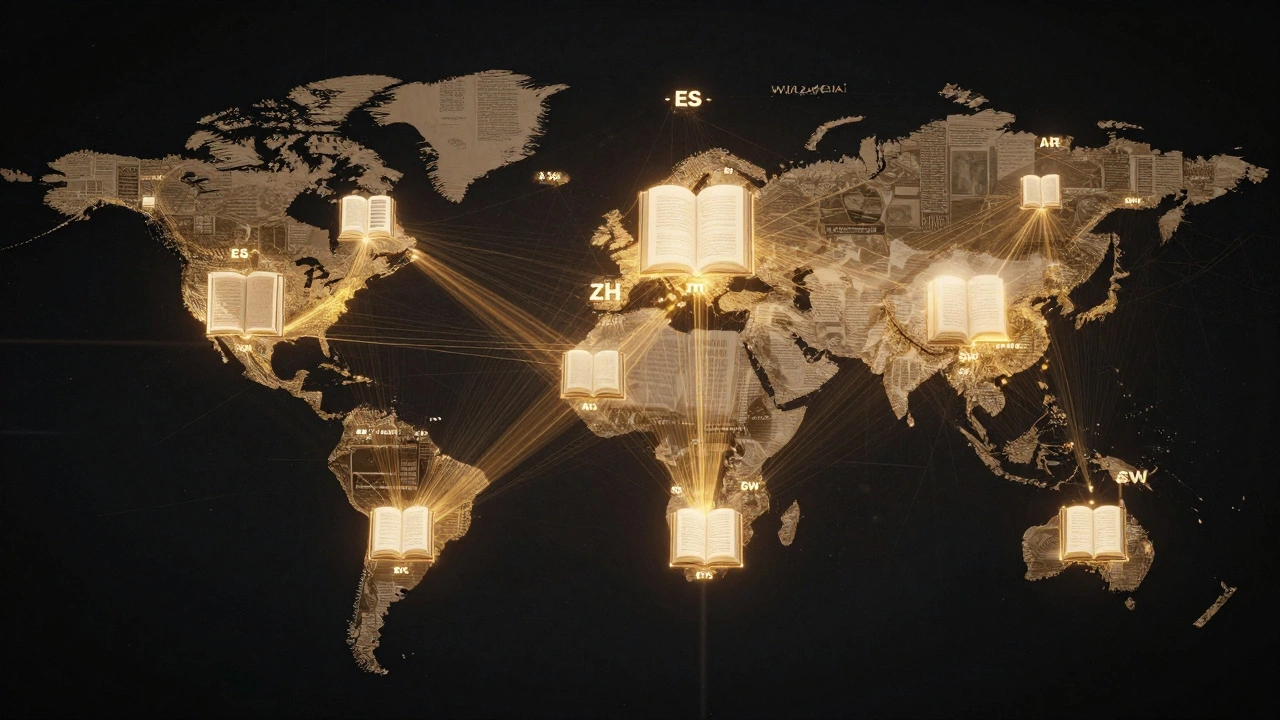
Wikipedia has over 300 language editions. Without Wikidata, coordinating facts across them would be a nightmare. Imagine editing the birth year of Marie Curie in 50 different languages every time a new biography came out. It wouldn’t scale. It wouldn’t be accurate.
Wikidata fixes that. It lets editors focus on writing good articles, not on fixing data everywhere. A single edit in Wikidata can fix hundreds of articles at once. In 2023, a volunteer corrected the spelling of a city in Ukraine in Wikidata. That one change automatically updated the infoboxes on 42 different language versions of Wikipedia.
It also helps smaller language editions. A Wikipedia in Kinyarwanda or Quechua can pull accurate data from Wikidata without needing dozens of editors to verify every number. That levels the playing field. Knowledge isn’t just for big languages anymore.
Real Examples You Can See Right Now
Go to the English Wikipedia page for Leonardo da Vinci. Scroll down to the infobox. Now open the same page in German: Leonardo da Vinci. The birth date, death date, nationality, and major works are identical - except translated. You won’t find a single difference in the facts.
Same with the COVID-19 pandemic. The total cases, deaths, and vaccine rollout dates are pulled from the same Wikidata item. If a health agency updates its official numbers, someone can update Wikidata once - and every language version reflects it within hours.
Even obscure entries benefit. The Wikipedia page for the Mayon Volcano in the Philippines has infoboxes in Tagalog, Cebuano, and even Basque - all sharing the same elevation, last eruption date, and volcanic type from Wikidata.
Who Maintains Wikidata? And How Reliable Is It?
Wikidata is edited by volunteers - just like Wikipedia. But the community is global and growing. Over 100,000 people have made at least one edit to Wikidata. Many are academics, librarians, or data enthusiasts who care about accuracy.
It’s not perfect. Some entries are incomplete. Some facts lack sources. But there are safeguards. Each statement must cite a reliable source. Bots flag edits that contradict established data. And editors can lock high-profile items from random changes.
Studies from the Wikimedia Foundation show that over 95% of Wikidata statements on major topics like countries, people, and scientific concepts have at least one verifiable source. That’s higher than the average Wikipedia article’s citation rate.
And unlike commercial databases, Wikidata is open. Anyone can download the whole thing. Researchers use it to study global knowledge gaps. Developers use it to build apps that need accurate, multilingual data. Governments even use it to cross-check public statistics.
The Bigger Picture: Wikidata as Global Infrastructure
Wikidata isn’t just for Wikipedia. It’s becoming the backbone of open knowledge on the web. Google uses it to power knowledge panels. Apple pulls data from it for Siri. The European Union’s Open Data Portal links to Wikidata items. Museums use it to tag artifacts across collections.
That’s why multilingual coordination matters. If Wikidata only worked in English, it would be just another database. But because it’s built for every language, it becomes something rare: a truly global public good. It doesn’t favor big languages. It doesn’t ignore small ones. It treats all languages equally - because the facts don’t care what language you speak.
When you look at a Wikipedia infobox in any language, you’re seeing the result of years of quiet, collaborative work. No headlines. No funding announcements. Just thousands of people quietly fixing data, one statement at a time - so that whether you’re reading in Swahili, Mandarin, or Icelandic, you get the same truth.
How You Can Help
You don’t need to be a programmer or a scholar to contribute. If you speak more than one language, you can help translate labels and descriptions in Wikidata. If you know a fact is wrong in your language’s Wikipedia, you can fix it once in Wikidata and save everyone else the trouble.
Visit wikidata.org. Search for any topic. Click “Edit.” Add a missing translation. Add a source. Fix a typo. You’re not just helping Wikipedia. You’re helping build a world where knowledge is shared, not siloed.
How are Wikidata infoboxes different from regular Wikipedia infoboxes?
Regular Wikipedia infoboxes store data directly in the article - so each language edition has its own copy. Wikidata-powered infoboxes pull data from a central database. That means one edit fixes every language version at once. No more manual updates across dozens of sites.
Can anyone edit Wikidata?
Yes. Anyone with a free account can edit Wikidata. But edits are monitored. High-profile items can be protected, and most changes require sources. Bots and experienced editors review new edits to prevent errors and vandalism.
Does Wikidata support all languages equally?
It tries to. Wikidata supports over 400 languages. But not all languages have the same number of contributors. English has the most data, but smaller languages like Tagalog or Estonian often have better coverage for local topics because their editors focus on what matters to them. The system doesn’t favor big languages - it just reflects who’s editing.
What happens if someone adds wrong data to Wikidata?
Wrong data gets flagged. Other editors can revert changes. Sources are required for most facts. Bots detect contradictions - for example, if someone says the Eiffel Tower is taller than Mount Fuji. The community responds quickly. Most errors are fixed within hours.
Can I use Wikidata data in my own app or website?
Yes. Wikidata is completely open. You can download the entire database for free or use its API to pull specific data. Many apps, from language learners to museum guides, use Wikidata because it’s reliable, multilingual, and free to use.
If you’ve ever wondered how Wikipedia stays so consistent across languages, now you know. It’s not magic. It’s not a secret algorithm. It’s people - from Nairobi to Nagoya - working together to make sure facts are shared, not locked behind language barriers.