Wikipedia isn’t run by a single team of editors. It’s not even run by a small group of volunteers. It’s run by hundreds of thousands of people - many of whom never meet, never talk on the phone, and might live on opposite sides of the planet. So how does it stay organized? How do editors who care about, say, ancient Roman history or modern jazz music find each other and actually get things done? The answer lies in something called WikiProjects.
What Exactly Is a WikiProject?
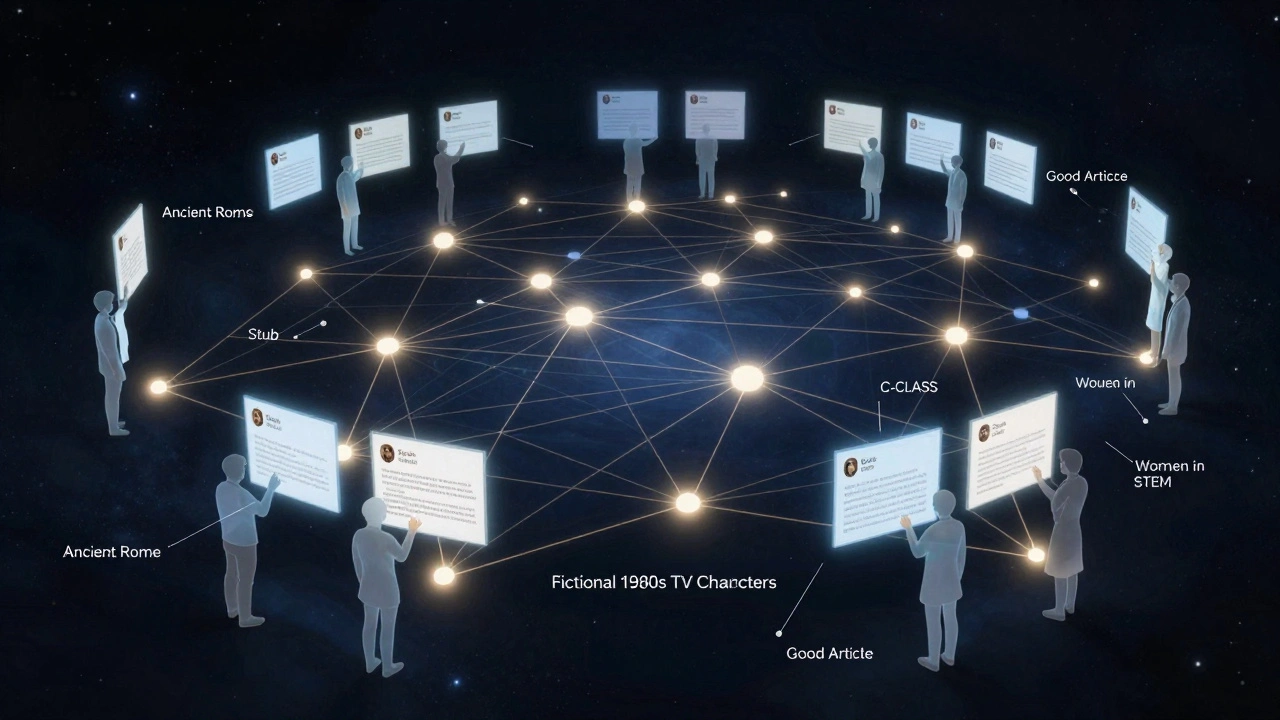
A WikiProject is a group of Wikipedia editors who come together around a shared topic. It could be something broad like "Medicine" or "History," or something hyper-specific like "Women in STEM" or "Fictional Characters from 1980s TV Shows." These aren’t official departments or corporate teams. There’s no boss, no salary, no formal hierarchy. Instead, they’re self-organized, volunteer-run, and entirely driven by interest.
Each WikiProject has its own page on Wikipedia - usually under a namespace like "Wikipedia:WikiProject Medicine." That page acts as a hub. It lists goals, guidelines, assessment scales, task lists, and links to related articles that need work. Editors join by adding their username to the project’s participant list. From there, they start helping - fixing broken links, expanding stubs, tagging articles for citation needed, or even writing entirely new content.
How Do They Keep Track of What Needs Doing?
Without a central command, WikiProjects rely on tools and shared norms. The most important tool is the article assessment scale. Every article in a WikiProject’s scope gets tagged with a quality rating: Stub, Start, C-Class, B-Class, Good Article, or Featured Article. These aren’t just labels - they’re roadmaps.
For example, if you’re editing an article on "Neuroplasticity" and it’s tagged as a "Stub," you know it’s barely started. If it’s a "B-Class," you might focus on improving references or adding subsections. If it’s a "Featured Article," you might check for recent updates or peer review feedback. This system lets editors prioritize work without being told what to do.
Many WikiProjects also maintain "to-do lists" - simple pages that list articles needing attention. One might say: "17 articles need citations," or "5 articles need infoboxes," or "3 articles are flagged for neutrality issues." These lists are updated manually, often by volunteers who scan recent changes or run automated reports.
How Do They Handle Disagreements?
Wikipedia has rules - lots of them. But rules alone can’t resolve every conflict. What if two editors disagree on whether a scientific claim is well-supported? Or if one thinks a historical figure deserves more space, and another thinks the article is too long?
WikiProjects step in as mediators. They don’t enforce rules. Instead, they build consensus. A typical process might look like this:
- An editor raises an issue on the project’s talk page.
- Others chime in with evidence - citations, policy excerpts, past discussions.
- After a few days of back-and-forth, a rough agreement forms.
- The outcome is documented on the project page as a guideline.
Over time, these discussions become part of the project’s official guidance. For example, WikiProject Medicine has clear policies on which medical sources are acceptable (like peer-reviewed journals) and which aren’t (like patient blogs). These aren’t imposed from above - they’re built by editors who actually work on medical articles every day.

Who Runs These Projects?
No one officially runs them. But some people show up more than others. These are the active participants - the ones who keep the to-do lists updated, who respond to discussion threads, who organize edit-a-thons or outreach campaigns.
Some WikiProjects have coordinators - volunteers who take on extra tasks like moderating talk pages or managing bots. But even coordinators don’t have special powers. They can’t delete articles, block users, or override decisions. Their influence comes from trust and consistency. If someone’s been helping with WikiProject Astronomy for five years, others will listen when they say, "This article needs more references from NASA publications."
How Do WikiProjects Improve Wikipedia’s Quality?
The data speaks for itself. Articles tagged by WikiProjects are more likely to be well-sourced, longer, and less likely to be vandalized. A 2023 study by the Wikimedia Foundation found that articles participating in a WikiProject were 40% more likely to reach "Good Article" status than those without project involvement.
Why? Because WikiProjects create accountability. When you know others are watching - and care deeply about the topic - you’re more likely to double-check your edits. You’re more likely to cite properly. You’re more likely to fix errors you’d otherwise ignore.
Take WikiProject Women in Red. Started in 2015, it focused on creating articles about notable women who were missing from Wikipedia. By 2025, it had created over 200,000 new articles. That’s not because one person had a big idea. It’s because hundreds of editors, coordinated across time zones, kept showing up and adding one article at a time.
What Happens When a Project Fades?
Not all WikiProjects survive. Some die out because interest wanes. Others get absorbed into larger projects. A few become so successful they spawn offshoots - like WikiProject LGBTQ+ Studies, which grew from the broader "Gender Studies" project.
A project doesn’t vanish just because it’s quiet. It might be dormant for months, then suddenly come alive after someone posts a new task list or hosts an edit-a-thon. Wikipedia’s structure is resilient. If a topic matters, editors will find it again.
How Can You Get Involved?
Anyone can join. You don’t need to be an expert. You don’t even need to know how to code. If you care about a topic - whether it’s video games, climate science, or local history - there’s probably a WikiProject for it.
Start by searching "WikiProject [your topic]" on Wikipedia. If one exists, read its main page. Look at the assessment scale. Check the to-do list. Pick one small task: fix a broken link, add a citation, or improve the lead section. Then save your edit. That’s it. You’re part of the project now.
Many new editors think they need to write a whole article to help. But the real magic happens in the small stuff - cleaning up references, adding categories, updating dates. Those edits matter. They’re the glue that holds Wikipedia together.
Why This Model Works
Most organizations rely on top-down control. WikiProjects work because they’re bottom-up. They let people with passion lead - not because they have authority, but because they show up consistently. They don’t need permission to help. They just do it.
This system scales because it’s decentralized. You don’t need a central office to manage 1,500 WikiProjects. Each one runs on its own rhythm. And because they’re topic-specific, they develop deep expertise. A WikiProject on African history knows which sources are reliable. A WikiProject on video game music knows which composers are notable. They don’t guess. They’ve seen it before.
Wikipedia’s success isn’t because it’s perfect. It’s because it’s flexible. And WikiProjects are the engine that keeps it moving - one small edit at a time.
Can anyone start a new WikiProject?
Yes. Any registered Wikipedia editor can propose a new WikiProject by creating a page under "Wikipedia:WikiProject [Topic]." They need to outline the scope, goals, and assessment criteria. The community then reviews it. If enough editors show interest and contribute over a few weeks, the project becomes active. There’s no formal approval process - just organic growth.
Do WikiProjects have any official power on Wikipedia?
No. WikiProjects have no administrative authority. They can’t delete pages, block users, or enforce rules. Their influence comes from consensus and trust. Editors follow their guidelines because they’ve been developed through discussion and proven effective - not because they’re mandated.
How are WikiProjects different from Wikipedia categories?
Categories are automated groupings based on article tags - like "Category:Medicine" or "Category:20th-century composers." WikiProjects are human-led initiatives with goals, discussion pages, and task lists. Categories help organize content; WikiProjects help improve it.
Are WikiProjects only for English Wikipedia?
No. Every language version of Wikipedia has its own WikiProjects. The French Wikipedia has over 300 active ones. The Spanish version has more than 200. Each operates independently, following local norms and source standards. The model is universal - but the content is local.
Do WikiProjects help with vandalism or edit wars?
They can. If a topic is prone to disputes - like articles on politics or religion - WikiProjects often create detailed guidelines to prevent conflicts. They may also monitor recent changes and step in when edits violate consensus. While they can’t block users, they can flag issues to administrators and provide context that helps resolve disputes faster.
WikiProjects are the quiet backbone of Wikipedia. They’re not flashy. They don’t make headlines. But without them, Wikipedia would be a collection of disconnected articles - full of gaps, errors, and inconsistencies. With them, it’s a living, growing, collaborative knowledge base - built by people who care enough to show up, day after day.