You read a breaking news story on CNN and then check the same event on Wikipedia. The facts look similar, but the tone feels different. One feels urgent and selective; the other feels flat and exhaustive. This isn't an accident. It’s the result of two completely different philosophies about how truth should be presented to the public.
For decades, we’ve been told that journalists must remain "objective." Meanwhile, Wikipedia editors are instructed to maintain "neutrality." These terms sound like synonyms, but in practice, they lead to vastly different outcomes. Understanding this distinction is crucial for anyone trying to navigate the modern information landscape. If you treat a news article like an encyclopedia entry, or vice versa, you’re likely to miss half the picture.
The Myth of Journalistic Objectivity
Journalistic objectivity is a professional norm in news media that requires reporters to present facts without personal bias, emotion, or opinion. On paper, it sounds simple: just report what happened. In reality, it’s nearly impossible to achieve pure objectivity because every step of the news process involves subjective choices.
Consider the moment a reporter decides what is "news" at all. Why do we cover a celebrity divorce but ignore a quiet policy change in a small town? That decision isn’t objective; it’s editorial. It reflects the values of the publication, its audience, and its advertisers. Once the story is chosen, the reporter selects which quotes to include, which photos to use, and who gets to speak first. These choices shape the narrative, even if the individual sentences are factually accurate.
In traditional journalism, objectivity often manifests as "both-sidesism." If there’s a debate between Climate Change Skeptics and Climate Scientists, a strictly objective approach might give equal airtime to both, implying a balance that doesn’t exist in the scientific consensus. This creates a false equivalence that can mislead readers. The goal is to appear neutral by balancing opinions, but the result is often a diluted version of the truth.
Modern journalism has begun to shift away from strict objectivity toward transparency. Instead of pretending to have no perspective, some outlets now explain their methodology, disclose potential conflicts of interest, and label opinion pieces clearly. This approach acknowledges that complete detachment is a myth, but accountability is real.
Wikipedia’s Neutral Point of View (NPOV)
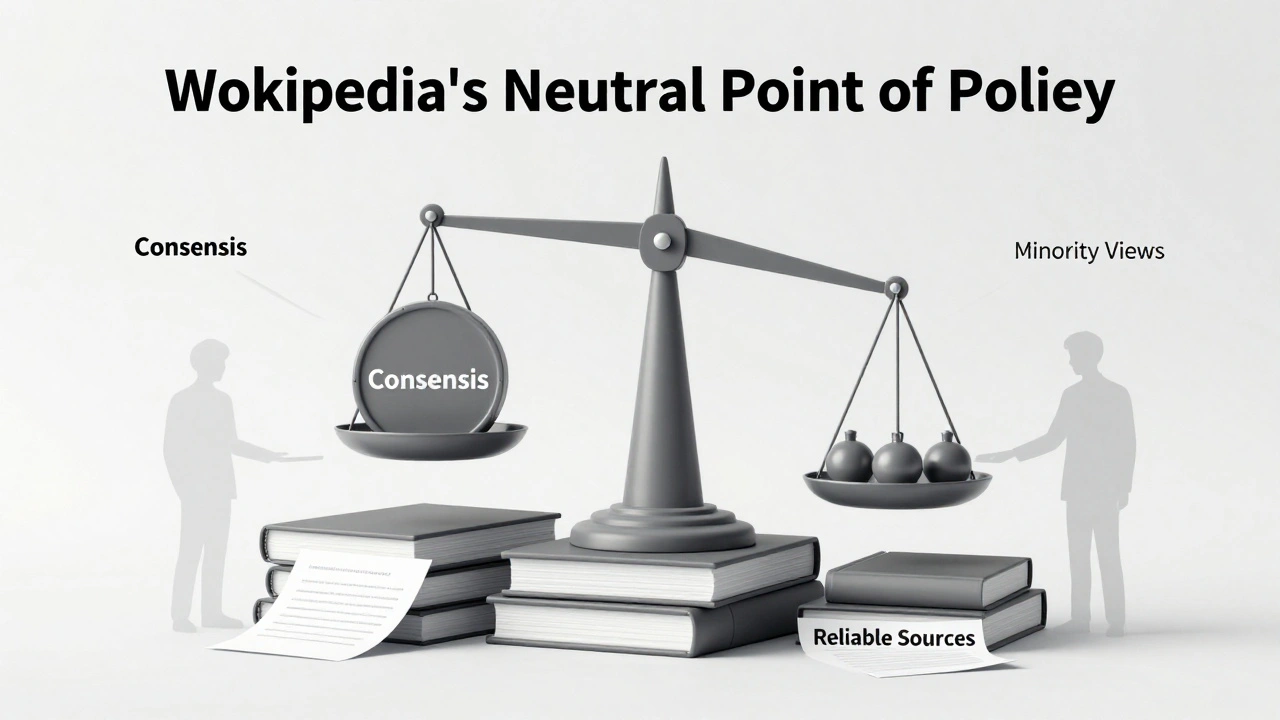
Wikipedia neutrality, formally known as the Neutral Point of View (NPOV) policy, is the core principle requiring articles to represent fairly, proportionally, and without editorial bias all significant views that have been published by reliable sources. Unlike journalistic objectivity, which tries to eliminate the reporter’s voice, NPOV accepts that bias exists everywhere and seeks to manage it through structure and sourcing.
Wikipedia doesn’t claim to tell you what is true. It claims to tell you what reliable sources say is true. If three major newspapers say Event A caused Disaster B, and one blog says Event C caused it, Wikipedia will reflect the majority view while acknowledging the minority view in proportion to its notability. The key here is proportionality. A fringe theory doesn’t get equal space with mainstream science unless it has gained significant traction in credible discourse.
This approach relies heavily on Verifiability and the requirement that all material added to Wikipedia must be attributable to a published source. You can’t just state a fact; you need a citation. And not just any citation-it must come from a Reliable Source, such as peer-reviewed journals, reputable news organizations, or established books. Self-published blogs, social media posts, and press releases are generally excluded.
The result is a tone that can feel dry or bureaucratic. Wikipedia avoids adjectives like "shocking," "tragic," or "inspiring" because these words inject emotion. Instead, it uses neutral language: "The event resulted in 50 deaths" rather than "The tragedy killed 50 people." This stylistic choice removes the emotional pull that journalism often uses to engage readers.
Key Differences in Practice
| Feature | Journalistic Objectivity | Wikipedia Neutrality (NPOV) |
|---|---|---|
| Primary Goal | Inform the public quickly about current events | Summarize existing knowledge comprehensively |
| Tone | Engaging, urgent, sometimes emotive | Dry, encyclopedic, detached |
| Sourcing | Original reporting, interviews, eyewitness accounts | Secondary sources only (no original research) |
| Bias Handling | Avoids expressing personal opinion; may use "both-sidesism" | Represents all significant views proportionally |
| Timeliness | Highly time-sensitive; focuses on "now" | Timeless; focuses on established history |
| Authorship | Byline attached to specific journalist | Anonymous collective editing |
One of the biggest differences lies in timeliness. Journalism thrives on immediacy. When a political scandal breaks, news outlets rush to publish details, often updating stories hourly. Wikipedia, however, moves slowly. Editors wait for reliable sources to establish a narrative before adding it to an article. This means Wikipedia is often behind the curve on breaking news but catches up once the dust settles. By the time an event is covered in depth on Wikipedia, it has usually transitioned from "news" to "history."
Another critical difference is the prohibition of Original Research on Wikipedia. Journalists are expected to gather new information through interviews and investigations. Wikipedia editors are forbidden from synthesizing unpublished data or drawing new conclusions. They can only summarize what others have already said. This makes Wikipedia a secondary source, not a primary one. If you want to know what happened yesterday, go to the news. If you want to know how historians interpret last year’s events, go to Wikipedia.

The Role of Sources and Verification
In journalism, the credibility of a source often depends on the reporter’s access and reputation. A Pulitzer-winning journalist can publish an exclusive interview based on confidential tips. The reader trusts the outlet’s brand and the reporter’s track record. There is rarely a link to the raw audio recording or the signed affidavit.
On Wikipedia, trust is decentralized. No single editor has authority. Instead, the community enforces rules through discussion and voting. Every claim must be backed by a citation that anyone can check. This system is slower and more cumbersome, but it reduces the risk of individual error or malice. If a user adds a false claim, another user can remove it instantly if it lacks a source. This constant peer review creates a self-correcting mechanism that traditional journalism lacks.
However, this system has vulnerabilities. If all reliable sources agree on a falsehood, Wikipedia will reflect that falsehood until a new source emerges. For example, during the early days of the Iraq War, many reputable newspapers reported that weapons of mass destruction were found in Iraq. Wikipedia mirrored these reports. It wasn’t until later, when independent inspectors confirmed otherwise, that the articles were updated. Wikipedia doesn’t verify truth; it verifies consensus among reliable sources.
Handling Controversy and Bias
When controversy arises, journalism and Wikipedia react differently. A news organization might assign a senior editor to oversee coverage, ensuring that sensitive topics are handled with care. The byline carries weight, and the outlet stands behind its reporting. If an error occurs, a correction is published, often prominently.
Wikipedia handles controversy through Edit Wars and conflicts between editors over the content of an article. When users disagree on how to phrase a controversial topic, they revert each other’s changes. This can escalate into prolonged battles. To resolve this, Wikipedia offers formal dispute resolution processes, including mediation and arbitration. The goal is to reach a compromise that satisfies the NPOV policy, even if it means diluting strong arguments on either side.
This process can feel frustrating for readers who want clear answers. But it prevents any single viewpoint from dominating the narrative. In journalism, a powerful owner or advertiser might influence coverage subtly. On Wikipedia, influence requires convincing hundreds of anonymous editors, which is much harder to achieve covertly.
Why the Distinction Matters for Readers
Understanding the difference between journalistic objectivity and Wikipedia neutrality helps you consume information more critically. Don’t expect Wikipedia to break news. Use it to understand context, background, and historical interpretation. Don’t expect news articles to provide exhaustive, balanced summaries of every perspective. Use them to stay informed about current events and emerging trends.
If you’re researching a complex topic, start with Wikipedia to get an overview and identify key players and concepts. Then, follow the citations to find the original news reports and academic studies. This hybrid approach leverages the strengths of both systems. You get the breadth of Wikipedia and the depth of journalism.
Also, be aware of the limitations. News can be biased by selection and framing. Wikipedia can be biased by the availability of reliable sources. Both systems are human-made and imperfect. But by knowing how they work, you can spot errors and biases more easily. You’ll notice when a news story omits crucial context or when a Wikipedia article relies on outdated sources.
The Future of Information Integrity
As digital media evolves, the lines between journalism and reference are blurring. News outlets are creating long-form databases and interactive timelines that resemble encyclopedias. Wikipedia is experimenting with faster updates for current events. Yet, the core principles remain distinct. Journalism prioritizes speed and narrative; Wikipedia prioritizes stability and consensus.
In an age of misinformation, both models face challenges. Fake news spreads faster than corrections. Conspiracy theories gain traction on social media before reaching reliable sources. Both journalists and Wikipedia editors must adapt to these threats. Journalism is investing in fact-checking units and transparency tools. Wikipedia is improving its anti-vandalism software and community guidelines.
Ultimately, neither system is perfect. But together, they form a robust ecosystem for sharing knowledge. Journalism captures the pulse of the present. Wikipedia preserves the memory of the past. By respecting their differences, we can use both to build a clearer understanding of the world.
Is Wikipedia considered a reliable source for academic work?
Generally, no. Most universities and academic institutions prohibit citing Wikipedia directly because it is a tertiary source that allows anonymous editing. However, it is an excellent starting point for research. You should use the references listed at the bottom of Wikipedia articles to find primary and secondary sources that are acceptable for academic citation.
Why does Wikipedia avoid using emotional language?
Wikipedia avoids emotional language to maintain its Neutral Point of View (NPOV). Words like "tragic," "heroic," or "disastrous" imply a value judgment. By using neutral, factual language, Wikipedia ensures that the article represents all significant viewpoints without favoring one emotional perspective over another.
Can I edit a Wikipedia article to correct a mistake?
Yes, anyone can edit most Wikipedia articles. However, your changes must adhere to the NPOV policy and be supported by reliable sources. If you add unsourced information or express a personal opinion, other editors may revert your changes. Always check the talk page for ongoing discussions about the article before making edits.
How does journalistic objectivity differ from fairness?
Objectivity aims to remove the reporter's bias, often by presenting multiple sides equally. Fairness implies giving each side a reasonable opportunity to be heard, but not necessarily equal time if one side is significantly less credible. Modern journalism is moving toward fairness and transparency rather than strict objectivity, acknowledging that some perspectives are more valid than others.
What is the "No Original Research" policy on Wikipedia?
The No Original Research (NOR) policy prohibits editors from adding new theories, interpretations, or conclusions that are not published elsewhere. Wikipedia can only summarize existing knowledge from reliable sources. This ensures that the encyclopedia remains a reference tool rather than a platform for publishing new ideas.