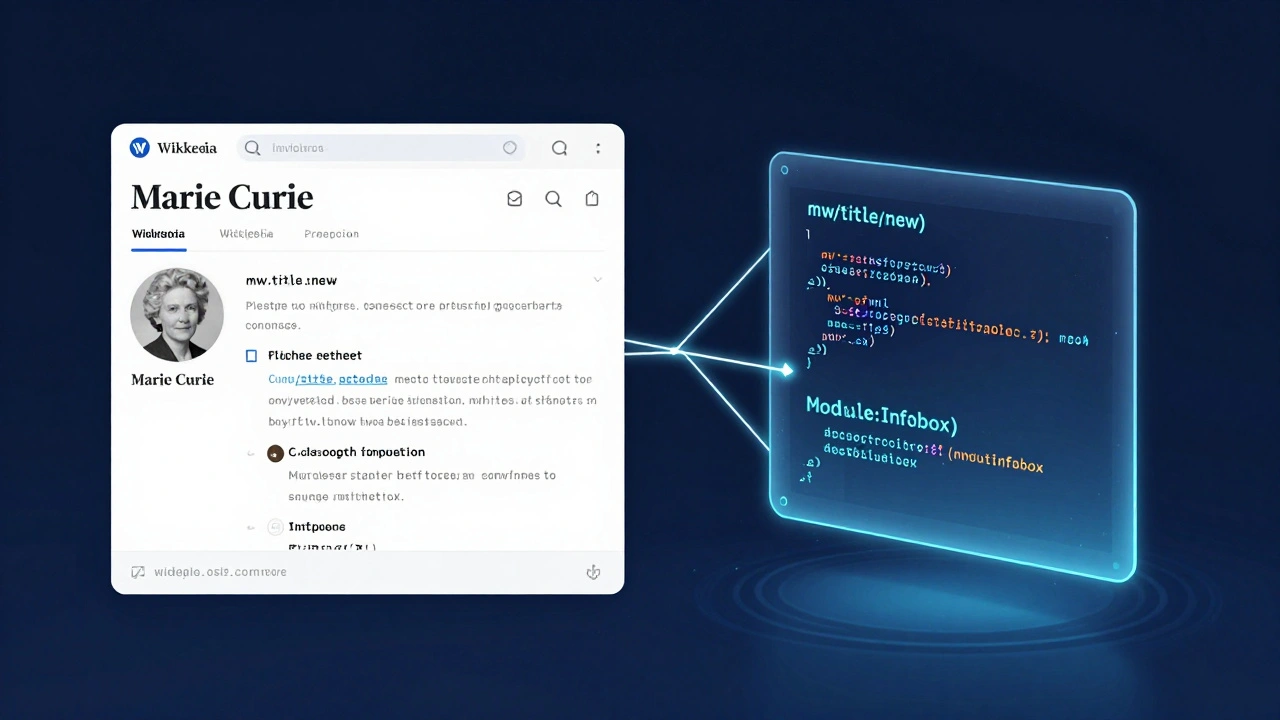
Wikipedia doesn’t run on plain HTML and hand-written templates anymore. Behind every infobox, navigation box, citation, and complex data display is a quiet but powerful engine: Lua modules. These small scripts, written in the Lua programming language, handle the heavy lifting that used to fall on messy, hard-to-maintain wiki markup. If you’ve ever clicked "View source" on a Wikipedia page and seen strange-looking code that doesn’t look like regular wiki syntax, you’ve probably seen Lua in action.
What Lua Modules Actually Do on Wikipedia
Before Lua, Wikipedia templates were built using wiki markup-lines of text with double braces, pipes, and nested calls. A simple infobox for a person could stretch across hundreds of lines. Editing one meant juggling dozens of parameters, and a single typo could break the whole thing. Performance suffered. Debugging was a nightmare.
Enter Lua. In 2013, Wikipedia began rolling out the Scribunto extension, which lets editors write modules in Lua. These modules are stored in the Module: namespace-like Module:Citation/CS1 or Module:Infobox. Instead of writing complex logic in wiki markup, editors write clean, reusable functions in Lua. These functions get called by templates, which now act as simple wrappers.
For example, a template called {{Cite web}} doesn’t format citations itself anymore. It calls a Lua module that checks the URL, validates the author names, formats the date, pulls in metadata from Wikidata, and even auto-generates DOI links. All of this happens in milliseconds, without bloating the page’s source code.
Why Lua? Not Python, Not JavaScript
Why Lua and not another language? The answer is simplicity and safety.
Lua is lightweight. It runs fast on Wikipedia’s servers, which handle over 500 million page views per day. It has a small memory footprint and doesn’t allow dangerous operations like direct file access or network calls. That’s critical-Wikipedia can’t let a single module crash the whole site or leak private data.
Compared to JavaScript, Lua doesn’t have browser-side quirks. Compared to Python, it doesn’t require heavy dependencies or complex installation. Lua’s syntax is minimal: no semicolons needed, functions are first-class objects, and tables (Lua’s only data structure) handle everything from arrays to dictionaries. That makes it perfect for a volunteer-driven environment where editors aren’t professional developers.
Wikipedia’s Lua environment is also sandboxed. Modules can’t access the server’s file system, can’t call external APIs, and can’t modify pages directly. They only process input and return formatted output. This keeps the system stable even when thousands of modules run simultaneously.
How Templates and Modules Work Together
Think of templates as the front door and Lua modules as the backend office.
A template like {{Infobox person}} is what you see in the article’s source. It looks like this:
{{Infobox person
| name = Marie Curie
| birth_date = 1867-11-07
| death_date = 1934-07-04
| field = Physics, Chemistry
}}
That’s not doing anything by itself. When the page loads, MediaWiki sees the template name and calls the corresponding Lua module: Module:Infobox. That module reads the parameters (name, birth_date, etc.), validates them, formats dates into readable text, checks if the person has a Wikidata item, pulls in additional data like Nobel Prize info, and then outputs clean HTML.
So when you see a beautifully formatted infobox on a Wikipedia page, you’re not seeing raw wiki markup-you’re seeing the result of a Lua script that did 20+ checks and data lookups behind the scenes.
Real-World Impact: Numbers That Matter
The shift to Lua wasn’t just technical-it changed how Wikipedia operates.
- Over 1.2 million Lua modules are active on English Wikipedia as of 2026.
- More than 90% of all infoboxes now use Lua modules.
- Citation templates (like {{Cite journal}}) are now 70% faster to render than before Lua.
- Template errors dropped by 65% after migration to Lua, because validation happens in code, not in messy markup.
One study from the Wikimedia Foundation in 2024 showed that pages using Lua modules had 30% fewer edit conflicts during high-traffic events like elections or breaking news. Why? Because editors change template parameters, not the underlying logic. The module stays the same; only the input changes.
Who Writes These Modules?
Not professional coders. Mostly volunteers.
Wikipedia’s Lua module editors are a mix of retired IT professionals, students learning programming, and longtime editors who wanted to fix template bugs. Many learned Lua just to make their favorite templates work better. There’s no formal training program. Instead, there’s a thriving community of module maintainers who review each other’s code on talk pages, fix bugs, and document best practices.
The Module:Documentation template is used by nearly every module to explain how to use it. That documentation is often clearer than commercial software manuals. Why? Because if it’s confusing, someone will fix it-fast.
What You Can Do With Lua Modules
If you’re an editor, you don’t need to write Lua to use it. But if you want to help improve Wikipedia’s infrastructure, here’s what you can do:
- Fix a broken template by checking its Lua module. Go to the template page, click "View source," and look for
{{#invoke:Module:...}}. That’s the Lua call. - Test changes in the sandbox. Every module has a /sandbox subpage where you can experiment without breaking live pages.
- Improve documentation. Many modules have incomplete parameter lists. Adding a clear example helps others.
- Translate modules. Lua modules are language-agnostic. You can adapt a module from English Wikipedia to work on Spanish or Japanese Wikipedia by translating the text strings inside.
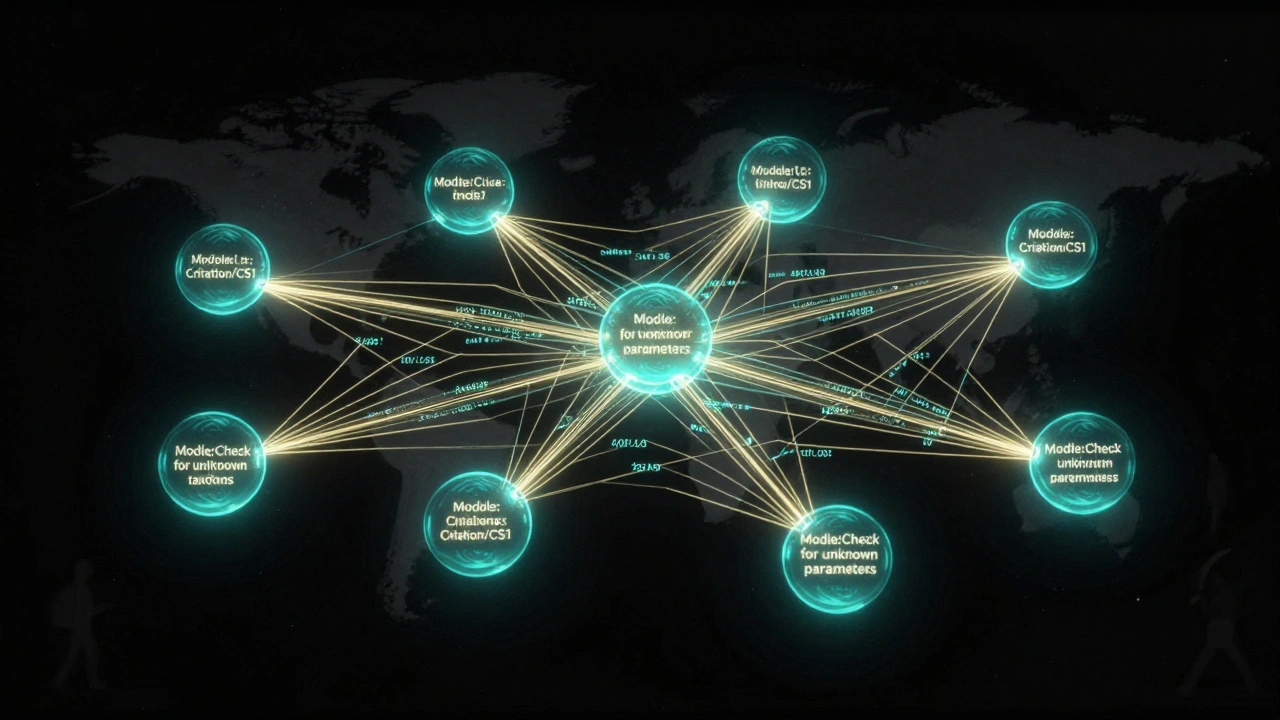
There’s even a Module:Check for unknown parameters that automatically warns editors when they misspell a template parameter. That module alone has prevented thousands of broken citations.
Limitations and Risks
Lua isn’t magic. It has limits.
Each module has a strict execution time limit-usually under 10 seconds. Complex modules that pull data from Wikidata or parse large tables can hit that limit. Editors have to optimize: cache results, avoid nested loops, and use efficient table lookups.
There’s also a learning curve. Lua syntax is simple, but understanding how MediaWiki’s Lua environment works takes time. Functions like mw.title.new() or mw.text.split() aren’t obvious to newcomers.
And while modules are safer than raw code, bad code still breaks things. A poorly written module can cause a cascade of errors across hundreds of pages. That’s why module changes go through a review process, often requiring approval from experienced editors before going live.
The Bigger Picture: Wikipedia as a Living Codebase
Wikipedia is one of the largest open-source projects in the world-and Lua modules are its hidden engine. Unlike GitHub repos with commit histories and pull requests, Wikipedia’s code lives in plain sight. Anyone can edit it. Anyone can fix it. And millions of people use it every day without realizing it’s powered by code written by volunteers in their spare time.
That’s what makes it special. Lua modules aren’t just a technical upgrade. They’re a cultural shift: Wikipedia moved from static templates to dynamic, maintainable software-built by a global community, not a corporation.
Next time you see a neatly formatted citation or a timeline of a historical event, remember: it’s not magic. It’s Lua. And it’s all powered by people who care enough to make it work.
What are Lua modules on Wikipedia?
Lua modules are scripts written in the Lua programming language that handle complex logic behind Wikipedia templates. They replace messy wiki markup with clean, reusable code that generates infoboxes, citations, navigation menus, and other dynamic content. These modules are stored in the Module: namespace and are called by templates using the {{#invoke:}} syntax.
Why does Wikipedia use Lua instead of another language?
Wikipedia uses Lua because it’s lightweight, fast, and safe. It runs efficiently on Wikipedia’s servers, has a small memory footprint, and doesn’t allow dangerous operations like file access or network calls. Unlike Python or JavaScript, Lua doesn’t require complex dependencies and has a simple syntax that’s easy for volunteers to learn. Its sandboxed environment ensures modules can’t crash the site or access private data.
How do templates and Lua modules work together?
Templates act as user-friendly interfaces. When you use {{Infobox person}}, you’re not writing code-you’re filling in parameters. Behind the scenes, MediaWiki calls a Lua module (like Module:Infobox) that reads those parameters, validates them, pulls data from Wikidata, formats dates and links, and returns clean HTML. The template is just a bridge between the editor and the module.
Can anyone edit Lua modules on Wikipedia?
Yes, but with caution. Anyone can edit Lua modules, but changes to widely used modules often require review by experienced editors. Most modules have a /sandbox subpage where you can test changes before applying them live. Breaking a major module can affect thousands of pages, so edits are usually tested and discussed on talk pages first.
Do I need to know Lua to use Wikipedia?
No. You don’t need to know Lua to read or edit Wikipedia articles. Lua modules run behind the scenes. You interact with templates like {{Cite web}} or {{Infobox}} the same way you always have. Only if you want to improve or fix templates yourself do you need to learn Lua-and even then, you can start by just editing documentation or testing in a sandbox.
How do Lua modules improve Wikipedia’s reliability?
Lua modules improve reliability by centralizing logic. Instead of having the same citation format copied across hundreds of templates, one module handles it all. If a citation style changes, you update one module instead of hundreds of templates. This reduces errors, makes updates faster, and ensures consistency across the site. Template errors dropped by 65% after Lua adoption.