
Imagine opening an encyclopedia entry and seeing a timestamp that says "Updated by Algorithm v4.2" instead of a human editor's name. Would you trust the information more or less? This is no longer a hypothetical scenario. As AI automation reshapes how we curate knowledge, the fundamental question shifts from accuracy to governance. Who decides what is true? And does it matter if a machine or a person makes that call?
The debate isn't just about technology; it's about the social contract of information. Traditional encyclopedias relied on peer review and institutional authority. Modern digital platforms rely on community consensus. Now, we are entering an era of algorithmic curation, where speed and scale often outweigh deep contextual understanding. To measure trust effectively, we need to look beyond simple error rates and examine the mechanisms of accountability.
The Shift from Peer Review to Algorithmic Curation
Peer review has long been the gold standard for scientific and academic publishing. In this model, experts evaluate work before publication, ensuring rigor but sacrificing speed. However, the volume of new data generated daily far exceeds human capacity. This gap is where AI automation steps in. Algorithms can scan millions of sources, cross-reference facts, and flag inconsistencies in seconds.
Yet, automation brings its own set of biases. If an AI model is trained on historical data, it may perpetuate existing gaps or errors. For instance, if previous encyclopedia entries underrepresented certain global perspectives, an AI system might replicate those blind spots at scale. Human editors, while slower, bring contextual nuance. They understand cultural sensitivity, political nuance, and the difference between a factual statement and a persuasive argument. The tension lies in balancing the speed of machines with the judgment of humans.
Defining Trust: Beyond Accuracy Metrics
Many assume trust equals accuracy. But trust is multidimensional. It includes reliability, transparency, and accountability. A perfectly accurate entry that lacks context can be misleading. Conversely, a slightly imperfect entry that clearly cites its sources and explains its limitations might foster more trust than a polished but opaque AI-generated summary.
To measure this, researchers use frameworks like the Trust Equation, which weighs competence, reliability, intimacy, and self-orientation. In the context of encyclopedias, competence refers to factual correctness. Reliability is consistency over time. Intimacy involves how well the content resonates with the reader's needs. Self-orientation asks whether the platform serves the user or its own agenda. AI systems excel at competence and reliability but often struggle with intimacy and self-orientation because they lack genuine intent.
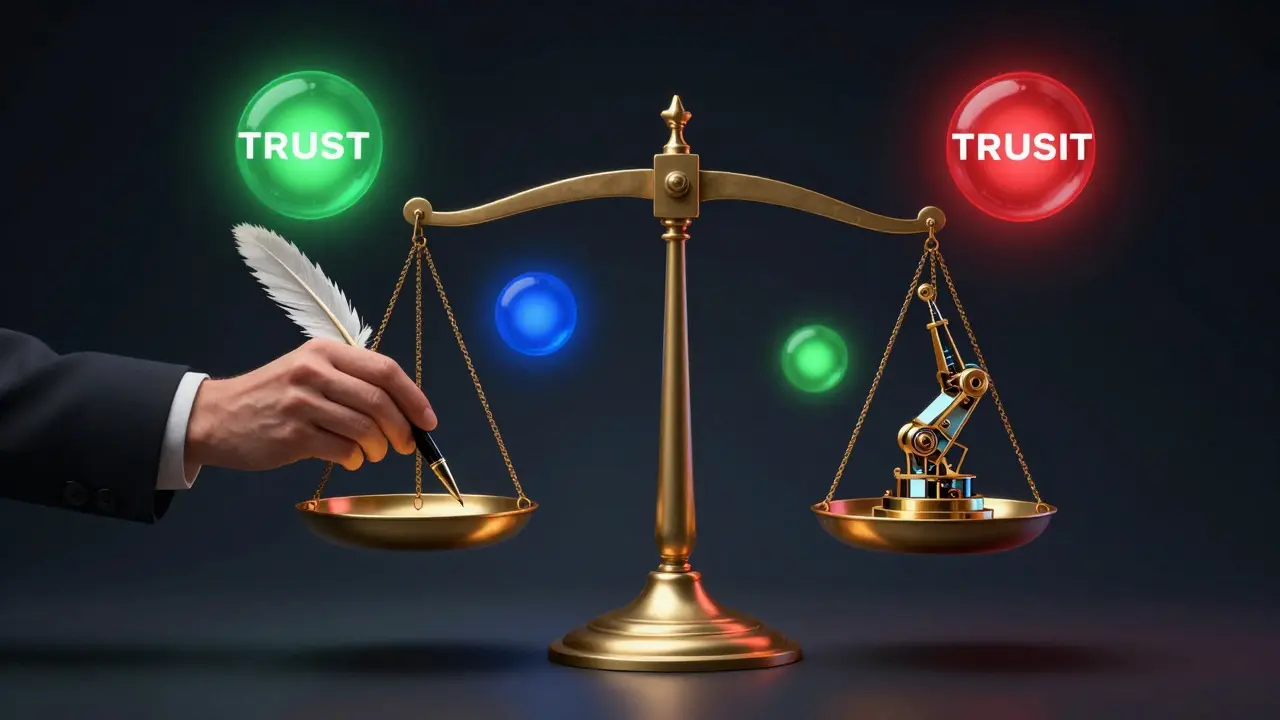
Case Studies: Where Humans and Machines Diverge
Consider the handling of breaking news events. During a natural disaster, an AI-driven encyclopedia can update weather data and casualty figures within minutes. This speed is invaluable. However, when interpreting the political implications or long-term social impact, human journalists and historians provide depth that algorithms miss. In one notable incident, an automated system incorrectly attributed a quote to a public figure due to a minor linguistic variation. It took four days for human moderators to correct the record, during which misinformation spread widely.
On the other hand, in highly technical fields like mathematics or coding, AI tools have proven remarkably effective at verifying syntax and logical consistency. Here, the objective nature of the subject matter reduces the risk of subjective bias. The key takeaway is that the domain matters. High-stakes, subjective topics require human oversight, while low-stakes, objective data can benefit from automated updates.
| Attribute | Human Editors | AI Automation |
|---|---|---|
| Speed of Updates | Slow (days to weeks) | Instant (seconds) |
| Contextual Nuance | High | Low to Moderate |
| Consistency | Variable (depends on individual) | High (standardized rules) |
| Accountability | Clear (named individuals) | Diffuse (algorithm version) |
| Bias Risk | Cultural/Personal Bias | Data/Training Bias |
The Role of Transparency in Building Confidence
Transparency is the bridge between human and AI governance. Readers don't necessarily need to know who wrote every word, but they need to know *how* the information was verified. Platforms that label AI-generated content and provide clear citation trails tend to maintain higher trust levels. When users see that an AI flagged a discrepancy and a human confirmed it, they perceive a robust verification process.
Conversely, hidden automation erodes trust. If readers discover that their trusted source relies heavily on unvetted machine learning models, skepticism rises. Therefore, the most successful hybrid models are those that make the governance process visible. This includes displaying confidence scores, showing recent edit histories, and allowing users to report issues easily.

Practical Frameworks for Measuring Trust
If you are evaluating an encyclopedia platform, consider these practical metrics:
- Error Correction Time: How quickly are known mistakes fixed? Human-led platforms may take longer, but AI platforms should correct instantly unless blocked by moderation queues.
- Citation Density: Are claims backed by primary sources? Both humans and AI can cite sources, but humans are better at evaluating source quality.
- User Feedback Loops: Can readers easily flag errors? Effective feedback mechanisms indicate a commitment to continuous improvement.
- Editorial Standards: Does the platform publish its guidelines? Clear standards help users understand what to expect.
For organizations implementing AI in knowledge management, start with a hybrid approach. Use AI for initial data ingestion and fact-checking, then route complex or controversial topics to human experts. Track metrics like user retention and complaint rates to gauge trust levels over time.
Future Implications: The Hybrid Model
The future likely isn't human *or* AI, but human *and* AI. We are moving toward collaborative intelligence, where machines handle the tedious tasks of data aggregation and pattern recognition, while humans focus on interpretation, ethics, and storytelling. This division of labor could enhance trust by leveraging the strengths of both. Imagine an encyclopedia where AI monitors real-time changes in scientific literature, flags potential updates, and suggests edits, which are then reviewed by domain experts. This workflow ensures speed without sacrificing quality.
However, this requires significant investment in training both humans and algorithms. Editors need digital literacy to work effectively with AI tools. Algorithms need fine-tuning to respect editorial standards. The goal is not to replace human judgment but to augment it, creating a more resilient and trustworthy knowledge ecosystem.
Is AI-generated encyclopedia content reliable?
It depends on the topic and the verification process. For objective, factual data, AI is highly reliable. For subjective or nuanced topics, human oversight is essential. Always check for citations and editorial reviews.
How do I tell if an encyclopedia uses AI editing?
Look for labels indicating automated updates, frequent minor edits, or standardized language patterns. Many platforms now disclose their use of AI tools in their methodology sections.
Which is better: human or AI for fact-checking?
Neither is universally better. AI excels at speed and consistency, while humans excel at context and nuance. The best results come from combining both approaches.
Does AI introduce new types of bias?
Yes. AI can inherit biases from its training data, such as historical inaccuracies or cultural blind spots. Regular audits and diverse training datasets help mitigate this risk.
How can I improve trust in my organization's knowledge base?
Implement transparent editorial standards, use AI for routine updates, reserve human review for critical content, and provide clear feedback channels for users.