Wikipedia doesn’t own the content on its site. That’s not a bug-it’s the whole point. Since its launch in 2001, Wikipedia has built the largest free knowledge repository in human history by refusing to lock down its content behind traditional copyright. But that freedom didn’t come without a fight, confusion, or a long series of policy shifts. Understanding how Wikipedia’s copyright rules evolved isn’t just about legal jargon-it’s about how a global community decided to share knowledge differently than anyone had before.
Starting with No Rules
When Wikipedia launched, it used a simple license: the GNU Free Documentation License (GFDL). It was borrowed from the free software movement and designed for manuals, not encyclopedias. The GFDL required that any modified version of a text include a copy of the full license, list all previous authors, and keep an invariant section-parts that couldn’t be changed. For a software manual, that made sense. For an encyclopedia edited by thousands of anonymous users? It was a nightmare.
Imagine trying to trace every single edit made to the article on "Climate Change" over five years. Now imagine needing to include every contributor’s name and a copy of the license with every reprint. That’s what publishers and educators faced. Schools couldn’t print Wikipedia pages. Libraries couldn’t archive them. The GFDL was designed for software, not mass collaboration.
The Big Switch: Creative Commons
In 2009, after eight years of debate, the Wikimedia Foundation made a historic move: it dual-licensed Wikipedia’s text content under both the GFDL and the Creative Commons Attribution-ShareAlike 3.0 Unported License (CC BY-SA 3.0). By 2010, all new content was licensed only under CC BY-SA. The GFDL was phased out for new contributions.
Why? Because Creative Commons was built for this exact problem. CC BY-SA let anyone reuse, remix, and redistribute content as long as they gave credit and shared it under the same terms. No need to include the full license text. No invariant sections. No bureaucratic clutter. It was clean, simple, and designed for the web.
The change didn’t happen overnight. Contributors argued for months. Some feared losing legal protections. Others worried about commercial exploitation. But the practical benefits won out. Suddenly, museums could display Wikipedia content on tablets. Teachers could print handouts. Developers could build apps that pulled in encyclopedia entries without legal teams signing off on every use.
Fair Use and Images: The Gray Area
Text on Wikipedia is almost always freely licensed. But images? That’s where things get messy. Because of U.S. copyright law, Wikipedia allows limited use of copyrighted images under "fair use"-especially for coverage of historical events, portraits of public figures, or album covers. These images can’t be reused outside Wikipedia without permission.
That creates a split. The text on the page about "Michael Jackson" is CC BY-SA. The photo of him on stage? Probably not. It’s marked as "fair use" and can’t be copied to another site. This inconsistency trips up users. Many assume everything on Wikipedia is free to use. It’s not. Only text and media explicitly labeled as CC BY-SA, CC0, or public domain are safe for reuse.
Wikimedia Commons, the media repository linked to Wikipedia, tries to fix this. It only hosts freely licensed or public domain files. If you want to reuse a Wikipedia image legally, you’re better off finding it on Commons. But not everything is there. Thousands of fair-use images still live on Wikipedia itself, especially in English-language articles.
What Happens When Someone Violates the License?
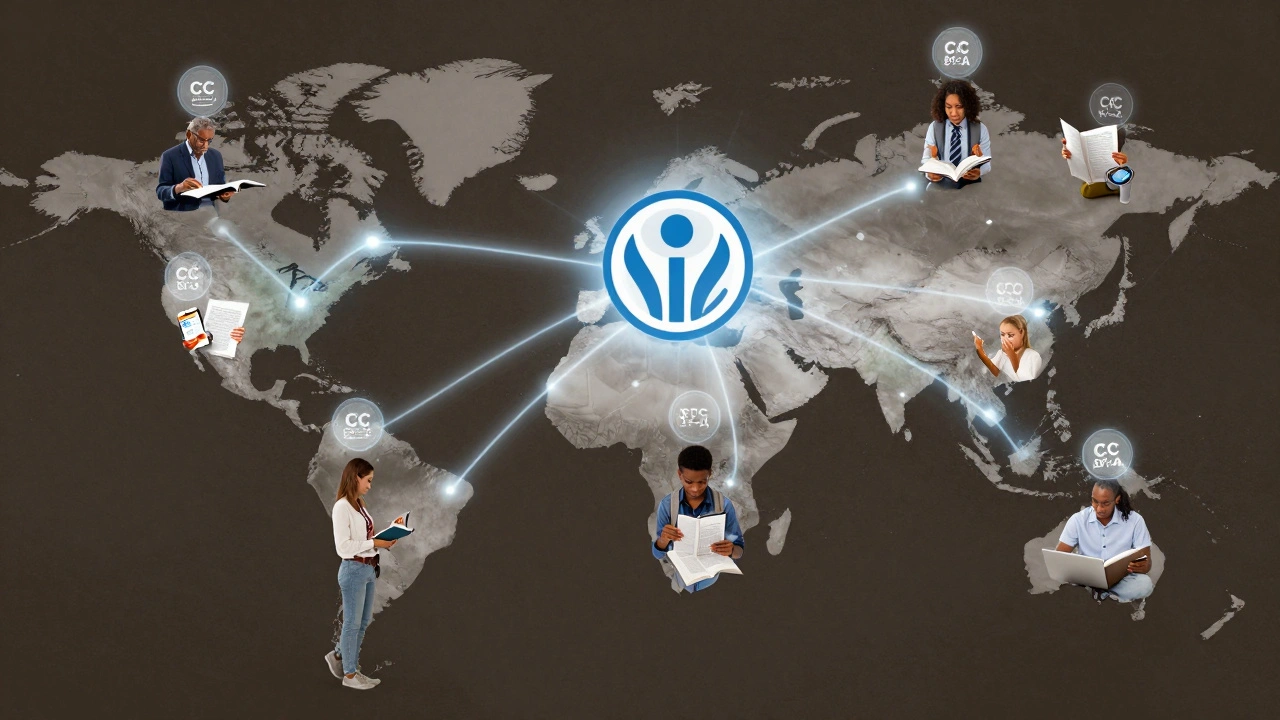
Wikipedia doesn’t sue people. It doesn’t have the resources, and it doesn’t believe in legal threats as a tool for enforcement. Instead, it relies on community reporting and public shaming. If a company copies Wikipedia text without attribution, someone will notice. A Wikipedia editor will contact them. A blog post will go viral. The company will get called out on social media. That’s usually enough.
There have been exceptions. In 2015, a German publisher printed a book using Wikipedia articles without proper attribution. The Wikimedia Foundation didn’t file a lawsuit. Instead, they published a public letter detailing the violations. The publisher pulled the book, issued an apology, and started crediting Wikipedia properly.
Another case involved a Chinese website that copied 20,000 Wikipedia articles and sold them as an e-book. The community flagged it. The site was shut down by Chinese authorities after pressure from international users. Wikipedia’s power isn’t in its lawyers-it’s in its global network of readers who care enough to speak up.
How Licensing Affects Contributors
When you edit Wikipedia, you’re not just writing an article-you’re agreeing to release your work under CC BY-SA. That means anyone can take your words, translate them, sell them in a book, or turn them into a YouTube script. You don’t get paid. You don’t get a byline in every reuse. But you do get something bigger: your words become part of a living, global knowledge base.
Some contributors struggle with this. They spend weeks researching a topic, only to see their work appear on a commercial site with no credit. But Wikipedia’s policy is clear: attribution is required, and it’s enforced by the community. If you see a reuse without credit, you can report it. You can also check the article’s history to see who wrote what. Every edit is tracked.
Wikipedia doesn’t protect your ego. It protects the flow of knowledge. That’s the trade-off.
Current Rules in 2025
As of 2025, Wikipedia’s licensing rules are stable but still evolving. All text is licensed under CC BY-SA 4.0, the latest version of the license. This version is more international-friendly, clearer in language, and works better across different legal systems. Media on Wikimedia Commons is either CC BY-SA, CC0 (public domain dedication), or public domain.
There’s no plan to switch again. The community has accepted the trade-offs. The Wikimedia Foundation now focuses on helping people understand the license-not changing it. They’ve created tools like the "License Checker" to help users verify if an image is safe to reuse. They’ve updated their help pages with real-world examples: "Can I use this in my podcast?", "Can I print this for my class?", "Can I sell this in a book?"
The result? Wikipedia is now the most reused knowledge source on the planet. It powers AI training data, language translation tools, school textbooks in developing countries, and museum exhibits in Tokyo, Lagos, and Buenos Aires. None of that would be possible without a licensing system that prioritizes access over control.
What’s Next?
Wikipedia’s licensing model is being tested in new ways. As AI models scrape Wikipedia for training data, questions arise: Does using Wikipedia text in an AI system count as "reuse" under CC BY-SA? Should the model credit Wikipedia? The community hasn’t settled on an answer yet. Some argue that AI training falls under fair use. Others say the license requires attribution even for machine learning.
The Wikimedia Foundation has released a position paper stating that AI systems using Wikipedia content should provide attribution when the output is publicly accessible. But enforcement? That’s still unclear. For now, it’s a gray area-and the community is watching closely.
One thing is certain: Wikipedia’s success isn’t because of perfect laws. It’s because of a radical idea-that knowledge should be free, and that people will respect it enough to share it properly. The license isn’t a wall. It’s a handshake.
Can I use Wikipedia text in my book?
Yes, you can use Wikipedia text in your book as long as you follow the CC BY-SA 4.0 license. You must give appropriate credit-include the article title, link to the original page, and mention that the content is licensed under CC BY-SA. You must also license your book under the same terms if you distribute it. You cannot claim exclusive ownership or restrict others from using your book.
Are all images on Wikipedia free to use?
No. Only images on Wikimedia Commons that are labeled as CC BY-SA, CC0, or public domain are free to reuse. Many images on Wikipedia itself are marked as "fair use" and are restricted to use on Wikipedia only. Always check the image’s description page for licensing details before reusing it elsewhere.
Why doesn’t Wikipedia use public domain for everything?
Public domain content can be taken and locked behind paywalls or used without credit. CC BY-SA requires attribution and sharing alike, which helps keep knowledge open. Wikipedia prefers licenses that protect openness, not just freedom. Public domain is allowed, but CC BY-SA is the standard because it ensures future users can also build on the work.
Can schools use Wikipedia as a textbook?
Yes, many schools do. Teachers can print Wikipedia articles, assign them as reading, or use them in lessons. Because the text is under CC BY-SA, they don’t need permission. They just need to credit the source. Some schools even encourage students to edit Wikipedia as part of their coursework-turning them from passive readers into active contributors.
What happens if someone uses Wikipedia content without credit?
If someone uses Wikipedia text without attribution, they’re violating the license. The community typically responds by contacting them directly, posting about it online, or reporting it to platforms like Google or YouTube. Legal action is rare, but public pressure usually leads to corrections. The Wikimedia Foundation supports these community efforts but doesn’t handle enforcement itself.