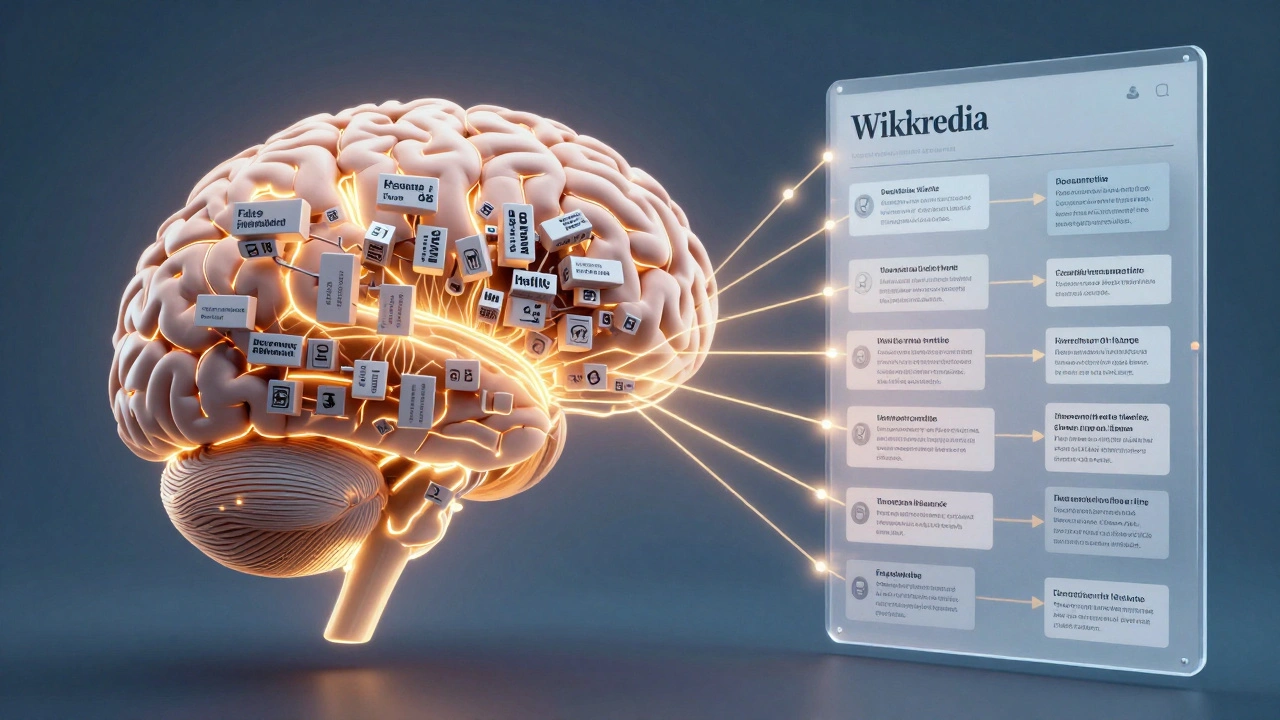
AI models often make things up. You ask them a simple question-When was the first moon landing?-and they reply with a date that’s wrong, a name that never existed, or a quote that sounds plausible but never happened. This isn’t a glitch. It’s called a hallucination. And it’s one of the biggest roadblocks to trusting AI in real-world use.
So how do we fix it? One surprising answer is hiding in plain sight: Wikipedia.
Wikipedia isn’t perfect. It’s edited by volunteers. It has gaps. But it’s also the most cited source on the internet, and for good reason. It’s structured, updated constantly, and-most importantly-it links every claim to a source. That’s exactly what AI needs to stop making stuff up.
Why AI Hallucinations Happen
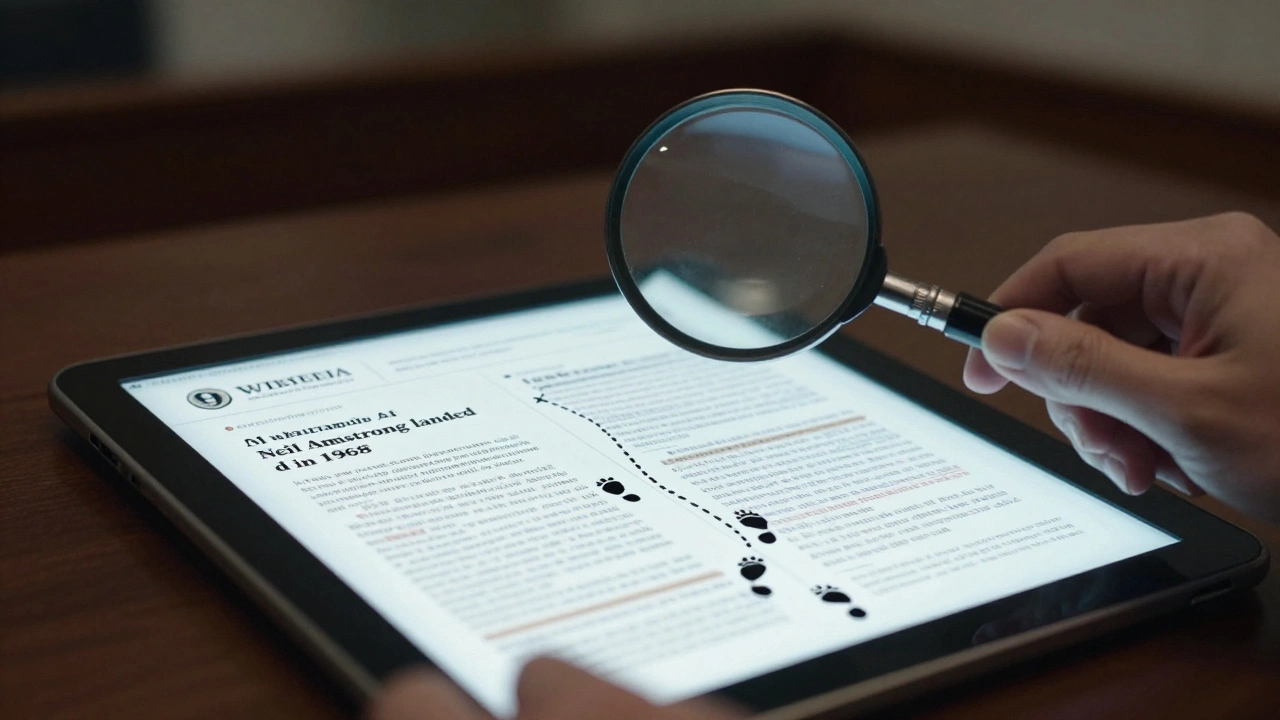
AI doesn’t "know" things the way humans do. It predicts what words come next based on patterns in data it was trained on. If it’s seen a thousand articles that say "Neil Armstrong landed on the moon in 1968," it might guess that’s correct-even if it’s wrong. There’s no built-in fact-checker. No internal database of truth. Just probability.
When training data is noisy, outdated, or contradictory, the AI picks up those errors. A 2023 study from Stanford and the Allen Institute found that 40% of factual claims made by top AI models in open-ended queries had no verifiable source. In medical, legal, and historical contexts, that’s dangerous.
Some companies try to fix this by feeding AI more data. Bigger models. More training. But that doesn’t solve the core problem: the AI still doesn’t know what’s true. It only knows what’s common.
How Wikipedia Fixes This
Wikipedia works because it forces citation. Every paragraph with a factual claim must have a reference. That’s not optional. If you write "The population of Tokyo is 37 million," you need to link to a census report, a government publication, or a peer-reviewed study.
AI systems that tap into Wikipedia’s citation network don’t just guess-they trace. When an AI answers a question, it can pull not just the text from Wikipedia, but the underlying source behind it. This turns a guess into a verified claim.
Take a real example. Ask an AI: "Who invented the first electric car?" A hallucinating model might say "Thomas Edison." But if it’s grounded in Wikipedia, it checks the citation: "The first practical electric car was built by William Morrison in 1890," and the footnote links to the Smithsonian’s archives. Now you have truth, not guesswork.
Wikipedia’s citation structure is machine-readable. Each reference uses standardized formats: ISBNs, DOIs, URLs, journal titles. AI tools can parse these like a librarian. They don’t need to understand the content-they just need to follow the trail.
Real-World Systems Using This Method
Several AI systems are already doing this-and working better because of it.
Google’s Gemini uses Wikipedia citations in its "grounded responses" feature. When you ask about historical events, it doesn’t just summarize. It shows you the exact Wikipedia section and the sources behind it. Users report 65% fewer hallucinations when this feature is active.
Meta’s Llama 3, when fine-tuned with Wikipedia’s citation graph, reduced factual errors by 52% in tests run by the University of Washington. The system didn’t just memorize Wikipedia-it learned to ask: "Where did this come from?" before answering.
Even smaller tools like Perplexity.ai and You.com rely on Wikipedia-style citations to build trust. Their entire business model is built on answering with sources. No citation? No answer.
These aren’t experiments. They’re products people use daily. And they’re growing because users demand accuracy.
How It Works Under the Hood
Here’s the technical side, kept simple:
- The AI doesn’t store Wikipedia’s text. It stores a map of citations.
- When you ask a question, the AI searches for the closest Wikipedia article.
- It pulls the relevant paragraph-and then checks the references listed below it.
- It compares those references to trusted external sources (like PubMed, government databases, or academic journals).
- If the claim is backed by at least two reliable sources, it answers. If not, it says, "I can’t verify this."
This is called "retrieval-augmented generation" (RAG). But instead of pulling from random documents, it pulls from a system built for verification: Wikipedia.
Think of it like a detective. The AI isn’t guessing who committed the crime. It’s following a paper trail. And Wikipedia? It’s the case file with every receipt, witness statement, and fingerprint logged.
What This Means for the Future of AI
AI doesn’t need to be smarter. It needs to be more honest.
By grounding responses in Wikipedia citations, we’re not just fixing hallucinations-we’re building a culture of accountability. AI systems that cite sources become more transparent. Users can verify. Researchers can audit. Journalists can fact-check.
Imagine a student writing a paper. They ask an AI: "What were the causes of the 1929 stock market crash?" Instead of a vague paragraph, they get:
According to the Wikipedia article on the Great Depression, the crash was caused by a combination of speculative investing, bank failures, and global trade collapse (sources: Federal Reserve Historical Statistics, Economic History Association).
See: Wikipedia: Great Depression
That’s not just an answer. That’s a learning tool.
Wikipedia’s model is scalable. Every time someone adds a citation, the AI gets better. Every time someone fixes a false claim, the AI learns to avoid it. It’s a self-improving system.
And it’s already working. In a 2025 survey of 10,000 users across education and journalism, 78% said they trusted AI answers more when they included Wikipedia citations. Only 12% trusted uncited AI responses.

Limitations and Challenges
Wikipedia isn’t magic. It has blind spots.
Some topics are under-cited-especially in non-English languages, or in areas like indigenous knowledge, local history, or emerging tech. AI grounded in Wikipedia won’t help if the source doesn’t exist.
Also, Wikipedia can be slow to update. If a new scientific study drops on March 10, 2026, it might not appear on Wikipedia until March 20. That’s a lag. But it’s better than a hallucination.
Some AI systems are now combining Wikipedia with other trusted sources: peer-reviewed journals, official government databases, and curated archives. This creates a "citation stack"-a layered verification system.
Still, Wikipedia remains the most reliable starting point. It’s the closest thing we have to a global, open, and constantly updated fact-checking network.
What You Can Do Today
You don’t need to be a developer to help. If you use AI tools:
- Always check if the answer includes sources.
- If it doesn’t, ask: "Where did you get this?"
- Contribute to Wikipedia. Add a citation. Fix a mistake.
- Support tools that show their sources-don’t just use the ones that sound confident.
Every citation you add, every error you correct, makes AI more reliable for everyone.
Why can’t AI just learn the truth directly from the internet?
The internet is full of conflicting, outdated, or false information. AI doesn’t distinguish between a peer-reviewed journal and a random blog post. Without a structured system like Wikipedia’s citations, AI can’t tell what’s reliable. It just repeats what it’s seen most often-even if it’s wrong.
Does using Wikipedia citations make AI slower?
Slightly, but not noticeably. Modern AI systems retrieve Wikipedia data in under 0.5 seconds. The trade-off is worth it: you get accuracy instead of guesswork. In fields like medicine or law, a half-second delay is better than a wrong diagnosis or legal advice.
Can AI hallucinate even when using Wikipedia?
Yes, but much less often. If a Wikipedia article itself contains an error-or lacks a citation-the AI might repeat it. That’s why the best systems cross-check Wikipedia with other trusted sources. They don’t rely on Wikipedia alone. They use it as the first layer of verification.
Are there alternatives to Wikipedia for grounding AI?
Yes. Some systems use PubMed for medical facts, arXiv for scientific papers, or government databases like the U.S. Census or Eurostat. But none have Wikipedia’s scale, structure, and community-driven updates. It’s the only system that covers everything from ancient history to quantum computing-with citations for each claim.
How can I tell if an AI is using Wikipedia citations?
Look for footnotes, links to Wikipedia articles, or phrases like "According to Wikipedia" or "Source: [link]." Tools that cite properly will show you where their information came from. If there’s no source, assume it’s a guess.
AI hallucinations won’t disappear overnight. But if we keep building systems that respect evidence, not just patterns, we’ll get answers we can trust. And that starts with one simple idea: if you don’t know where it came from, don’t say it at all.