Have you ever noticed that a news story on Wikinews is a free, collaborative online news source where editors report current events using a wiki model often looks different from an entry on Wikipedia is the world's largest free encyclopedia, relying on cited sources for factual accuracy rather than real-time reporting? It’s not just about the topic. It’s about how we decide what is true and what is new. While both platforms run on volunteer power and open editing, their core mechanisms for quality control are fundamentally different. Understanding this distinction helps you read these sites with sharper critical eyes.
The Core Philosophical Difference
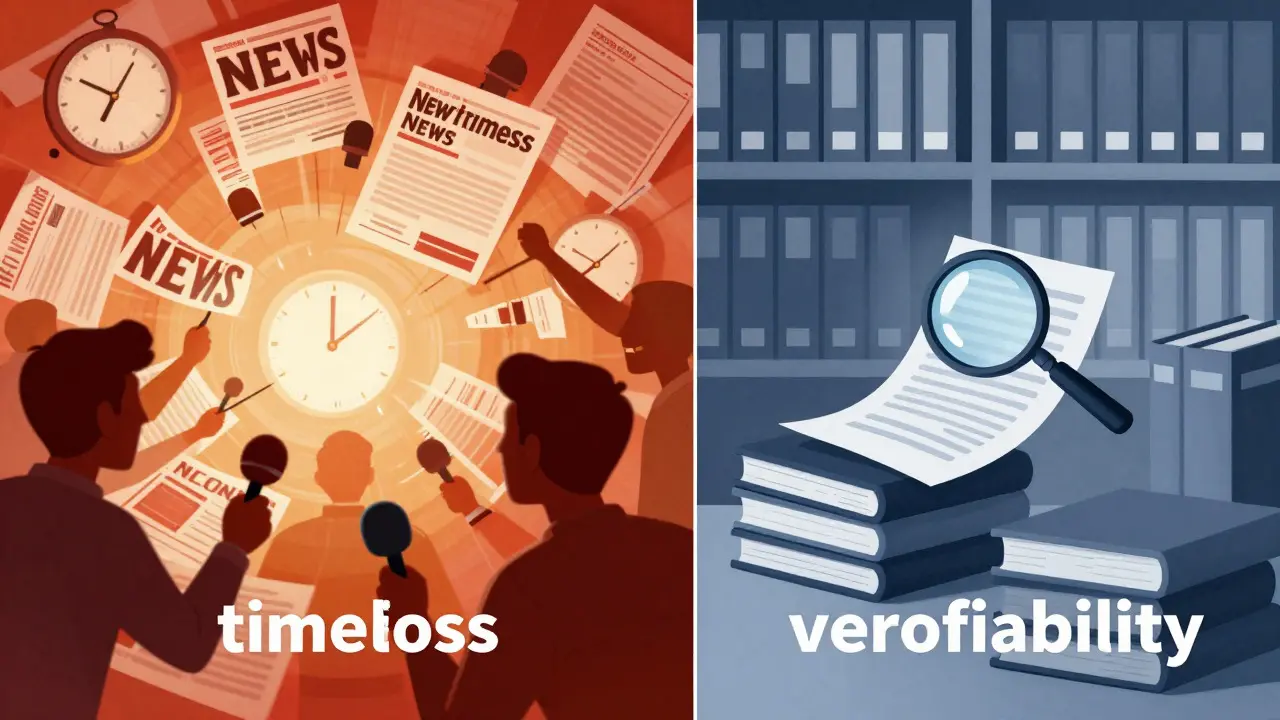
At its heart, Wikinews operates on a journalism model. The goal is to report events as they happen. Editors act like reporters, gathering facts, interviewing subjects (sometimes), and writing narratives. The primary standard here is timeliness and narrative coherence. If a major election happens, Wikinews aims to have a comprehensive article up within hours. The "truth" in this context is constructed through consensus among editors who are present at the moment of discussion.
In contrast, Wikipedia operates on an encyclopedic model. The goal is to summarize established knowledge. The primary standard is verifiability. This means every non-trivial claim must be backed by a reliable, published source. You don’t need to agree with the source; you just need to show it exists. This creates a slower, more rigid process but one that is far more resistant to personal bias or fleeting rumors.
How Quality Control Works on Each Platform
On Wikinews, quality control is largely social and immediate. When an editor writes a draft, other editors jump in to fix grammar, add missing details, or challenge interpretations. This is often called "peer review" in the casual sense, but it’s really just continuous collaboration. There is no formal gatekeeping body. A story can go live with minimal citations if the community agrees the facts are solid based on general knowledge or direct observation. This makes it agile but vulnerable to groupthink or rapid misinformation during breaking news cycles.
Wikipedia uses a structured system of checks. The most famous is the talk page, where disputes are resolved through discussion. But the real enforcement mechanism is the citation requirement. If you add a fact without a reference, a bot or a vigilant editor will remove it. For high-stakes articles, there are formal processes like Good Article or Featured Article reviews, which involve detailed scrutiny of sourcing, neutrality, and structure. These reviews take weeks or months, ensuring that only well-documented content reaches the highest tiers of recognition.
| Feature | Wikinews | Wikipedia |
|---|---|---|
| Primary Goal | Report current events quickly | Summarize established knowledge accurately |
| Key Standard | Consensus and timeliness | Verifiability via reliable sources |
| Citation Requirement | Recommended, but flexible for breaking news | Mandatory for non-trivial claims |
| Review Process | Continuous, informal peer editing | Formal reviews (GA/FA) and talk page debates |
| Risk Profile | Higher risk of transient errors or bias | Lower risk of error, higher risk of lagging behind current events |
The Role of Sources and Citations
This is where the two projects diverge most sharply. On Wikipedia, a reliable source is defined clearly. It usually means a publication with a professional editorial board, such as a major newspaper, academic journal, or government report. Personal blogs, social media posts, and self-published works are generally considered unreliable unless the subject is the author themselves. This strictness ensures that Wikipedia reflects a consensus of credible experts, even if that consensus lags behind real-world developments by days or weeks.
Wikinews has a more pragmatic approach to sourcing. Because news moves fast, waiting for a peer-reviewed journal article is impossible. Therefore, Wikinews editors frequently cite wire services (like AP or Reuters), official press releases, and sometimes even social media feeds if they provide direct evidence of an event. The burden of proof is lighter because the context is "this is what is happening right now," not "this is what is historically true." However, this flexibility means readers must be more careful about verifying the origin of specific claims, especially in controversial stories.

Handling Controversy and Disputes
When facts are disputed, the resolution paths differ significantly. In Wikipedia, disputes are settled by finding better sources. If two groups disagree on a historical interpretation, the solution isn't to vote on who is right, but to find more authoritative sources that support each view and present them neutrally. This is known as Neutral Point of View (NPOV). The process can be slow, sometimes leading to edit wars where bots lock pages temporarily to force calm.
In Wikinews, disputes are often resolved through quick consensus in the article's talk space or directly in the text. Since the goal is to report the event, not to adjudicate long-term truth, editors tend to focus on what was said or done at the time. If a politician makes a statement, Wikinews reports the statement. If the statement is later proven false, the article might be updated, but the initial report stands as a record of the moment. This makes Wikinews valuable for tracking the evolution of public discourse, even if the underlying facts shift.
Implications for Readers and Researchers
So, which should you use? It depends on your needs. If you are looking for a snapshot of a developing story-like the latest updates on a natural disaster or a political protest-Wikinews is often faster and more comprehensive than traditional media outlets. It aggregates multiple perspectives in real-time. Just keep in mind that the narrative may change as new information emerges.
If you are researching a topic for a paper, a business decision, or general understanding of a complex issue, Wikipedia is the safer bet. Its rigorous citation standards mean that the information is less likely to be wrong, even if it isn't the absolute latest. Always check the references in a Wikipedia article to see what sources are backing up the claims. This transparency allows you to verify the information yourself, which is a powerful tool for critical thinking.

Common Misconceptions About Both Platforms
A common myth is that Wikipedia is "wrong" because anyone can edit it. In reality, the combination of thousands of volunteers, automated tools, and strict sourcing rules makes it remarkably accurate for stable topics. Another misconception is that Wikinews is "unreliable" because it lacks formal peer review. While it is more prone to transient errors, its transparency and speed make it a unique resource for journalism enthusiasts and researchers studying media coverage in real-time.
Both platforms benefit from the same spirit of openness. They invite you to look under the hood. Whether you are checking the talk page on Wikipedia or reading the history of a Wikinews article, you are seeing the work in progress. This radical transparency is what sets them apart from traditional media, where the editorial process is hidden behind paywalls and corporate structures.
Frequently Asked Questions
Is Wikinews more accurate than Wikipedia?
It depends on the timeframe. For breaking news, Wikinews is often more current and detailed. For established facts, Wikipedia is generally more accurate due to stricter citation requirements. Neither is inherently "better"; they serve different purposes.
What does 'verifiability' mean in Wikipedia?
Verifiability means that any significant claim in an article must be supported by a reliable, published source. It doesn't mean the source is always correct, but that the claim is traceable back to a credible external authority.
Can I trust Wikinews for academic research?
Use it with caution. It is best used as a starting point to find primary sources or to track media trends. For final citations, you should verify the information against traditional academic or journalistic sources.
How do editors resolve disagreements on Wikinews?
Disagreements are typically resolved through discussion on the article's talk page or by reaching a consensus among active editors. Unlike Wikipedia, there is less reliance on formal voting or strict sourcing rules to break deadlocks.
Why does Wikipedia require so many citations?
Citations allow readers to verify facts independently. They also help maintain Neutral Point of View by ensuring that all significant claims are backed by reliable, external sources rather than personal opinion or unverified hearsay.