
Ever tried to edit a Wikipedia article about a controversial political figure or a new medical treatment and felt like you were walking through a minefield? You aren't alone. The Neutral Point of View is a core editorial guideline that requires articles to present significant viewpoints fairly, proportionally, and without bias. It sounds simple on paper, but maintaining this balance across millions of articles written by volunteers creates one of the most complex social engineering challenges in digital history.
The goal isn't to find a "middle ground" between two extremes. Instead, it’s about reflecting what reliable sources say. If 90% of credible scientific literature supports a claim, the article shouldn't spend half its word count debating the 10% that disagrees. This proportional representation is the heart of NPOV. For readers, this means getting a snapshot of established knowledge rather than an arena for debate. For editors, it means constantly checking their own assumptions against cited evidence.
What Actually Counts as Neutral?
Many people confuse neutrality with objectivity. In journalism, we often talk about being objective. On Wikipedia, the term is neutral. Why the distinction? Because absolute objectivity is impossible; every editor has a background, a culture, and a set of values. Neutrality acknowledges this. It asks editors to step back from their personal stance and ask: "What do the experts say?"
This approach relies heavily on the concept of Reliable Sources is publications with a track record of fact-checking, such as peer-reviewed journals, major news outlets, and academic books. If a claim appears in a tabloid but not in a reputable newspaper, it likely doesn't meet the threshold for inclusion unless it's specifically about the tabloid itself. This filter helps keep fringe theories in check while allowing legitimate minority views to exist where they belong.
Consider the article on climate change. Early drafts might have listed "proponents" and "skeptics" equally. Today, the structure reflects the scientific consensus. The majority of the text explains the mechanisms and data supported by bodies like the IPCC. Skeptical views are mentioned, but only to the extent that they appear in reliable secondary sources. This shift happened because editors applied NPOV consistently over years, moving away from false balance toward accurate representation.
The Mechanics of Consensus Editing
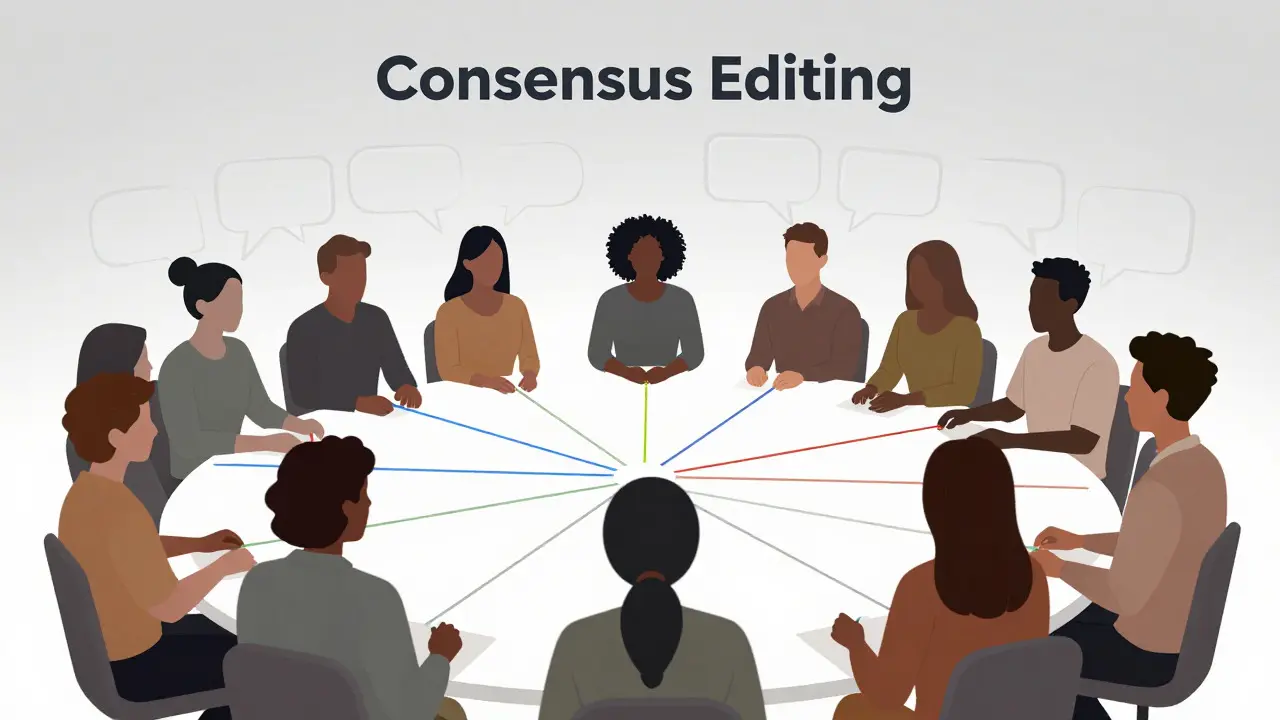
How do thousands of strangers agree on what is neutral? They use a process called Consensus Editing is a collaborative method where changes are accepted if they align with community guidelines, even if not everyone agrees unanimously. It’s not a vote. It’s a negotiation. If Editor A adds a paragraph citing a local blog, and Editor B removes it citing lack of reliability, the discussion happens on the talk page. The outcome usually favors the side with better sourcing.
This system prevents any single person from dominating an article. But it can be slow. Disputes over sensitive topics-like religion, politics, or medicine-can drag on for months. Editors develop a thick skin. They learn to separate their ego from their edits. If your edit gets reverted, it’s rarely a personal attack. It’s just another voice in the chorus saying, "Let's look at the sources again."
There are tools to help manage this friction. The Talk Page is a dedicated space adjacent to each article where editors discuss proposed changes, resolve disputes, and plan future work. These pages serve as the public record of how neutrality was achieved. Reading them offers a fascinating glimpse into the messy, human side of creating a neutral encyclopedia.
Handling Conflict of Interest
One of the biggest threats to NPOV is the Conflict of Interest is a situation where an editor has a personal, financial, or professional stake in the subject matter, potentially compromising impartiality. Think about it: if you run a small bakery, you’re excited when a local news outlet mentions you. You want to put that link on your business’s Wikipedia page. But is that source independent enough? Is the coverage substantial enough to warrant a standalone article?
Wikipedia has strict rules for this. Generally, if you have a COI, you should disclose it. You might propose the edit on the talk page instead of making it directly. This transparency allows other editors to scrutinize the change more closely. It’s a safeguard against promotional content slipping in under the guise of factual reporting.
COIs aren’t limited to businesses. Academics writing about their own research, politicians writing about their careers, and fans writing about their favorite bands all face this challenge. The solution is always the same: rely on third-party verification. Let someone else describe your impact. That’s how you maintain credibility.
Common Pitfalls and How to Avoid Them
Even experienced editors stumble. Here are the most common ways NPOV breaks down:
- False Balance: Giving equal weight to a widely accepted scientific fact and a fringe theory simply because both exist. If the science says vaccines work, don't dedicate half the section to anti-vaccine anecdotes.
- Loaded Language: Using adjectives that push a narrative. Instead of "The controversial politician made bold claims," try "The politician stated..." Let the facts speak.
- Missing Context: Presenting a statistic without explaining its significance or limitations. Numbers need context to be neutral.
- Sourcing Bias: Relying only on sources from one region or ideology. A truly neutral article draws from a diverse range of reliable perspectives.
Avoiding these pitfalls takes practice. New editors are encouraged to start with low-stakes topics-like historical dates or geographic facts-to build intuition before tackling hot-button issues.
The Role of Automation and Bot Editing
You might think NPOV is purely a human endeavor, but technology plays a part. Bots are automated scripts that perform repetitive tasks, such as fixing grammar, updating categories, or standardizing formats. While bots don't make editorial judgments about bias, they ensure consistency in presentation. A consistent format makes it easier for humans to spot actual bias.
More recently, machine learning models have been used to flag potential NPOV violations. These tools analyze language patterns to detect loaded terms or disproportionate source usage. They aren't perfect, but they act as a first-pass filter, helping volunteer reviewers focus their time on the most problematic areas. This blend of human judgment and automated assistance is how Wikipedia scales its quality control.
Why This Matters for Readers
At the end of the day, NPOV exists for you, the reader. You want information you can trust. You don't want to wade through propaganda or marketing copy. When an article follows NPOV, you get a balanced view that acknowledges complexity without drowning in noise.
It’s not perfect. Biases slip in. Debates rage. But the system works well enough to make Wikipedia the most visited reference site on the internet. By understanding how NPOV functions, you become a better consumer of information. You learn to look for sources, check for balance, and recognize when an article might be leaning too far in one direction.
Frequently Asked Questions
Does Neutral Point of View mean there is no right answer?
No. NPOV does not imply that all viewpoints are equally valid. It means that the article should reflect the consensus of reliable sources. If experts agree on a fact, the article should state it clearly. Minority views are included only if they are significant enough to be covered in those sources.
Can I cite my own blog post on Wikipedia?
Generally, no. Self-published sources are considered unreliable unless they are primary sources for the specific topic (e.g., a letter written by the subject). For most topics, you need independent, third-party sources with a reputation for accuracy.
What happens if two editors disagree on neutrality?
They discuss the issue on the Talk Page. If they can't resolve it, they may seek mediation from a neutral administrator or submit the case to a formal dispute resolution process. The goal is always to reach a consensus that aligns with Wikipedia's guidelines.
Is Wikipedia really neutral compared to traditional encyclopedias?
Traditional encyclopedias often have smaller teams of professional editors who curate content tightly. Wikipedia relies on a massive volunteer base and open editing. While this can lead to more variability, the rigorous application of NPOV and Reliable Source policies ensures a high level of accuracy and balance for most mainstream topics.
How do I report a biased article?
Start by checking the references. Are they reliable? Do they support the claims? If you see bias, leave a polite note on the Talk Page suggesting improvements with citations. If the problem persists, you can request attention from experienced editors or administrators via the Village Pump or dispute resolution channels.