Imagine logging into Wikipedia, the free encyclopedia that powers millions of daily searches, only to find your latest edit reverted instantly. For casual users, this is confusing; for seasoned contributors, it is a signal that you have crossed a line in the unwritten social contract of the platform. Understanding how policy enforcement mechanisms range from gentle warnings to permanent sitewide bans is crucial for anyone who wants to contribute without getting locked out.
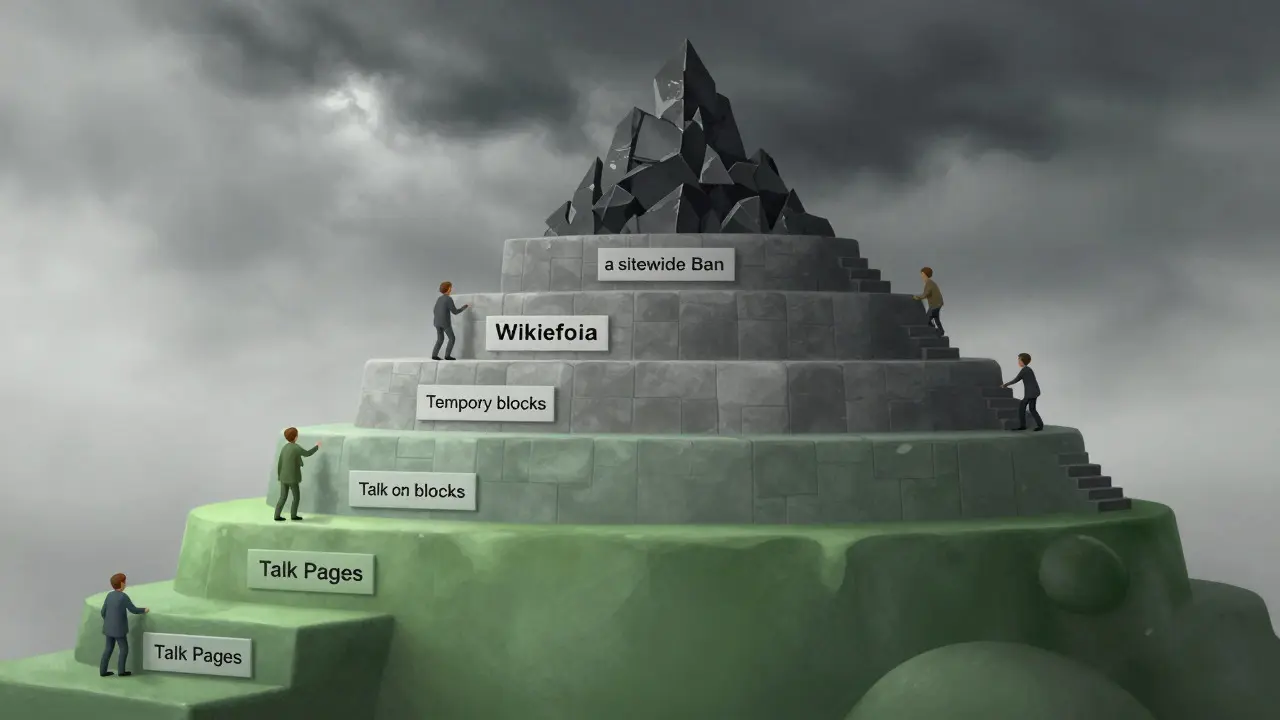
The process isn't random. It follows a logical escalation path designed to correct behavior before removing the contributor entirely. This guide breaks down exactly what happens at each stage, why administrators act the way they do, and how you can navigate these waters to keep your edits live.
The First Line of Defense: Talk Pages and Warnings
Before any formal action is taken, the community relies on communication. When an editor makes a questionable change-perhaps adding unsourced claims or reverting another user's work-the first response usually comes via the article's talk page. This is where editors discuss improvements. If the issue persists, a standard warning template appears on the editor's user talk page.
These warnings are not legal documents but social cues. They typically follow a tiered system:
- Level 1 (Minor): A polite nudge about minor issues like formatting or small reverts.
- Level 2 (Moderate): A clearer statement that repeated behavior will lead to stricter action.
- Level 3 (Severe): A final notice indicating that one more infraction will result in a block.
Most good-faith editors fix their mistakes here. The key attribute of this stage is consensus. Administrators rarely step in unless the editor ignores these signals or acts in bad faith. If you receive a Level 1 warning, read the linked policy carefully. Ignoring it turns a simple misunderstanding into a disciplinary case.
When Words Fail: Temporary Blocks
If warnings don't stop the disruptive editing, Administrators intervene with temporary blocks. These are time-limited restrictions that prevent an account from editing specific pages or the entire site for a set duration. Common durations include 24 hours, 7 days, or 30 days.
A temporary block serves two purposes: it stops immediate damage and gives the editor time to cool off and understand the rules. During this period, the editor can still view articles and participate in discussions, but cannot make changes. The length of the block often correlates with the severity of the offense. For example, a user engaged in a heated edit war over a single paragraph might get a 24-hour block, while someone systematically vandalizing biographies could face a month-long restriction.
It is important to note that temporary blocks are reversible. If the editor apologizes and agrees to follow guidelines, an administrator may lift the block early. However, if the editor returns immediately after the block expires to continue the same behavior, the next step is almost always a longer block or a sitewide ban.
| Stage | Action Type | Typical Duration | Reversibility |
|---|---|---|---|
| Warning | Talk Page Template | Ongoing until resolved | High (via discussion) |
| Temporary Block | Edit Restriction | 24 hours to 3 months | Moderate (via appeal) |
| Sitewide Ban | Permanent Account Lock | Indefinite | Low (requires ArbCom review) |
The Final Step: Sitewide Bans
A Sitewide Ban is the most severe penalty in Wikipedia's enforcement hierarchy. It prevents an account from editing any page on the English Wikipedia indefinitely. Unlike temporary blocks, which are handled by individual administrators, sitewide bans often require a higher level of scrutiny, especially if the ban is controversial.
Who gets banned? Usually, it is editors who exhibit persistent bad faith. This includes chronic vandals, sock puppet accounts used to evade previous blocks, and editors who refuse to engage in good-faith discussion. The ban itself is not just about stopping edits; it is a signal that the community no longer trusts the account to self-regulate.
However, a sitewide ban does not mean the end of the road. Editors can appeal their ban through the Arbitration Committee (ArbCom), a group of elected volunteers who handle the most complex disputes. An appeal requires a clear argument explaining why the ban was unjust or why the editor has changed their behavior. Success rates vary, but the process provides a formal avenue for justice within the ecosystem.
Navigating the Process: Practical Advice for Editors
Whether you are a new contributor or a veteran, knowing how to handle enforcement actions can save your account. Here are practical steps to take when you feel targeted by a moderator:
- Check the Reason: Always read the block reason or warning message. It usually links to the specific policy violated.
- Stay Calm: Reacting emotionally in the talk page often leads to further friction. Use neutral language.
- Document Your Intent: If you made an error, explain it clearly. If you disagree with a revert, cite sources.
- Use Appeals Wisely: Only appeal if you believe there was a procedural error or if you have significantly changed your approach.
Remember, the goal of Wikipedia's administration is not to punish but to maintain the quality of the encyclopedia. Most enforcement actions are routine and resolved quickly. By understanding the ladder from warnings to bans, you can climb back up with confidence and contribute effectively.
Frequently Asked Questions
Can I edit Wikipedia while blocked?
Generally, no. A sitewide block prevents all edits from that account. However, you can still read articles, view history, and participate in discussions on talk pages unless specifically restricted from doing so. Some partial blocks allow editing of certain namespaces but not others.
What is the difference between a block and a ban?
A block is a technical restriction that can be temporary or permanent. A ban is a decision by the community or arbitration committee that results in a permanent block. In common usage, 'ban' implies a final, indefinite status, while 'block' can refer to any restriction, including short-term ones.
How long does a typical temporary block last?
Durations vary based on severity. Minor infractions often result in 24-hour or 7-day blocks. More serious issues, like repeated vandalism or edit warring, can lead to 30-day or 90-day blocks. Indefinite blocks are reserved for extreme cases pending arbitration.
Who decides if a ban is lifted?
For temporary blocks, the administering volunteer or administrator can lift them upon request. For sitewide bans, the Arbitration Committee (ArbCom) reviews appeals. They assess whether the editor has demonstrated good faith and compliance with policies since the ban was imposed.
Does a ban affect my other Wikipedia accounts?
Yes. Using multiple accounts to evade a ban is considered 'sock puppetry' and is a serious violation. If detected, all associated accounts are typically banned as well. The community uses IP addresses and editing patterns to identify linked accounts.