Key Takeaways
- AI excels at aggregating data but struggles with the nuance of "verifiability" that humans provide.
- The "human-in-the-loop" model is the most likely future, not total replacement.
- AI-generated content risks creating "echo chambers" of misinformation through recursive training.
- The social fabric and community governance of Wikipedia are irreplaceable by algorithms.
The Machine vs. The Moderator
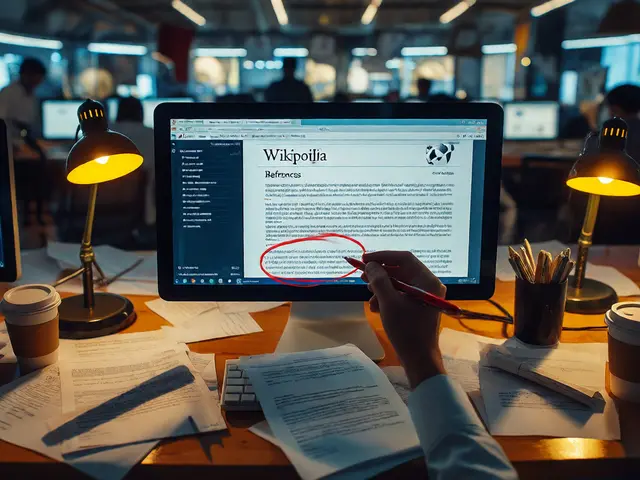
To understand the tension, we first have to look at what Wikipedia is a multilingual online encyclopedia written and maintained by a community of volunteers through a model of open collaboration. It's not just a database; it's a social experiment in consensus. When a volunteer editor flags a claim as "citation needed," they aren't just checking a box. They are applying human judgment to determine if a source is biased, outdated, or simply fake.
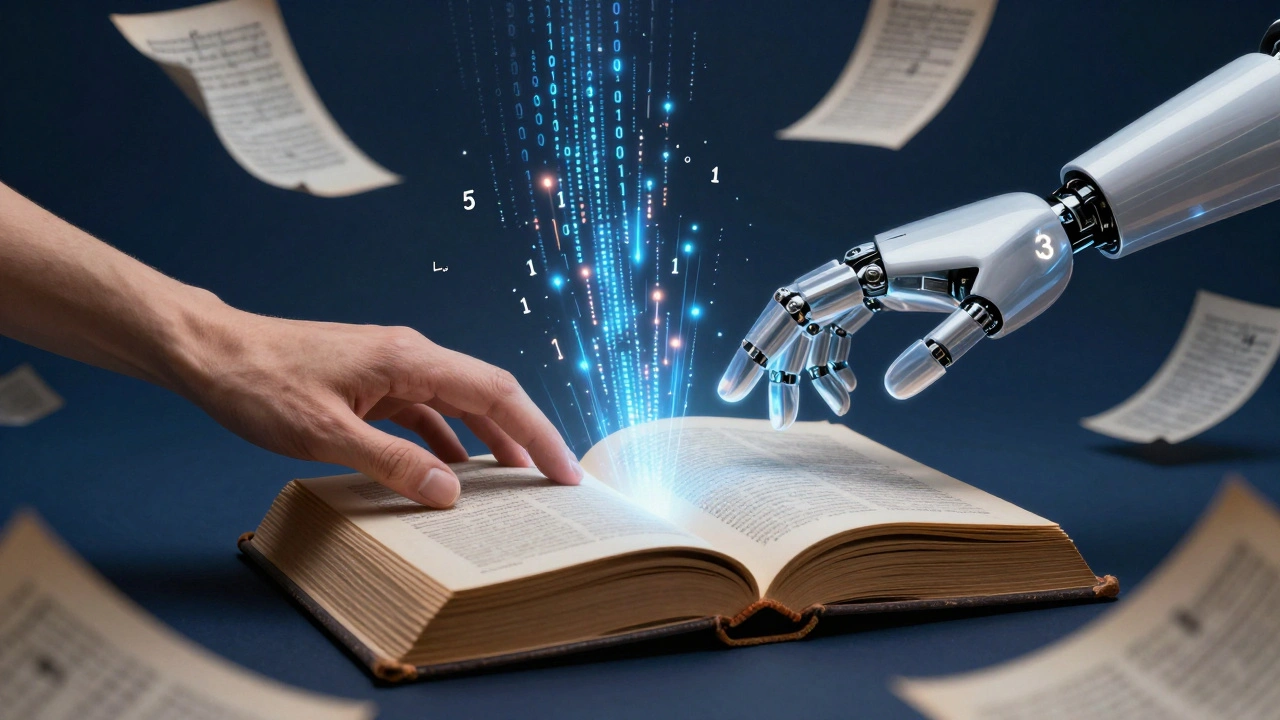
Enter Large Language Models (or LLMs), which are AI systems trained on massive datasets to predict the next token in a sequence, allowing them to generate human-like text. If you ask an LLM to write a biography of a 19th-century poet, it will do so in seconds. It can synthesize a thousand different sources into a clean, readable summary. But here is the rub: LLMs don't actually "know" anything. They understand patterns, not facts. This leads to the phenomenon known as AI Hallucinations, where the AI confidently presents a completely fabricated fact as truth-like inventing a book title or a fake award for that poet.
A human editor knows when a source feels "off." An AI, unless specifically tethered to a real-time verified database, simply follows the most likely path of words. Replacing a human editor with an AI is essentially swapping a cautious librarian for a very confident liar.
Where AI Actually Wins: The Boring Stuff
While AI might struggle with the "truth" part of editing, it's a powerhouse for the tedious parts. Most Wikipedia editors spend hours on the drudgery of formatting and basic cleanup. This is where AI doesn't replace the editor, but gives them superpowers. Think about the task of converting a messy list of raw data from a government PDF into a clean, structured table. For a human, that's three hours of squinting at a screen. For an AI, it's a three-second task.
We can see this in how Natural Language Processing (NLP) is being used to detect vandalism. When a bot instantly reverts a page that someone just changed to a series of insults, that's AI doing the heavy lifting. It allows human editors to stop playing "whack-a-mole" with trolls and instead focus on deep research and complex synthesis.
| Feature | Volunteer Editors (Human) | AI Systems (LLMs) |
|---|---|---|
| Speed of Drafting | Slow (Hours/Days) | Instant (Seconds) |
| Fact Verification | High (Cross-references sources) | Low (Prone to hallucinations) |
| Nuance & Tone | Context-aware, neutral | Pattern-based, can be biased |
| Scalability | Limited by volunteer numbers | Virtually infinite |
| Governance | Democratic consensus | Black-box algorithmic logic |
The Danger of the Feedback Loop
One of the scariest prospects of replacing humans with AI is what researchers call "model collapse." This happens when AI begins to train on data generated by other AIs. If Wikipedia-the gold standard for training data-becomes populated by AI-generated articles that aren't vetted by humans, the errors get baked into the training set of the next generation of AI. It's a digital photocopy of a photocopy; eventually, the image becomes a blur.
Human editors act as the circuit breaker in this loop. By insisting on primary sources and third-party verification, they ensure that the knowledge base remains anchored in reality. If we remove the humans, we risk creating a global encyclopedia that is grammatically perfect but fundamentally wrong. Imagine an AI deciding that a certain historical event didn't happen because it was mentioned less frequently in the training data. Without a human to say, "Wait, that's not right," the error becomes the new truth.

Governance and the "Soul" of Knowledge
Wikipedia isn't just a collection of pages; it's a community with a complex set of rules, like the Neutral Point of View (NPOV) policy. Determining what a "neutral" point of view is often requires an understanding of cultural sensitivities, historical trauma, and political tension. These are things an algorithm cannot "feel."
When two editors disagree on how to describe a controversial political figure, they argue. They cite sources. They reach a compromise. This process of debate is where the actual refinement of knowledge happens. An AI doesn't debate; it optimizes. If an AI is told to be "neutral," it might just average out two opposing views, even if one is a fact and the other is a conspiracy theory. The result isn't neutrality; it's a false equivalence.
The Hybrid Future: Augmented Intelligence
So, will AI replace the editors? No. But it will change their job description. We are moving toward a period of "Augmented Intelligence." In this scenario, the AI acts as the researcher and the human acts as the editor-in-chief. The AI can scan ten thousand pages of medical journals to find a specific trend and draft a summary. The human then steps in to verify that the AI didn't misunderstand the clinical trial's results and ensures the tone is appropriate for a general audience.
This shifts the value of the human editor from "writer" to "verifier." The skill set moves from knowing how to format a page to knowing how to critically analyze an AI's output. This is actually a more sustainable model for the growth of the internet's knowledge base. It allows us to expand into niche topics that currently have no human editors, provided there is a human overseeing the quality control.

Avoiding the Pitfalls of Automation
If we do lean into AI, there are a few red flags we need to watch for. First is the "authority bias," where humans trust a clean, professional-looking AI response more than a clunky, handwritten human note, even if the human is right. Second is the loss of the "long tail" of knowledge. AI tends to prioritize the most common information. If a topic is truly obscure, the AI might ignore the nuances that only a passionate human hobbyist would know.
To keep the encyclopedia healthy, we need to maintain strict boundaries. AI should be used for discovery, translation, and formatting-not for final decision-making on what is true. The moment we let a machine decide the "truth" without human oversight, we've stopped building an encyclopedia and started building a mirror of our own biases.
Can AI write an entire Wikipedia article from scratch?
Yes, current AI can generate a full article that looks identical to a Wikipedia page. However, it often fails at the "citation" part. While it can list sources, it sometimes creates "fake citations" that look real but don't actually exist in the real world. This is why human review is non-negotiable.
Will AI make it easier for new people to become Wikipedia editors?
Potentially. AI can handle the steep learning curve of Wikipedia's complex markup language and formatting rules. By simplifying the "how to post" part, AI allows newcomers to focus on the "what to write" part, potentially increasing the number of contributors.
What is the risk of AI-generated misinformation on encyclopedias?
The primary risk is the "hallucination" effect where AI presents false information with high confidence. If these errors are not caught by humans, they can be cited by other AIs and researchers, creating a cycle where a lie becomes accepted as a factual standard.
Are there already AI bots editing Wikipedia?
Yes, Wikipedia has used bots for years. However, these are typically "narrow AI"-they follow strict rules for things like fixing typos or updating dates. They are very different from the "generative AI" (like GPT-4) that creates new text and arguments.
Could AI eventually solve the problem of biased editing?
Unlikely. AI is trained on human data, which means it inherits all the biases present in that data. Instead of removing bias, AI often amplifies the most common biases found in its training set. Human debate and transparency are better tools for achieving neutrality.
What's Next for Knowledge Seekers
If you're someone who loves the spirit of open knowledge, the best thing you can do is stay involved. Don't assume that because an AI can summarize a topic, the human element is gone. Whether you're a casual reader or a hardcore editor, keep questioning the sources. The future of the internet isn't about choosing between human or machine; it's about knowing exactly when to trust the machine and when to demand a human explanation.
For those looking to get started in curation, focus on learning the art of verification. Learn how to spot a fake source, how to read a primary document, and how to spot an AI-generated pattern. These are the skills that will remain valuable long after the bots have mastered the art of the summary.